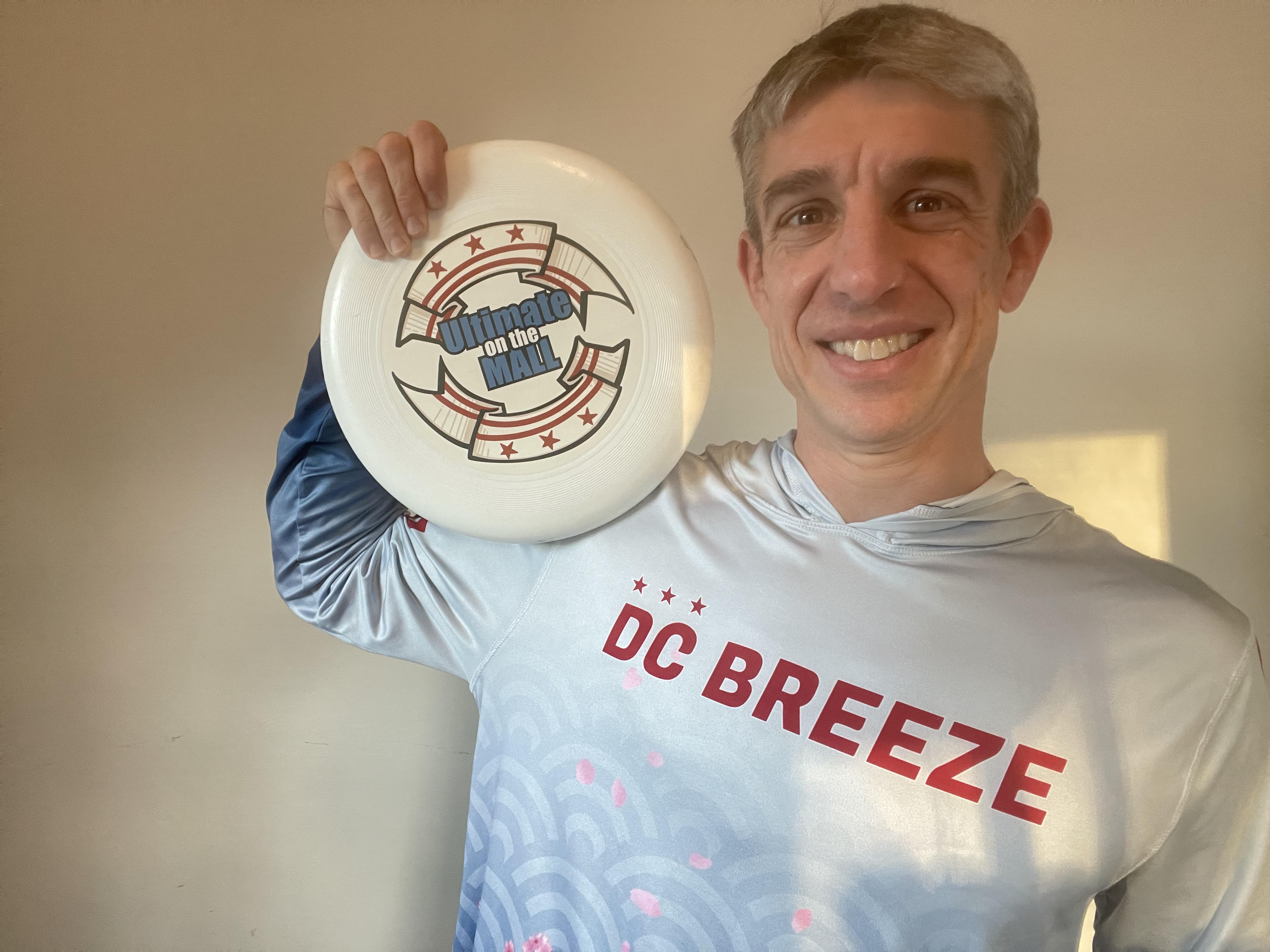
I learned to throw a Frisbee with my dad.
There was a big field behind Trinity School, just a block from our house in Oklahoma. I was about twelve years old. My dad had a big black Frisbee that flew like an UltraStar and a pink one with a hologram on the front that I thought was cool. We would go out to that field and throw.
I used to challenge him. "Try to throw it over my head. Throw it so far I cannot run it down." And he would launch these big backhands, sailing them way past me, and I would sprint after them as hard as I could. Chasing those long throws taught me something that would serve me for the rest of my playing life: how to track a disc over my shoulder and run it down at full speed.
My dad never taught me the flick forehand. He did not know it existed. Neither did I. We did not even know the game of Ultimate Frisbee because we did not have it in Oklahoma. But we had that backhand. And it became my foundation.
Today I can throw it at least 80 yards with my right hand and 50 to 60 yards with my left. The backhand is my strongest, most confident throw. If you read Book 1, you already know the detailed mechanics. This chapter is about using the backhand in the game, where defenders are in your face, the stall count is climbing, and you need to find the right variation for the right moment.
Why the Backhand Comes First
The backhand is the throw you will use the most on the field. Even if somebody is marking you and forcing a flick, you will still reach for the backhand constantly. I use it probably 90 percent of the time during games that matter.
Why the backhand is your foundation:
- Most natural throw — your body already knows the motion
- Most power — full torso rotation feeds into the release
- Most reliable — works in wind, rain, pressure, and chaos
- Most versatile — short touch passes to 70 yard hucks all use the same basic motion
Master the backhand first. Everything else builds on top of it.
The Washcloth Test
Here is the best way to understand why spin matters. Get a square washcloth. Try to throw it across the room. It flops. It tumbles. It goes nowhere. Now try spinning it as you throw. Suddenly it flies straight.
This is better than the classic "throw a plate" analogy because the washcloth only flies if you spin it. You cannot muscle it across the room with arm strength alone. The spin is everything. The same principle applies to your disc.
The Flow Throw
Here is something critical that separates the backhand from other throws: it works with your running momentum.
When you catch the disc while running and need to throw immediately, the backhand is your friend. Your body is uncoiling naturally. Your wrist stays closed. Your hand moves toward the target in the same direction you are running. Everything flows together.
Compare that to the flick, where your wrist extends outward, fighting against your running momentum. The backhand is perfect for quick dribbling, run, catch, run, catch, without breaking stride.
The Core Concept: Coil and Uncork
The backhand is all about coiling up energy, in your wrist, your arm, your biceps, your hips, and then uncorking it. Releasing all that kinetic energy in one controlled motion. Think of a golf swing but on the opposite side of your body. You can coil up more kinetic energy with your backhand than the forehand because your whole torso twists into it.
The coil: Curl your wrist so the disc is almost over your forearm. Twist your torso, just a little at first, more as you get comfortable. You should feel the stored energy mounting like pushing a spring back.
The uncork: Begin turning your torso slowly, then progressively faster. Let the energy transfer through your arm, then your wrist, then your fingers, in that order. Release when your arm points at your target. Then follow through. Let your arm continue its arc after the disc is gone, just like a golf swing.
For beginners, I usually say: just coil and chuck it as hard as you can. Grab a soft disc if you have one and unleash it. Does not matter where it lands. As you get more experienced, you learn to release at the specific point where the disc will float to exactly where you envision.
Finding Your Grip
The disc is going to whip out of your hand like the crack of a whip, spinning and flying off your fingers. So you need a strong hold. Start loose, then tighten just before you release as you uncoil.
The big variable is your index finger. Experiment with these three options:
- Finger on the outer rim: More precision and direction, less power. Similar to a push pass grip.
- Fully tucked under: More power, less precision. All four fingers curl under the rim together.
- Halfway on the rim: Resting on the edge. Excellent control.
Here is the truth about grips: I cannot tell you exactly where to put your fingers because your hands are different from mine. You have to throw a hundred bad throws before you throw a good one. That is the process.
Release Angles: Inside Out and Outside In
Once you can spin the disc well and point it where you want, you need to learn release angles. These apply to all your throws, backhand, flick, everything, so learn them now.
Inside Out (IO): The disc tilts away from your body on release, then curves back toward the middle. This is the most common angle for throws around a mark. You can usually get more power on IO throws. Master IO first, it is essential for breaking the mark and for pulls.
Outside In (OI): The disc tilts toward your body on release, then fades away from you. Trickier and more situational. Called a blade when thrown at a steep angle.
→ Action Step: Throw 10 IO backhands in a row, focusing on tilting the outside edge up. Then throw 10 OI backhands. Then try both with your non dominant hand. This simple drill builds angle awareness fast.
The Backhand Family
The backhand is not one throw. It is a family of nine variations, each designed for a different game situation.
Short backhand (Resets and dumps): All about touch. Just a quick wrist snap with enough spin to get it there flat. No windup needed.
Medium backhand (To cutters in space): Your bread and butter. 20 to 40 feet. Lead your receiver so they run onto it. This is where IO and OI angles become critical.
Long backhand / Huck: Full body coil. Steps into the throw. Hip rotation. Torso twist. Full arm extension and follow through. 50, 60, 70 yards downfield.
High release backhand: Release up high, above your shoulder, sometimes above your head. This lets you throw over defenders. The key is that it needs to land softly. It is a touch throw, not a bullet. This separates good handlers from great ones.
The dad throw: Instead of throwing from your non dominant side where you twist your torso, you bring the disc to your dominant side and throw backhand style with only your wrist, elbow, and arm. No torso twist. Your body sits between you and the defender, natural protection. The release is super fast, which makes it great for faking too. Perfect for short, accurate, softer throws. The trade off is that you cannot throw it far because you lack the torso's kinetic energy.
The push pass: Uses a slightly different grip with your index finger on the rim. Instead of the full windup and snap, you push the disc out gently with your index finger. It floats. Perfect for close range throws where you need touch instead of power.
The air bounce: The most important throw for breaking the mark. Push down with your thumb as you snap and release. The disc dips down and then bounces up off the air without hitting the ground. You throw it underneath the mark's hands and it rises on the other side into your receiver's catching window.
The critical advantage beyond beating the mark: the air bounce makes the catch easier. A straight backhand comes in fast and hot. Hard to handle. The air bounce floats softly into the catching window. Your receiver gets a gift instead of a bullet.
The pull: The pull starts each point. A good pull pins the offense deep. Most good pulls use a big IO angle, launch the disc high so it hangs, giving your team time to run down, then it fades and lands in a back corner. Power comes from footwork feeding the kinetic chain: take running steps forward, transfer energy through hips, torso, shoulder, arm, wrist, and fingers.
The lefty backhand: Legendary status. Seth Martin, who coaches at Jackson Reed High School, a program that produces DC Breeze professionals, teaches the offhand backhand extensively. Short flicks with your dominant hand are very difficult. A quick short backhand with your non dominant hand is much more gentle, softer, and more accurate. It really improves your game.
I can throw my lefty backhand 50 to 60 yards now. People do not expect it. They give you that lane. You throw a lefty backhand at close range instead of a hard flick, and your throwing window becomes significantly larger.
→ Action Step: Every practice session, spend at least five minutes throwing backhands with your non dominant hand. Start short, five yards, and build from there.
Creating Space Against the Mark
Even if somebody is forcing flick and standing on your backhand side, you can still get your backhand off. I learned this at the Hyattsville pickup game when I injured my right arm and could only throw backhands for weeks. It forced me to discover something important.
The weight shift back: When you catch the disc and the mark approaches, immediately shift your weight backward, away from the mark. This creates space and lets you see cuts developing.
Fake relentlessly: Make a fake one way and pull it back. Defenders almost always bite. Fake, fake, fake until you break them.
Pivot for windows: Step around the mark. Throw above them with a high release, underneath their arm with an air bounce, or around them by pivoting far enough. Do not accept that your backhand is taken away.
The dump reset: If no cut develops, turn on your pivot and look for a reset. Ninety percent of the time there is somebody close you can throw backwards or sideways to.
Faking and pivoting work together. Fake to freeze the mark. Pivot to create space. Be patient, cycle through your options until the window opens.
Quick Reference: Backhand Variations
- Short backhand — Resets and dumps. Touch and quick release.
- Medium backhand — To cutters in space. Lead the receiver.
- Long backhand (Huck) — Downfield bombs. Full body coil.
- High release — Over defenders. Soft landing.
- Dad throw — Quick dumps, windy days. Fast release, accuracy.
- Push pass — Close range, soft catch needed. Index finger, float.
- Air bounce — Breaking the mark low. Thumb push down, floats in.
- Pull — Starting points. IO angle, hang time.
- Lefty backhand — When right side is covered. Short range, surprise.
Wrap Up
◆ The backhand is your most natural, powerful, and reliable throw. Master it first and everything else builds on top.
◆ Spin wins games. The washcloth test proves that without spin, nothing flies straight.
◆ Coil and uncork. Load energy through your hips, torso, and arm, then release it in one connected chain with a full follow through.
◆ Experiment with three index finger positions to find the grip that gives you the best control for different situations.
◆ The backhand family includes nine variations, from short touch passes to long hucks to the air bounce to the lefty backhand.
◆ The air bounce is your most important mark breaking weapon and teaches the fine motor control that makes every other backhand better.
◆ Create space by shifting your weight back, faking relentlessly, and pivoting to find windows.
◆ The lefty backhand is Legend status. Seth Martin teaches it at Jackson Reed because a quick offhand backhand is gentler and more accurate than a short flick.
Mentor's Closing
I think about that field behind Trinity School sometimes.
My dad did not know about the flick. He did not know about Ultimate Frisbee. He did not know about IO angles or the kinetic chain or gyroscopic stability. He just knew how to throw a backhand to his kid and make it fun.
But he taught me the most important thing without ever saying it out loud. He taught me that the backhand is home. It is the throw you reach for when nothing else is working. It is the throw that feels right in your hand when the wind is howling and the stall count is climbing and your flick has abandoned you for the day.
Every advanced technique in this book grows from this foundation. The flick borrows from the backhand's kinetic chain. The hammer uses the same body rotation. Even your cutting and catching improve because a reliable backhand makes your teammates trust you more, which makes the whole offense flow.
So here is your challenge: go find a field. Bring five or six discs. And throw pulls until your arm tells you to stop. Then throw five more. Feel the coil. Feel the uncork. Feel the spin.
Because when you own the backhand, truly own it, you own the foundation of this entire sport. And from that foundation, you can build anything. :)