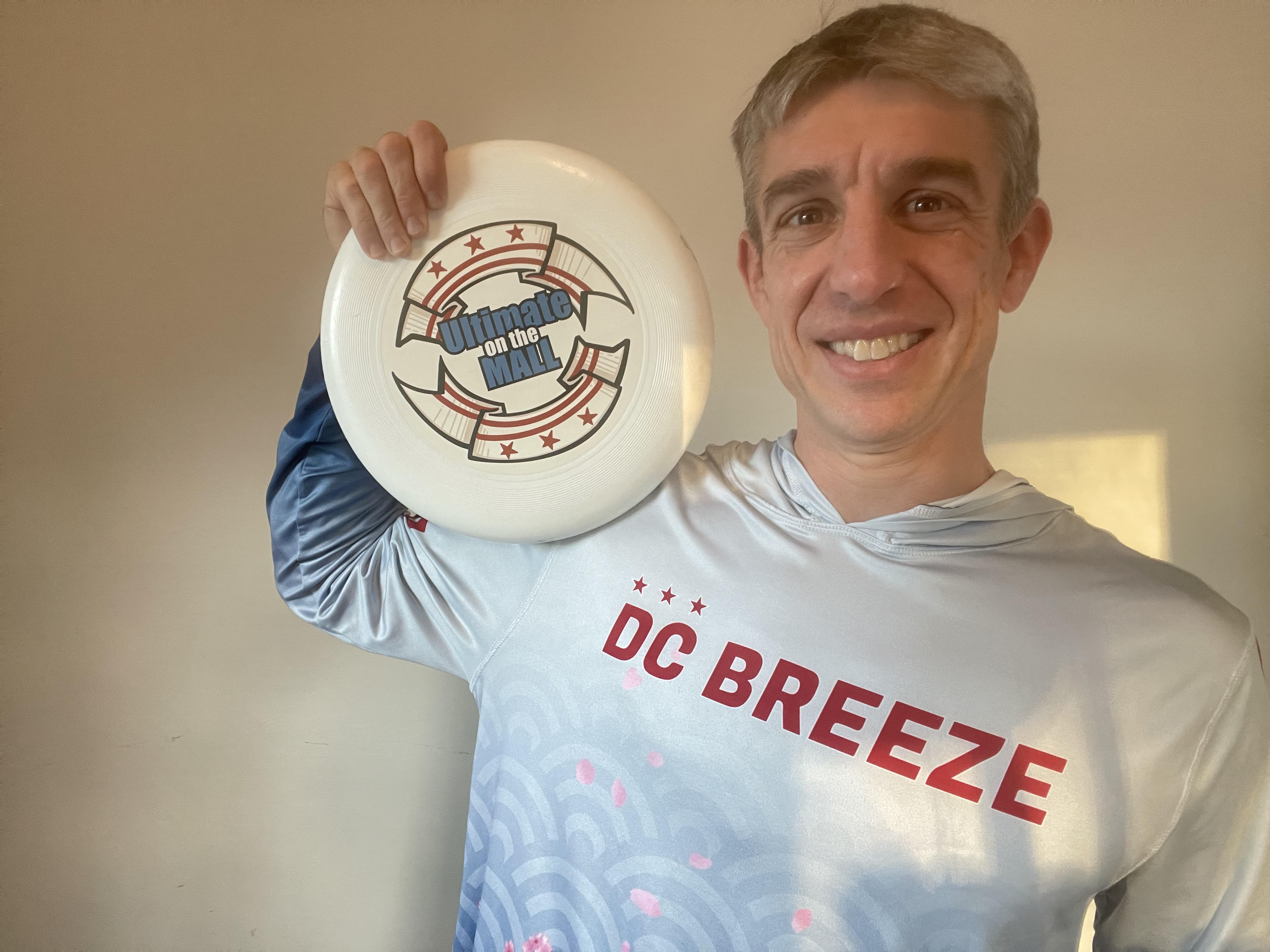
It was a Saturday in late January. The high was twenty three degrees with an eight mile per hour wind that made it feel colder. Not exactly ideal conditions for three hours of Ultimate Frisbee.
But I had signed up for the DC Breeze defensive clinic in Arlington, Virginia, and I was not about to miss it. Thirty dollars for three hours with nine professional players, including AJ Merriman, Charlie McCutcheon, Jasper Tom, Christian Boxley, and Miles Grovic. David Lino was there too. About thirty to forty participants showed up, mostly college players who were fast and hungry to learn.
I was in Group 2. By the end of the day, my legs were destroyed. And I had learned three principles that changed how I think about defense.
Principle One: Shuffle Your Feet, Protect Your Hips
The biggest emphasis of the entire clinic was footwork. Not positioning. Not reading throws. Footwork.
The pros drilled one concept over and over: do not turn your hips if you can avoid it. When you turn your hips to run one direction, it becomes extremely difficult to change direction and go back the other way. Your body is committed. And in that split second of reorientation, a good cutter will burn you.
The solution is the shuffle. Move one foot to the side and catch the other foot up to it. Stay on the balls of your feet the entire time. Shift your weight as quickly as possible. Keep your hips square to the cutter so you can explode either direction.
We did a mirror drill where one person shuffled back and forth while the other tried to stay with them. After twenty seconds, the offensive player would make a hard cut one way, then cut back the other way. The defender had to keep up.
It was nearly impossible. You simply do not know when they are going to cut or when they are going to reverse. But the players who stayed in their shuffle longest before committing were the ones who had the best chance of recovering.
The crossover variation: Instead of catching your feet side to side, you cross one leg in front of or behind the other. This lets you move diagonally while still keeping your hips square. We practiced this inside a box pattern, going straight, then diagonal, then straight. You must stay on the balls of your feet or you will stumble.
Principle Two: Stay on the Balls of Your Feet
This was the second constant refrain from the coaches. If you are flat footed or on your heels, you simply cannot accelerate fast enough to defend a good cutter.
One drill made this painfully clear. We had to make quick, tiny steps around four frisbees laid on the ground, pumping our legs as fast as possible while staring down at the discs. Then on the whistle, we had to sprint out to defend a cut.
The players who stayed light and bouncy during the small steps exploded out of the drill. The players who got heavy and flat took an extra beat to get going. That extra beat was the difference between a block and a score.
What staying light on your feet enables:
- Faster acceleration in any direction
- Quicker recovery when you guess wrong
- Better balance when changing direction
- Less fatigue over a long point because you are not fighting your own momentum
The outstanding players I watched, the ones who stood out from everyone else, all shared this quality. They moved to space before you could get there. If you started to cut one way, they were already shuffling to cut you off. If you reversed, they recovered and beat you to the throw anyway.
→ Action Step: Practice the four frisbee drill at home. Lay four discs in a square about two feet apart. Pump your legs with tiny, rapid steps while moving around the square. Stay on the balls of your feet. After twenty seconds, sprint ten yards in a random direction. Repeat until your calves burn.
Principle Three: Win on the Margins
Andrew Roy, one of the Breeze players coaching that day, said something that stuck with me: "You win on the margins."
What he meant is that defense is not about getting a block on every throw. It is about making small wins that add up over time. You give up certain spaces on purpose so you can protect the spaces that matter most.
What winning on the margins looks like:
- You let them have the undercut so you can protect the deep space near the end zone
- You funnel them toward the sideline where their options become limited
- You pressure them so that even when they catch it, they feel rushed and uncomfortable
- You dare them to make throws you have calculated they cannot make consistently
"Try and deny the under if you can," the coaches told us. "But if they get it, that is still a win for you. They did not score. You gave them that space on purpose. Now they are trapped near the sideline with fewer options."
This is the chess game that Khalif El-Salaam talked about in my interview with him. You are not trying to win every exchange. You are trying to accumulate small advantages until the offense makes a mistake. Especially in wind, the more throws they have to make, the more likely something goes wrong.
How I apply this in pickup:
- If I know someone has a weak flick, I let them get the disc on the flick side. I dare them to make that throw all day.
- If someone is faster than me, I do not try to stay step for step. I position myself to take away the end zone and force them into the spaces I am willing to give up.
- If they catch a pressured under near the sideline, I consider that a win even though they have the disc.
The Spin Move That Surprised Everyone
I want to share one moment from the clinic that made me smile.
We were doing a cutting drill where the defender had to stay with the cutter through multiple changes of direction. I was on offense against one of the college players. He was fast and positioned well.
I cut one way. He shuffled over and blocked me off. I cut the other way. He was there too. So I did something I had been practicing at pickup games: I spun.
I planted my foot, rotated my body one hundred eighty degrees, and came out the other side completely open. The defender had no idea it was coming.
A couple of people on the sideline said "nice spin move." I looked around and realized I had not seen anyone else use a spin the entire clinic. Everyone was doing hard cuts and jukes. But nobody was spinning.
What the Pros Had That I Did Not
I gave myself a B+ for the day. I ran hard. I made some good defensive blocks. I got fouled twice on deep balls that I had position on. My legs held up for all three hours thanks to the sprint training I had been doing at the gym.
But watching the truly elite players, I saw the gap clearly.
What separated the best from everyone else:
- Speed. Pure, explosive speed that let them recover from mistakes and still make plays.
- Quickness. The ability to change direction without any wasted motion.
- Anticipation. They seemed to know where the disc was going before it was thrown.
- Conditioning. They were just as fast in hour three as they were in hour one.
Miles Grovic put a move on AJ Merriman that I will not forget. Hop, hop, then a hard cut the other way. He accelerated into a tight window and made a catch that most players would not even attempt. That is what elite looks like.
I cannot teach you to be that fast. But I can tell you that the fundamentals, the shuffling, the light feet, the margin management, those are what let fast players use their speed effectively. And those same fundamentals help slower players compete against faster ones.
Wrap Up
◆ Shuffle your feet and keep your hips square so you can explode in either direction without committing too early.
◆ Stay on the balls of your feet at all times so you can accelerate instantly when the cutter makes their move.
◆ Win on the margins by giving up spaces on purpose, funneling cutters toward the sideline, and pressuring them even when they make the catch.
◆ The spin move is an underutilized tool for cutters that can beat even well positioned defenders.
◆ Speed wins at the highest levels, but fundamentals let you compete against faster players and help fast players maximize their gifts.
Mentor's Closing
I drove home from Arlington that evening with my legs aching and my brain buzzing. Twenty three degrees. Three hours. Nine professional players teaching thirty amateurs the fundamentals of defense.
And the biggest lesson was the simplest one: shuffle your feet.
Not the fancy schemes. Not the complex zone rotations. Not the film study or the analytics. Just shuffle. Stay light. Keep your hips square. Do not commit until you have to.
That is what thirty dollars and three hours of freezing cold taught me. And it was worth every penny and every shiver.
If a professional clinic comes to your area, go. I do not care how cold it is. I do not care how much it costs. The things you learn from watching professionals move, up close, in person, cannot be replicated on YouTube. You feel the speed. You see the quickness. You experience firsthand what elite defense looks like.
And then you go to your next pickup game and you shuffle a little better. You stay a little lighter on your feet. You give up the under on purpose and protect the deep. You win on the margins.
That is how you get better. One clinic, one drill, one shuffle at a time. :)