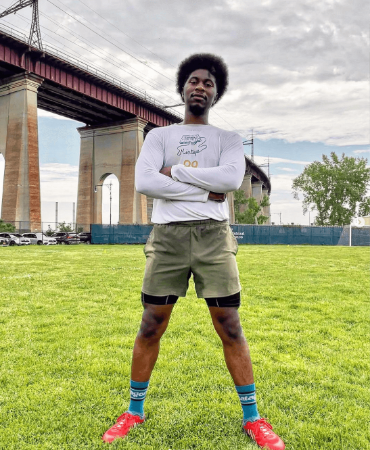
Through all my years of playing Ultimate Frisbee, the first thing I was good at was cutting.
Not throwing. My backhand took years to develop. Not catching spectacular grabs. That came later. But cutting? Reading a defender, creating separation, finding the open window? That clicked for me almost immediately.
And here is the single most important thing I have learned about cutting in twenty years of playing this sport: listen to your defender breathe.
The Breathing Battle
Before we talk about direction. Before we talk about tempo. Before we talk about any specific cut or technique. I need you to understand this: cutting is you against your defender, and the first person whose lungs give out loses.
Every time I step onto the field, I am tracking one thing above all else: how hard is my defender breathing? Are they calm and controlled? Are they starting to pant? Are they gasping, hands on knees, trying to recover between points?
This information is gold. It tells me exactly how much harder I need to push. If my defender is breathing easily and I am breathing easily, the battle is even and I need to be smart with my energy. But the moment I hear heavy breathing, the moment I sense fatigue, that is when I turn up the intensity. I run harder. I cut sharper. I force them to chase me at speeds their lungs cannot sustain. Because I know that a tired defender is a slow defender. And a slow defender means I am open.
Think of it like a boxing match. A smart boxer does not throw haymakers in the first round. They jab, they move, they make their opponent work. And then in the later rounds, when the opponent is gassed, they unload. Cutting works the same way. You are systematically bringing your defender's stamina down through movement and then exploiting the gap when their body cannot keep up with yours.
And here is the flip side. If your breathing is heavy and theirs is fine, you need to conserve. Take a slower point. Play closer to the disc where the cuts are shorter. Let your lungs recover so you can attack again on the next point.
Act Like Your Defender Smells
Here is a trick that sounds silly but works incredibly well. I act like my defender smells bad. Like I do not want to be anywhere near them.
What I mean is this: I am constantly drifting away from my defender. If they get close, I move away. If they start to close the gap, I cut the other direction. I am never standing still next to them. I am never letting them get comfortable in a position where they can shadow me easily.
I am just there for my teammates and the open space. My defender is someone I am always trying to get away from. Not aggressively, not by sprinting away every second, but by constantly, casually, relentlessly creating distance. A few steps sideways. A drift toward the sideline. A subtle shift away from wherever they are.
And the beautiful thing is, this constant movement tires them out. They are always chasing. They are always adjusting. They are always burning energy just to stay close to someone who does not want to be close to them. Over the course of a point, those little drifts and shifts add up. By the time you need to make a real cut, your defender has already spent energy they did not plan to spend.
Cutting Is a Conversation with Space
Early in my playing days, I thought about cuts as rigid patterns. Vertical cut. Horizontal cut. S curve. Like running routes in football. Go here, then go there.
But after watching professional footage in slow motion, studying how elite players move, I realized cutting is much more fluid than that. It is not about running preset routes. It is about reading space in real time and flowing into whatever opening appears.
Your defender is trying to take away certain spaces. Your teammates are occupying other spaces. The handler has a limited throwing range based on their skills and the mark they are facing. And all of this is constantly shifting.
Cutting is a conversation with that shifting space. You are asking questions with your movement. Is this space open? How about this one? What if I fake here and go there? And the field answers you, moment by moment.
The mark of a great cutter is someone who flows with team chemistry and gets open into the space where the play needs them to be. Not where they planned to be. Where the disc needs them to be.
Reading Your Defender: The First Three Seconds
The moment you step on the field against a new defender, your job is to gather intelligence. You have maybe three to five seconds of interaction before you need to know what you are working with.
Ask yourself immediately:
- How fast are they? Do a quick burst in one direction and see how quickly they react. If they stay glued to you, they are fast. If they give you a step, they are slower.
- How is their stamina? Are they breathing hard already? Did they just play a long point? This connects directly to the breathing battle above.
- How tight do they play? Some defenders crowd you, staying within arm's reach. Others give cushion, protecting against the deep throw. Their tendency tells you where the opportunity is.
- Are they tall or short? If they are tall, stay closer to the disc for under cuts. If they are short, attack deep and use your height advantage.
Once you have this information, you can start exploiting their weaknesses.
The Six Fundamental Cuts
Vertical Away (Deep Cut): Sprint straight toward the end zone, away from the handler. This is your huck opportunity, your touchdown play. Start by cutting toward the handler, drawing your defender in. The moment their hips shift to defend the under, break deep. Sprint with everything you have. Listen for "Up!" from your teammates. Glance back quickly to locate the disc, then run to where it is going to land.
Vertical Toward (Under Cut): Come straight back to the handler. This is your safe option, your "I am here if you need me" cut. You are making yourself available for an easy throw that keeps possession moving.
Horizontal East and West (Side to Side Cuts): Move perpendicular to the handler, cutting across the field. These are my favorite cuts because your defender has to choose: watch you or watch the disc. They cannot do both at the same time. This is where confusion happens.
S Curve Away and Toward: Sweeping, curved movements that wind through traffic. Essential when the field is crowded. You cannot always run straight lines. Sometimes you need to flow around bodies like water around rocks.
Mastering Tempo: Speed as Deception
Direction cuts confuse defenders by changing where you are going. Tempo cuts confuse them by changing how fast you are getting there.
The Slow Fast Slow Pattern: Start off slow, like you are just jogging into position. Then suddenly burst to top speed for three or four steps. Then stutter step and nearly stop. Then burst again. Your defender is constantly trying to figure out how fast you are going to be running, and they are always one step behind.
The Medium Pace Explosion: Maintain a steady jog, lulling your defender into matching your rhythm. Then out of nowhere, explode to full speed or come to a complete stop. The sudden change catches them off guard.
The Exhaustion Trap: When your defender keeps up with you through several tempo changes, they are working hard to match your speed. The moment you see them breathing heavy, immediately stop. As they are trying to catch their breath, that is when you explode again. They simply cannot react fast enough. This is the breathing battle put into action.
Tempo is also connected to the stall count. When the count is low, one, two, three, you can afford to go slowly. Use that time to set up your tempo changes and test your defender. But when the count climbs to seven, eight, nine, that is when you increase tempo immediately. Your burst of speed gets you open for the bailout throw that saves the possession.
Advanced Cuts: The Secret Weapons
The Pedal Backwards Cut (The Most Important). This connects directly to Jim Lovell's principle: the most open person on the field is the person that just threw it. You catch the disc and throw it to someone. Instead of standing still, you immediately backpedal away. Watch which side your defender is on, then cut hard to the opposite side. If the person with the disc can throw to space, there is nothing the defender can do. This cut keeps the give and go flowing and is devastatingly effective because defenders do not expect backward movement followed by a sharp lateral burst.
The Drunk Cut (Circular Confusion). Go in circles around your defender, almost like a 360 degree rotation. You move toward the disc, circle around your defender, then come back toward the disc from a different angle. This disorients defenders who are trying to maintain position and opens up throwing lanes they did not expect.
The Banana Cut (The J Shaped Fade). Make a J shape with your movement, curving away from the disc either to the left or right. Not sprinting, not jogging, just floating into the space where the sideline meets the end zone. The handler can throw a touch pass over the defender's head that lands softly in your hands as you reach the corner.
The Burst Cut: Geometry on Your Side
Khalif El-Salaam taught me something that changed how I think about cutting. When you run toward a defender and then change direction at a forty five degree angle, the physics are on your side. You are running forward. They have to backpedal. And nobody, no matter how fast they are, can backpedal as quickly as you can run forward.
Here is how it works:
- Start by jogging toward your defender at sixty or seventy percent speed. You are not sprinting yet. You are setting up the move.
- Watch their hips. The moment they start to shift, the moment they commit to matching your direction, that is when you strike.
- Plant hard and cut at a forty five degree angle. Not ninety degrees, which is too sharp and slows you down. Forty five degrees lets you redirect while maintaining speed.
- As soon as you plant, explode to full speed. Your defender is now facing the wrong direction while you are already at top speed heading toward open space.
My Favorite Cut: The Side to Side Dance
Of all the cuts in my arsenal, the horizontal back and forth is the one that makes defenders look silly.
Picture this: I am about fifteen feet from the handler. My defender is between us, trying to watch both me and the disc at the same time. Their head is turning back and forth, checking my position then checking the handler.
Every time they turn their head toward the handler, I shift to the opposite side. They glance back at me. I am not where they expected. So they adjust. And the moment they start adjusting, I shift again. Back and forth. Side step left, they follow, side step right. Side step right, they follow, side step left.
I am watching their head and their hips. The second they commit to one side, I explode the other direction. And suddenly I am wide open with my hands up, ready to catch.
This cut works because defenders cannot watch two things at once. They have to choose. And whatever they choose, I do the opposite.
→ Action Step: Practice the side to side dance with a friend. Have them stand between you and another person holding a disc. Every time they look away from you, move to the opposite side. See how quickly you can get them completely turned around.
The Dump Reset Cut
Not every cut is glamorous. Sometimes the most important cut you make is a simple five foot reset that keeps the disc moving.
The dump reset cut happens when the handler is in trouble. The stall count is rising. Defenders are closing in. The handler needs an easy throw to reset the play. Your job is to get open in a space where they can throw a short, safe pass.
This cut does not require much separation. Even a small window is enough because the throw is so short. What matters is timing. You need to be there when the handler needs you.
I love the dump reset because it builds chemistry with handlers. When you are consistently available for the easy throw, handlers learn to trust you. And that trust translates to more opportunities later when you make your bigger cuts.
Communicating with Your Handler
Getting open means nothing if your handler does not know you are open.
I use my hands constantly when cutting. I point to where I want the disc. I wave to get attention. I make eye contact and hold it, letting the handler know I am ready.
This communication is silent. Your defender should not know what you are saying. But your handler should see exactly where you want the throw. I point to my right, the handler knows to throw it there. I put my hands up high, they know I want it above my head. I tap my chest, they know I am coming underneath.
Over time, you develop chemistry with specific handlers. You learn their tendencies. They learn yours. And the communication becomes almost telepathic. You cut to a space because you know they want to throw it there. They throw to a space because they know you are about to arrive.
Building Cutting Strength
The most important exercise for cutting is squats. When you cut, you are using your legs to stop, start, and change direction at high speeds. The muscles that power those movements, your quads, glutes, hamstrings, and the smaller stabilizers around your hips and ankles, all get stronger with squats.
Add lateral hops to your routine too. Hop from one foot to the other, back and forth, for thirty to fifty reps. Start without weight, then add light dumbbells. This builds the explosive lateral power that makes side to side cuts devastating.
And do not neglect your cleats. Good cleats with solid traction let you stop on a dime and change direction instantly. Bad cleats mean slipping, sliding, and losing the advantage you worked so hard to create. I spent $140 on my cleats and I consider it the best investment in my game. When I plant my foot, it sticks. That confidence translates to sharper cuts and more open windows.
Quick Reference: All the Cuts
Basic Six:
- Vertical Away — Sprint deep toward end zone for the huck
- Vertical Toward — Come back to handler for the under cut
- Horizontal East — Cut across the field to the right
- Horizontal West — Cut across the field to the left
- S Curve Away — Sweeping curved movement away from disc
- S Curve Toward — Sweeping curved movement toward disc
Advanced Three:
- Pedal Backwards — After throwing, backpedal away, then cut opposite side of defender (most important for give and go)
- Drunk Cut — Circular 360 degree movement around defender back toward disc
- Banana Cut — J shaped fade cut curving away from disc
Specialized Techniques:
- Burst Cut — 70% speed toward defender, plant, 45 degree angle explosion
- Side to Side Dance — Shift opposite every time defender looks at handler
- Dump Reset — Short 5 foot cut when handler is in trouble
- Pivot Spin — 180 degree body rotation to put defender behind you
- Stutter Step — Change tempo to break defender's rhythm
- Decoy — Run defender ragged far from disc to create space for teammates
Wrap Up
◆ Listen to your defender breathe. The sound of their lungs tells you when to attack and when to wait. Cutting is an energy war.
◆ Act like your defender smells. Never stand still next to them. Constantly drift, shift, and create distance. The small movements tire them out before the big cut even happens.
◆ Cutting is a conversation with space. Read the field in real time and flow into whatever opening appears.
◆ Read your defender in the first three seconds. Test their speed, stamina, positioning, and height.
◆ Master the six fundamental cuts: vertical, horizontal, and S curve, both toward and away from the disc.
◆ The burst cut uses geometry. Run at 70% toward defender, then explode at a 45 degree angle. Physics is on your side.
◆ Tempo is as important as direction. The acceleration is the weapon, not the top speed.
◆ Communicate with handlers through hand signals, eye contact, and pre game coordination.
◆ Build cutting strength through squats, lateral hops, and quality cleats.
Mentor's Closing
I have been cutting and getting open for over twenty years.
I have made defenders look confused. I have made them frustrated. I have made them tired. And I have scored touchdowns that started with nothing more than listening to their breathing and knowing the moment had come to attack.
Cutting is not about being the fastest player on the field. It is about being the smartest. It is about reading your defender's hips, watching the handler's eyes, listening to the lungs of the person chasing you, feeling the rhythm of the game, and striking exactly when the window opens.
When you master cutting, you become dangerous. Handlers trust you. Defenders fear you. And touchdowns come not from spectacular athleticism, but from being in the right place at the right time, over and over and over again.
So practice your cuts. Test your defenders. Listen to their breathing. Build your leg strength. Communicate with your handlers. And most importantly, never stop asking the field where the space is.
Because the space always answers. You just have to be ready to move when it does. :)