You have spent the entire book building skills. Fingers, wrists, throws, kinetic chain, running, strength, flexibility. Chapter after chapter, drill after drill, rep after rep. You have put in the work.
But how do you know it is working?
How do you know your flick is better this month than last month? How do you know your endurance has actually improved? How do you know your off hand is closing the gap? You feel like you are getting better. Your throws feel smoother. Your catches feel more confident. But feelings are not data. Feelings cannot tell you whether your backhand went 35 yards last month and 42 yards this month. Feelings cannot tell you whether your accuracy has improved by 15% or stayed flat.
You need a test. A standardized, repeatable, measurable test that you can take monthly and compare your scores over time. A test that turns everything in this book into numbers. Real, honest, trackable numbers that show you exactly where you are, where you have been, and where you need to go.
That test exists. USA Ultimate created it. It is called the Skills Challenge, and the five event competitive version is called the Discathlon. Think of it as your report card for disc skills. Except instead of a teacher grading you, you grade yourself. And instead of getting the grade once a semester, you take the test every month and watch the numbers climb.
This chapter teaches you every event, how to set it up solo, how to score yourself, and how to use your scores to guide your training so that every practice session targets the skills that need the most work.
Why Measuring Matters
There is a principle in business and athletics that applies perfectly here: what gets measured gets improved.
When you track your throwing distance, you naturally start paying more attention to the things that increase distance. You focus on your kinetic chain connection. You work on your hip rotation. You experiment with your run up. Not because someone told you to, but because you saw your number last month and you want to beat it this month. The measurement itself creates the motivation to improve.
Without measurement, you are guessing. You think your flick has improved. But has it? By how much? At what rate? Maybe your flick improved but your accuracy decreased because you were chasing distance and ignoring control. Maybe your backhand plateaued three months ago and you did not notice because it still felt the same. Maybe your off hand is improving faster than you think, which would tell you that the Hula Hoop Drill is working and you should do more of it.
Numbers do not have feelings. They do not flatter you. They do not lie. They show you exactly where you are, and that honesty is the most powerful training tool you can have.
Here is the other benefit, the emotional one. On the days when practice feels pointless, when your throws feel sloppy and your motivation is low and you wonder if any of this is actually making a difference, you look at your scores from three months ago versus today. And the numbers tell you the truth. Your backhand went from 30 yards to 41. Your accuracy ladder went from 9 yards to 18. Your Compass time dropped by 4 seconds. Progress is real. It is measurable. It just happens too slowly to notice day by day. The Discathlon catches what your feelings miss.
The USA Ultimate Skills Challenge
In 2020, USA Ultimate launched the Skills Challenge program through their free mobile app, available on both iOS and Android. It is one of the best things USA Ultimate has ever created for solo players, and it costs nothing to use.
The program includes 12 different skills challenges divided into four categories.
Throwing: challenges that test and improve your throwing accuracy, technique, and range.
Game Skills: challenges that combine multiple skills like throwing, running, and catching into one test.
Athleticism: challenges focused on speed, agility, endurance, and body movement.
Disc Fun: tricks and disc manipulation that improve your on field game without feeling like training.
The entire program is self officiated. Spirit of the Game applies, even when the only person you are competing against is yourself. Be honest with your scores. A number you fudged teaches you nothing.
You can download the app, create an account for free (no membership required), and start tracking your personal performance in each skill. If you want, you can opt into the global leaderboard to see how you compare to other players worldwide. That leaderboard can be motivating or intimidating depending on your personality, but either way, it gives you context for where your numbers sit.
The program was designed to be accessible. Most challenges need just one or two people. Many can be done in a backyard or neighborhood. You do not need a regulation field or fancy equipment. A disc, some cones (shoes work fine), and an open space are all you need.
Five of the twelve challenges make up the Discathlon, which is the core competitive format. Those five events are the heart of this chapter.
THE FIVE DISCATHLON EVENTS
Event 1: Accuracy Ladder
This is the event that humbles everybody.
Setup: Place a target at 3 yards from your starting point. A trash can works perfectly. A laundry basket. A cone. A Nalgene bottle if you want a real challenge. Mark your starting line.
How it works: You have 3 attempts to hit the target from your current distance. If you hit it on any of your 3 attempts, you move back 3 yards and try again from the new distance. If you miss all 3 attempts from any distance, the test is over.
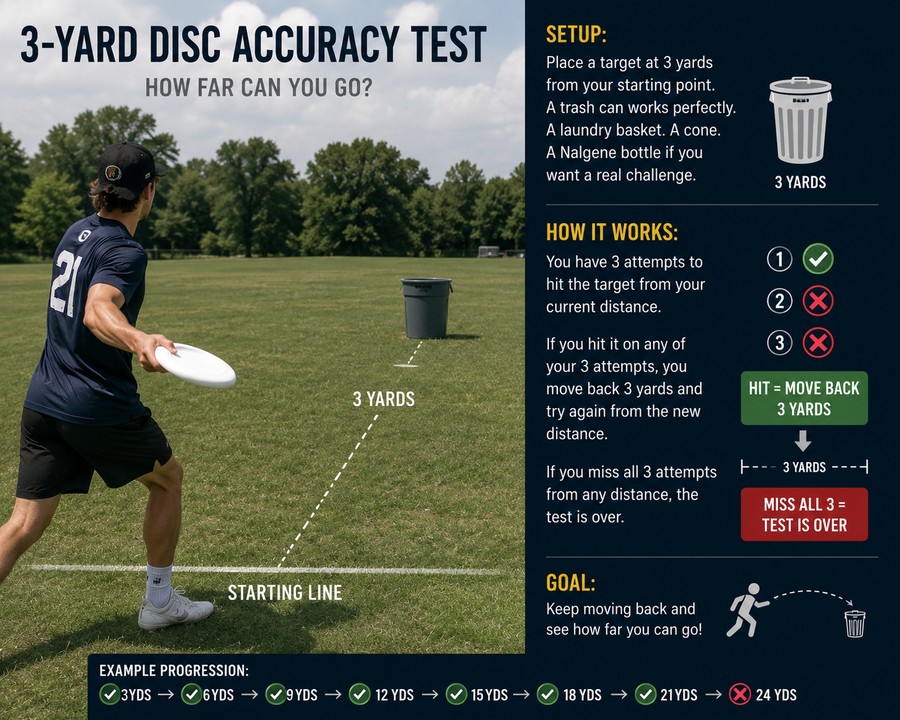
Your score: The farthest distance from which you successfully hit the target.
This sounds simple at 3 yards. And it is. You will probably hit the target on your first throw. Then you move to 6 yards. Still manageable. Then 9. Getting interesting. Then 12. Now you have to actually aim. Then 15. Now your throw has to be genuinely accurate. Then 18. Now the margin for error is tiny. Then 21. Now you are threading a needle from across a room.
The Accuracy Ladder tests something that distance throws do not: precision under pressure. Each attempt matters more as you get farther back, because you only have 3 tries. That first miss at 18 yards does not feel the same as a first miss at 6 yards. The pressure mounts. Your heart rate increases. And your ability to throw accurately under that pressure is exactly what you need in a game when the stall count is at 7 and the only window is a tight one.
Solo practice tips: Use the same target every time for consistency. Run the ladder with your backhand, then run it again with your flick. Then run it with your off hand. Track each one separately. The gap between your backhand accuracy and your flick accuracy is one of the most revealing numbers in the entire Discathlon.
This event connects directly to the target practice from the field drills chapter, the 80% power sweet spot from the flick chapter, and the "throw at the receiver's chest" mentality from the hammer section. Accuracy is a skill. It improves with measurement and practice. The Accuracy Ladder gives you both.
Event 2: Compass
This is the pure athleticism event. No disc required. Just you, five cones, and a stopwatch.
Setup: Create the shape of a compass with 5 cones. Place one cone in the center. Then place four cones 10 yards away from the center, one each at the "north," "south," "east," and "west" positions.
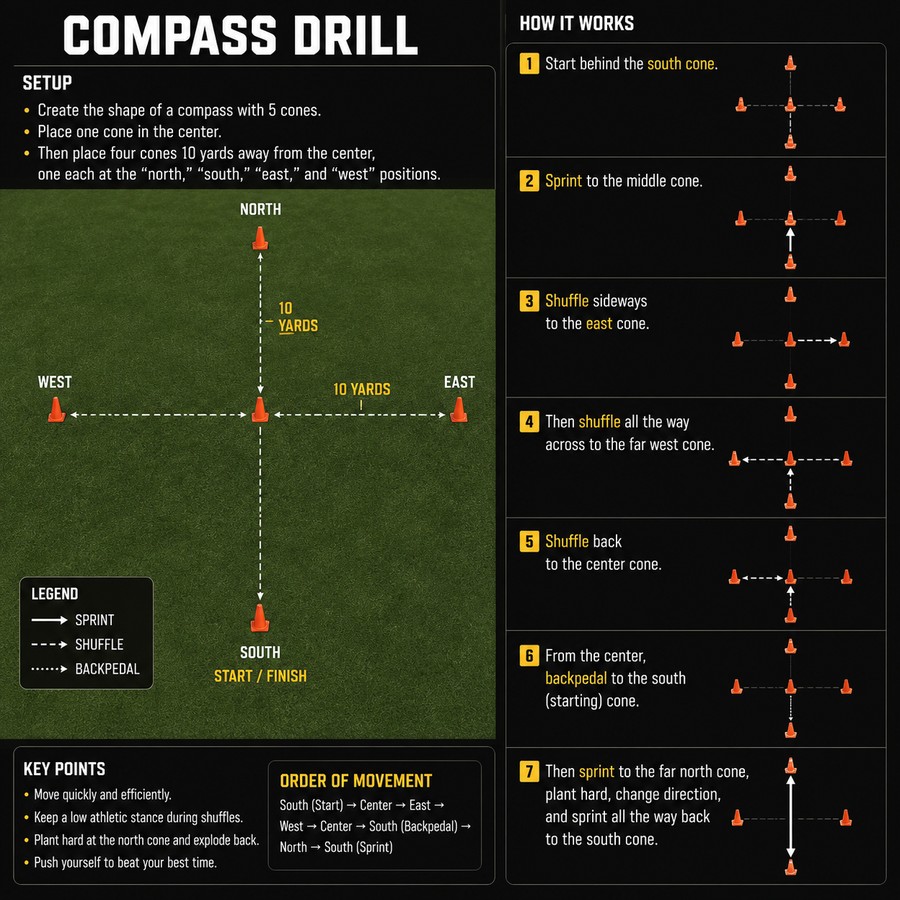
How it works: Start behind the south cone. When you are ready, start your timer and sprint to the middle cone. Shuffle sideways to the east cone. Then shuffle all the way across to the far west cone. Shuffle back to the center cone. From the center, backpedal to the south (starting) cone. Then sprint to the far north cone, plant hard, change direction, and sprint all the way back to the south cone.
Your score: Total time to complete the course.
If you have been reading this book carefully, you already recognize every movement pattern in the Compass. Sprinting, shuffling, backpedaling, explosive direction changes. This is the entire Running, Cutting, and Outlasting chapter compressed into one timed test. The Compass does not care how strong your throws are. It cares about your feet, your legs, your agility, and your ability to change direction without losing speed.
Solo practice tips: Set up the cones once and run the Compass repeatedly. Your time will drop fast in the first few sessions as you learn the pattern and stop hesitating at each cone. Focus on the fundamentals from the running chapter: stay on the balls of your feet, keep low during shuffles, do not let your feet cross during lateral movement, keep your ankles dorsiflexed (pulled up, cocked, ready to push off). The backpedal to sprint transition is usually where the most time is lost. Practice that transition separately if your Compass time is plateauing.
Tips from the official USA Ultimate guidelines: for backpedaling and shuffling, stay low, balanced, and bend at the knees. Ensure your feet do not cross when shuffling.
Event 3: Throw for Distance (Backhand)
This is the most straightforward event in the Discathlon and probably the most satisfying. How far can you throw a backhand?
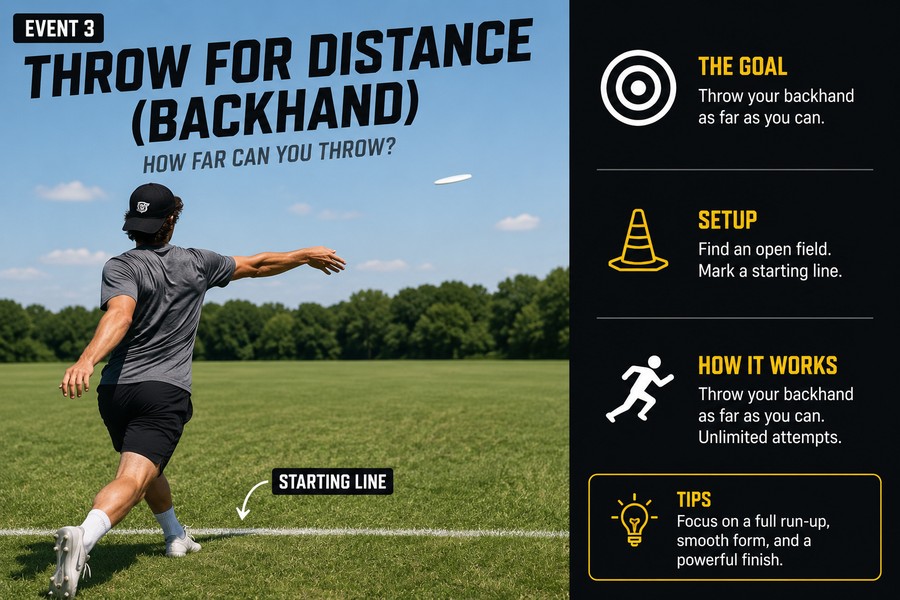
Setup: Find an open field. Mark a starting line.
How it works: Throw your backhand as far as you can. Unlimited attempts.
Your score: The distance from the starting line to where the disc first touches the ground, measured in yards. Your farthest throw counts.
This event tests the entire kinetic chain for your backhand. Hips, core, shoulder, arm, wrist, fingers, all connecting in the coil and uncork sequence from the throwing mechanics chapter. Every link matters. A broken chain at any point costs you yards.
Solo practice tips: Bring 6 to 9 discs to the field. Line them up. Throw them all one after another, as hard and far as you can. Walk to the farthest one and measure the distance from your starting line. That is your score. Experiment with your run up, your IO angle, your release height. Try different amounts of coil. The first couple throws will be stiff. By the fifth or sixth, your body loosens up and you start finding your range. This is normal.
Track your best throw monthly. The benchmarks from the throwing chapters give you context:
→ Beginner: 15 yards.
→ Intermediate: 30 yards.
→ Advanced: 45 yards.
→ Legend: 60+ yards.
Your backhand distance connects to everything: the kinetic chain chapter, the strength training chapter (especially core rotational work and push ups), the flexibility chapter (deeper coil equals more stored energy), and the field drills chapter where you first started practicing max effort throws.
Event 4: Throw for Distance (Forehand/Flick)
Same setup, same rules, same scoring as the backhand distance event. But now you throw the flick.
For most players, this is the hardest of the five Discathlon events. The flick is the harder throw. The kinetic chain is less natural. The wrist snap has to be more precise. And because most players have spent more hours throwing backhands than flicks, their flick distance almost always lags behind.
Solo practice tips: Same as the backhand. 6 to 9 discs, throw them all, measure the farthest. But pay extra attention to the gap between your backhand distance and your flick distance. That gap is one of the most revealing numbers in the entire Discathlon.
If your backhand goes 50 yards and your flick goes 25, you know exactly where to focus your next month of training. The flick needs work. Go back to the Gravity Flick drill from Chapter 5. Do Khalif's behind the back wrist isolation drill. Increase your Hula Hoop time on your middle finger. Do weighted Eagle Slashes. The gap tells you what to practice.
If your flick and backhand are within 5 to 10 yards of each other, you have a balanced throwing game. That is rare and valuable. Maintain it.
The same benchmarks apply: Beginner 15 yards, Intermediate 30, Advanced 45, Legend 60+. Most recreational players will find their flick benchmarks are one tier below their backhand. Closing that gap is one of the most impactful things you can do for your overall game.
Event 5: Throw, Run, Catch (TRC)
This is the event that feels most like a real game, and it is the most fun of the five.
Setup: Open field. One disc. Mark a starting line.
How it works: Stand at the starting line. Throw the disc both high and far. Then sprint after it and catch your own throw one handed, as far from the starting line as possible.
Your score: The distance from the starting line to where you catch the disc. One handed catch required.
Think about what this event demands. You need throwing power to get the disc far. You need throwing accuracy to put it where you can actually reach it. You need sprint speed to close the distance. You need disc reading ability to track a disc in the air while running full speed. And you need one handed catching skill to secure it at full extension.
This is a throw and go. You throw it and then you chase it. In a game, this is what happens when you throw a huck and then sprint downfield to be available for the next pass. The TRC simulates that scenario perfectly, except you are catching your own throw instead of someone else's.
Solo practice tips: The key is finding the right arc. A throw that goes 60 yards far but only 10 feet high will hit the ground long before you get there. A throw that goes 40 yards far but 40 feet high gives you time to sprint underneath it. The ideal TRC throw is high enough to hang in the air while you close the gap, and far enough that your catch point is as far from the starting line as possible.
Experiment with throw height versus distance. Too flat and you cannot catch up. Too high and it does not go far enough. There is a sweet spot, a specific arc, that maximizes your score. Finding that arc takes reps. But once you find it, the TRC becomes deeply satisfying. There is nothing quite like launching a disc, sprinting after it, and snatching it out of the air at full extension 40 yards from where you started.
This event connects to the field drills chapter (throw up and catch in the wind), the jumping emphasis from outdoor drills, the sprint training from the running chapter, and the one handed catching skills you built throughout the self-throw drills.
The Other 7 Skills Challenges
The Discathlon is five events, but the full USA Ultimate Skills Challenge includes twelve. The other seven are not part of the official competitive Discathlon, but every single one of them is worth doing and worth tracking. Here is what they are and how they connect to this book.
Sink a Disc. Stand 3 yards from a laundry basket. You have 20 consecutive throws. How many land in the basket? This is pure short range accuracy. You already know this drill from the target practice section in Chapter 10. Track your score out of 20 for backhands, then flicks, then off hand.
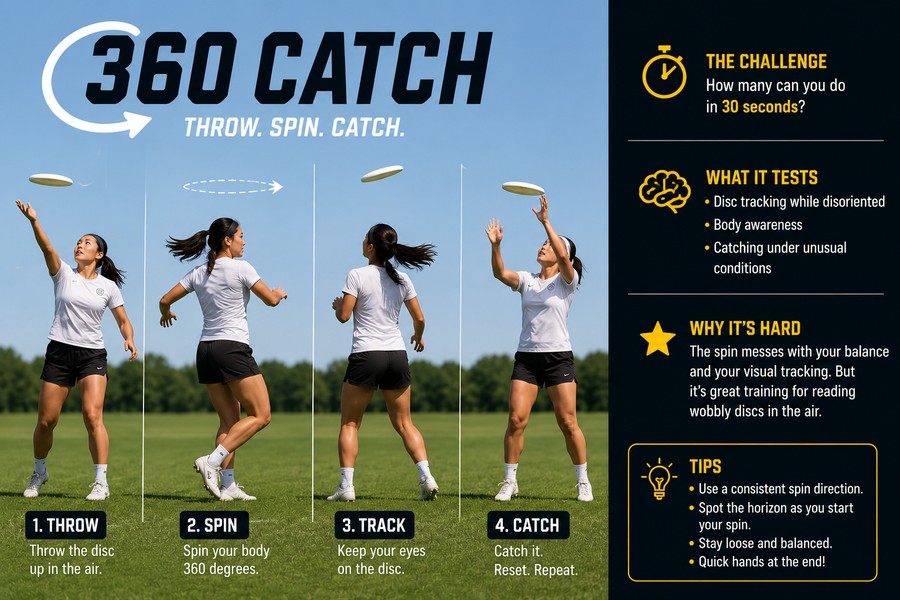
360 Catch. Throw the disc up in the air. Spin your body 360 degrees. Catch it. How many can you do in 30 seconds? This tests disc tracking while disoriented, body awareness, and catching under unusual conditions. It is harder than it sounds. The spin messes with your balance and your visual tracking. But it is great training for reading wobbly discs in the air.
W Drill. Sprint through cones set up in a W pattern as fast as you can. This is a pure agility and direction change test, similar to the cone cutting drills from the running chapter.
Disc Spin. How long can you spin the disc on your finger? This is the Hula Hoop Drill from Chapter 4 in its official competitive format. Your Hula Hoop training pays off here literally. If you have been spinning the disc on your middle finger every day as this book recommends, you already have a significant advantage in this event. Track your time in seconds.
Flip Toss. Toss the disc up a few feet in front of you. Plant and attack at full speed. Catch with both hands and run through. How many can you do in 60 seconds? This is catching on the move, similar to the self-throw drills from Chapter 6 but with forward momentum and a timer.
Figure 8. Sprint in figure 8 patterns around two cones set 10 yards apart while a partner tosses short passes. How many catches in 60 seconds? This one requires a partner, but you can adapt it solo by throwing the disc to yourself at each turning point.
Trick Catch. Creative catches: behind the back, under the leg, clap and catch, between the legs. This connects directly to the freestyle skills from Chapter 12. The more creative catching you have practiced, the more comfortable these feel.
Your Personal Discathlon: The Book Version
The official Discathlon is five events. But this book has given you skills that go far beyond those five. So I want you to create an expanded personal Discathlon that includes benchmarks from every chapter. Here are the additional measurements I recommend tracking monthly.
Hula Hoop Duration. How long can you sustain the vertical spin on your middle finger? Dominant hand and non dominant hand, separately. This is your finger strength benchmark from Chapter 4. If this number is climbing, your finger strength is growing, and your flick is getting more powerful whether you realize it yet or not.
Gravity Flick Streak. How many Gravity Flicks in a row can you do without dropping the disc? Dominant hand and non dominant hand. This is your wrist snap and finger push benchmark from Chapter 5.
Dual Flick Simultaneous Launch. Throw both discs at the same time. Read the flight paths. Are they X pattern, V pattern, or parallel? This is your ambidexterity benchmark from Chapter 11. Take a photo or video of the flight paths each month and compare.
Off Hand Throw Distance. Both backhand and flick with your non dominant hand. How far can your left hand (or right hand if you are left handed) throw? Track this separately from your dominant hand distance. The gap between the two tells you how your ambidexterity training is progressing.
Push Up Max. How many push ups can you do in one set without stopping? This is your upper body strength benchmark from the strength training chapter.
Combined with the five official Discathlon events, you now have ten benchmarks that cover throwing accuracy, throwing distance (both throws, both hands), athleticism, finger strength, wrist snap, ambidexterity, and upper body strength. Ten numbers that tell the complete story of your solo training progress.
Track them in a simple log. A notebook, a spreadsheet, a notes app on your phone. Date, score, conditions (windy, calm, wet, dry). One line per test. Review monthly. Celebrate the improvements. Identify the plateaus. Adjust your training focus based on what the numbers tell you.
How to Run Your Own Discathlon Day
Pick a day once a month. Mark it on your calendar. Make it a ritual. Here is how to structure it.
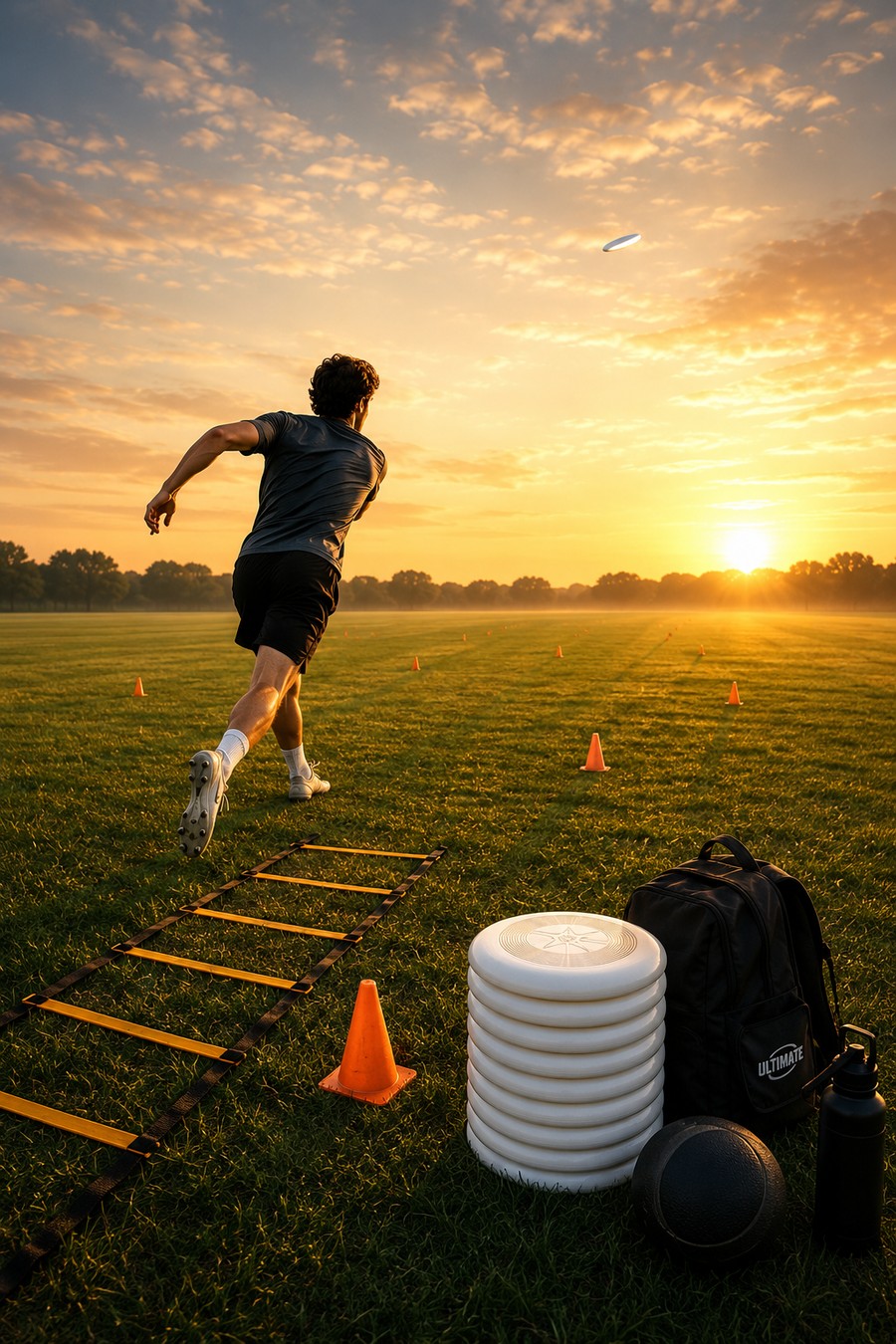
Warmup (10 minutes): Dynamic stretching from the flexibility chapter. Arm circles, lunges with torso rotation, leg swings, wrist circles, standing torso rotations. Then 5 minutes of easy throwing at a close target. Get your body warm and your release calibrated.
Event 1: Accuracy Ladder. Start here because accuracy requires a fresh arm and a fresh mind. Run the ladder with your dominant hand backhand first. Log the score. Then run it with your flick. Log the score. If you have time, run it with your off hand. Log each score separately.
Event 2: Compass. Set up the five cones. Run the course. Log your time. Run it again if you want a second attempt. Take the better time.
Event 3: Throw for Distance (Backhand). Bring 6 to 9 discs. Throw them all. Walk to the farthest. Measure. That is your score.
Event 4: Throw for Distance (Flick). Same discs, same field, same process. Throw, measure, log.
Event 5: Throw, Run, Catch. Give yourself 5 to 10 attempts. Log your farthest successful one handed catch.
Personal Benchmarks: Hula Hoop duration on middle finger (both hands). Gravity Flick streak (both hands). Dual Flick Simultaneous Launch (observe and note the pattern). Off hand distance (backhand and flick). Push up max set.
Cool down (10 minutes): Static stretching from the flexibility chapter. Seated spinal twist, pigeon pose, prayer stretch, calf stretch. Let your body recover.
Log everything. Compare to last month.
Total time: about 60 to 90 minutes including warmup and cooldown. One morning a month. That is all it takes to measure everything in this book.
And here is a suggestion that makes it even better: invite friends, family, or your pickup group to do it with you. Make it an event. Competition makes it more fun. You push harder when someone else is watching. And comparing scores with friends creates accountability and motivation that solo tracking cannot replicate. Turn your monthly Discathlon into a social event and everybody improves faster.
What Your Scores Tell You
The numbers are not just scores. They are a diagnostic tool. Each pattern in your results tells you something specific about where your training should focus next.
High distance, low accuracy: You have power but not control. You are probably throwing at 100% when you should be at 80%. Focus on the Accuracy Ladder. Do more target practice. Work on Khalif's Table Drill to keep the disc flat. Practice the 80% power sweet spot until it becomes your default.
High accuracy, low distance: You have control but your kinetic chain is not fully connected. You are probably throwing with too much arm and not enough body. Go back to the kinetic chain chapter. Do the isolation drill: wrist only, add forearm, add shoulder, add hips. Focus on hip rotation initiating every throw. Do medicine ball rotational throws.
Fast Compass, low distance: You have athleticism but your throwing mechanics need work. Your legs are ready. Your arm is the bottleneck. Spend more time on throwing technique and less on running drills until the balance evens out.
Backhand distance much higher than flick distance: This is the most common pattern. Your flick kinetic chain is incomplete or your flick specific muscles are weaker. Go back to the Gravity Flick drill. Do Khalif's behind the back wrist isolation drill daily. Increase your Hula Hoop time on your middle finger. Do weighted Eagle Slashes. The flick improves when the supporting muscles and mechanics get specific attention.
Dominant hand scores far above off hand scores: You need more off hand training time. Increase from 5 minutes per session to 10. Do the Hula Hoop on your non dominant hand first, when your motivation is highest. Track off hand scores separately and celebrate improvements as their own victories.
Everything improved except one skill: That one skill is where your next month of focus should go. The Discathlon identifies your weakest link with mathematical precision. Train that link and your overall game rises.
Everything plateaued: You need variety. Your body has adapted to your current training routine and is no longer being challenged. Change something. Add weight to your Eagle Slashes. Add a run up to your distance throws. Try a different target distance on the Accuracy Ladder. Switch up your sprint drill patterns. New stimulus creates new adaptation.
Wrap Up
◆ The Discathlon is your monthly progress report. Five events that test throwing accuracy, athleticism, backhand distance, flick distance, and the throw-run-catch combination.
◆ Download the free USA Ultimate app to access all 12 Skills Challenge events with instructional videos and a global leaderboard.
◆ The Accuracy Ladder tests precision under pressure. Three attempts per distance, moving back 3 yards each time you succeed.
◆ The Compass tests sprinting, shuffling, backpedaling, and direction changes. It is the defensive footwork chapter in one timed course.
◆ Throw for Distance (Backhand and Flick) tests your full kinetic chain. The gap between your two distances tells you which throw needs more work.
◆ The Throw, Run, Catch is the most game like event. It tests power, accuracy, speed, disc reading, and one handed catching all at once.
◆ Create a personal expanded Discathlon that includes Hula Hoop duration, Gravity Flick streak, Dual Flick test, off hand distance, and push up max.
◆ Run your Discathlon once a month. Log every score. Use the patterns to guide your training. High distance but low accuracy? Focus on control. Low distance but fast Compass? Focus on throwing mechanics.
◆ Invite friends to join your monthly Discathlon. Competition and accountability make everyone improve faster.
Action Steps
→ Download the USA Ultimate app today. It is free. Create an account and browse the 12 Skills Challenges. Watch the instructional videos for each one.
→ This week, run the Accuracy Ladder with your backhand and your flick. Log both scores. See the gap between them.
→ Set up the Compass with 5 cones (or shoes or water bottles) and run it once. Log your time. That is your baseline.
→ Throw for distance with your backhand and your flick. Bring 6 discs to a field. Measure your farthest throw for each. Write both numbers down.
→ Try the Throw, Run, Catch at least 5 times. Experiment with the arc of your throw. Find the sweet spot between height and distance. Log your farthest one handed catch.
→ Do your personal benchmarks: Hula Hoop duration on your middle finger (both hands), Gravity Flick streak (both hands), push up max set. Write them all down with today's date.
→ Schedule your first official Discathlon Day for one month from today. Put it on your calendar. Make it real.
→ Invite at least one friend to do it with you. Everything is more fun with company.
Mentor's Closing
There is a moment that happens about three months into tracking your Discathlon scores. You sit down with your notebook or your phone and you look at the numbers from month one, month two, and month three. And you see a line going up.
Your Accuracy Ladder went from 9 to 12 to 15. Your flick distance went from 22 to 28 to 33. Your Compass time dropped from 28 seconds to 24 to 21. Your Hula Hoop duration went from 45 seconds to 1 minute 20 to 2 minutes 10. The numbers are climbing. Every single one of them.
And in that moment, something clicks. All those mornings doing Gravity Flicks on the carpet. All those evenings spinning the Hula Hoop while watching TV. All those push ups. All those stairs. All those wall throws and target practice sessions and weighted Eagle Slashes. They are not just habits anymore. They are data points. They are proof. They are the measurable evidence that you are becoming a better player, one rep at a time, in ways that are too gradual to feel but too consistent to deny.
That moment is worth every boring rep that came before it. And it will keep you going through every rep that comes after.
Measure your progress. Trust the numbers. And keep climbing. :)