Think about the coil from the throwing mechanics chapter. You wind your body up like a spring, loading energy into your hips, core, shoulder, arm, wrist, and fingers. Then you uncork it. All that stored energy releases in one explosive, connected sequence. The tighter the coil, the more energy you store. The more energy you store, the more power you release.
But here is the part most players miss: the depth of your coil is determined by your flexibility.
If your hips can only rotate 60 degrees, that is all the coil you get. If your shoulders are tight, your arm cannot wind back far enough to load the spring. If your wrists are stiff, your snap is shortened before it even begins. Every joint in the kinetic chain has a range of motion, and whatever that range is, that is your ceiling for power at that joint.
Stretching raises the ceiling.
Think of a rubber band. A stiff, dried out rubber band barely snaps when you pull it back. It has no range. No elasticity. No potential energy. But a fresh, supple, well stretched rubber band? Pull it back and it launches across the room. Same rubber band. Same finger. The only difference is flexibility.
Your body is the rubber band. Stretching makes you snap harder. Every extra degree of rotation you gain through stretching is more kinetic energy flowing through the chain. More power. More distance. More spin. Flexibility is not a separate skill from throwing. It IS throwing. It is the range of motion that your power travels through.
This is also why older players who stretch regularly can still throw far into their fifties and sixties. They have maintained their range of motion. Players who ignore stretching lose range every year, a degree here, a degree there, and they wonder why their throws are getting shorter even though they feel like they are putting in the same effort. The effort is the same. The range is smaller. And a smaller range means less coil, less energy, less power.
This chapter is about unlocking every degree of rotation, extension, and flexibility that your body has available. From your fingertips to your hips. From the smallest joint in your hand to the largest joint in your body. All of it matters. All of it connects. And all of it makes your throws better.
The Pull Up Bar: My Favorite Stretching Tool
Before we go through the body section by section, I want to share something personal. The piece of equipment that has helped my flexibility more than anything is a simple pull up bar mounted in a doorway at home.
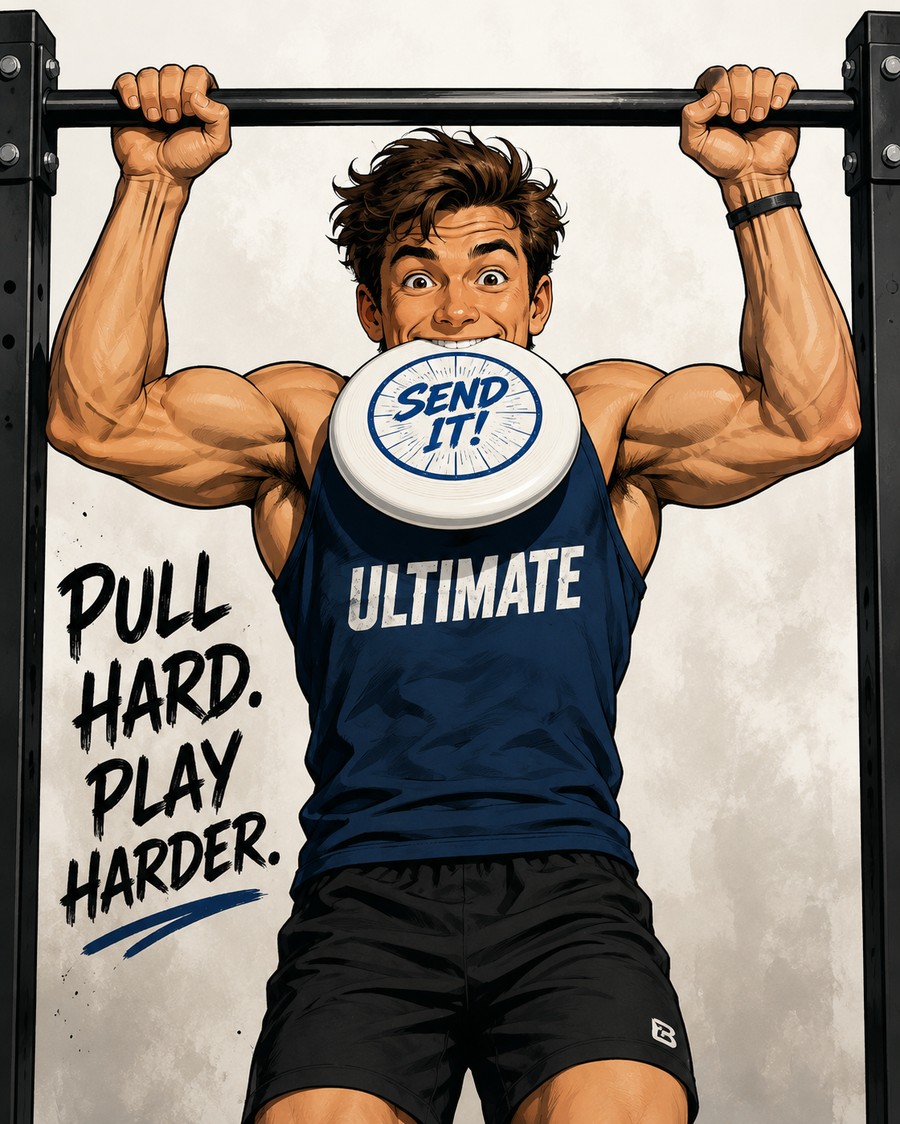
I do not just use it for pull ups. I use it for stretching every day, and the ways I use it might surprise you.
The dead hang. I grab the bar with both hands and just hang there. Arms fully extended. Feet off the ground. My body weight stretches my shoulders, my lats, my spine, and my forearms all at the same time. I can feel the vertebrae in my back decompress. My shoulders open up. My grip gets a gentle endurance workout. Thirty seconds of hanging does more for my upper body flexibility than five minutes of individual stretches. It is the ultimate multitasker.
The hanging twist. While hanging from the bar, I twist my lower body side to side. My hands stay fixed on the bar and my torso and legs rotate beneath them. This stretches the entire rotational chain, from my shoulders through my core to my hips, under the gentle load of my own body weight. It feels like wringing out a towel. Every twist opens up the spine a little more.
The leg and ankle stretch. I hold onto the bar, plant my feet on the ground, and push my feet forward while leaning my body backwards. This creates a deep stretch through my calves, my ankles, and the front of my legs. It is similar to a wall calf stretch but the angle is different because I am holding the bar overhead, and I can control exactly how deep the stretch goes by how far I lean back. I do this regularly because stretching my legs for running is critical, and this position hits angles that standard standing stretches miss.
If you have a pull up bar at home, or access to one at a gym or a park, use it for these stretches every day. It takes two minutes. And those two minutes of hanging and twisting will open up your shoulders, spine, and hips in ways that floor stretches alone cannot replicate because gravity is doing the work for you.
Fingers and Hands
Your hands contain 25% of all the bones in your entire body. Twenty seven bones in each hand, packed into these small, intricate structures that do everything from gripping the disc to snapping the final spin onto a flick release. These are the smallest, most precise joints in the kinetic chain, and they are the very last thing to touch the disc before it flies. If they are stiff, your release suffers.
I am constantly stretching my fingers. Constantly. I push my middle finger and my index finger backwards with my thumb, pressing them to their limit until I feel the stretch deep in the tendons. Sometimes I get a pop. I do this on both hands, with every finger, including my thumb. I do it while driving. While watching TV. While sitting in a meeting. While waiting in line. There is no dedicated "finger stretching time" in my schedule. I just do it all the time, whenever my hands are free.
That constant stretching has made my fingers noticeably more flexible over the years. My wrist cocks back farther. My fingers extend more. My grip has more range. And I can feel the difference when I throw, especially on the flick where the finger extension at the end of the snap is what generates the final burst of spin.
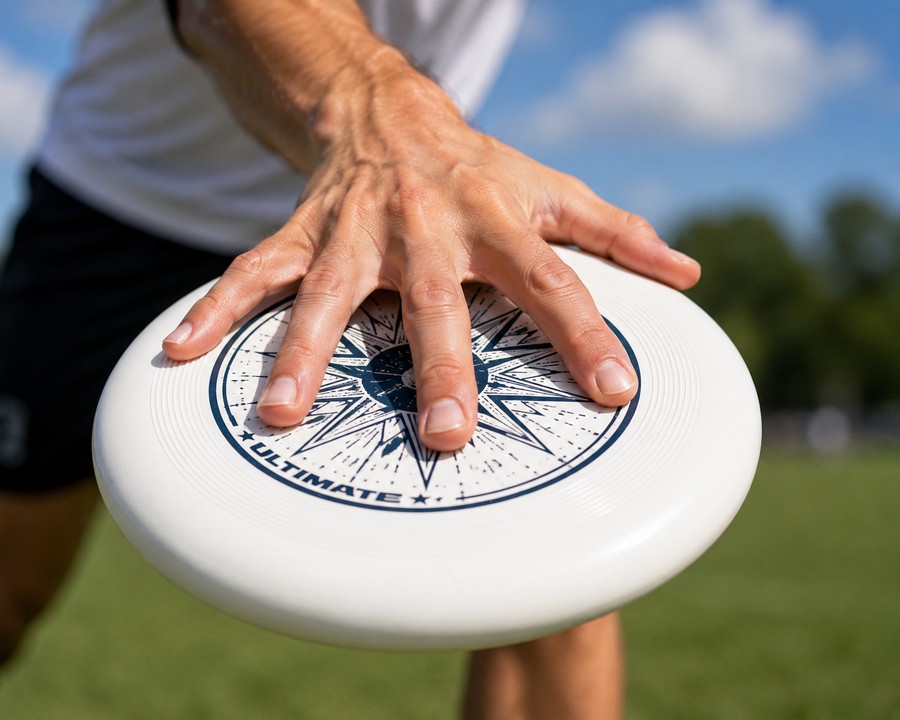
David Lingua's finger routine (from Chapter 3). Finger spreads: take two fingers and spread them apart, press them down on your leg, hold. Do every pair on both hands. Finger extensions: put your fingers on a flat surface, gently press or pull back until you feel the stretch at the base of each finger. Thumb stretches: pull your thumb back gently in both directions. David is emphatic: "Definitely do not forget your thumb."
Individual finger pulls. Extend one finger at a time. With your other hand, gently pull that finger back toward your body while the remaining four fingers spread wide. Hold for one deep breath. Move to the next finger. Do all five on both hands. This isolates each finger individually and reveals which ones are tighter than others.
Fist to splay. Make a tight fist. Squeeze hard. Hold for 5 seconds. Then splay your fingers as wide as possible, stretching them apart like a starfish. Hold for 5 seconds. Repeat 10 times. This builds range of motion in both directions, closed and open, and the contrast between the tight squeeze and the wide splay teaches your muscles the full extent of their range.
Piano fingers. Tap each finger to your thumb in rapid sequence, like you are playing fast piano keys. Index to thumb, middle to thumb, ring to thumb, pinky to thumb, then reverse. Do this for 30 seconds per hand. It is not a stretch exactly, but it warms up the small muscles and tendons that connect your fingers and improves the coordination between them.
Prayer press with finger separation. Press your palms together in prayer position in front of your chest. Now spread your fingers apart as wide as you can while keeping the palms pressed together. Feel the stretch in the webbing between each finger. Hold for 15 seconds. That webbing IS the Webbing Whip release point from Chapter 7. Stretching it gives the disc more room to travel through during the release.
Wrists
Your wrist is where spin is born. The snap of the wrist is the final accelerator in the kinetic chain. A flexible wrist cocks back farther before the snap, which means a longer acceleration path, which means more spin on the disc. Every degree of additional wrist extension translates directly to throwing power.
Prayer stretch. The most classic and one of the most effective wrist stretches. Press your palms together in front of your chest, fingers pointing up. Slowly lower your hands toward your waist while keeping the palms pressed together. You will feel the stretch intensify in your wrist flexors as your hands go lower. Hold at your deepest comfortable point for 30 seconds.
Reverse prayer. The balance stretch. Press the backs of your hands together in front of your chest, fingers pointing down. Press firmly together from knuckles to fingertips. This stretches the extensor side of your wrists, the muscles that balance the flexors you use when throwing. Hold for 30 seconds to one minute.
360 degree wrist stretches. Get on all fours. Place your hands flat on the floor and rotate through four positions, holding each for 30 seconds. First, fingers pointing forward (standard position). Second, fingers pointing backward toward your knees (intense flexor stretch). Third, fingers pointing outward away from your body. Fourth, place the backs of your hands on the floor with fingers pointing forward (intense extensor stretch). In each position, gently shift your body weight forward and back to increase or decrease the intensity. This covers every angle of wrist flexibility in one sequence.
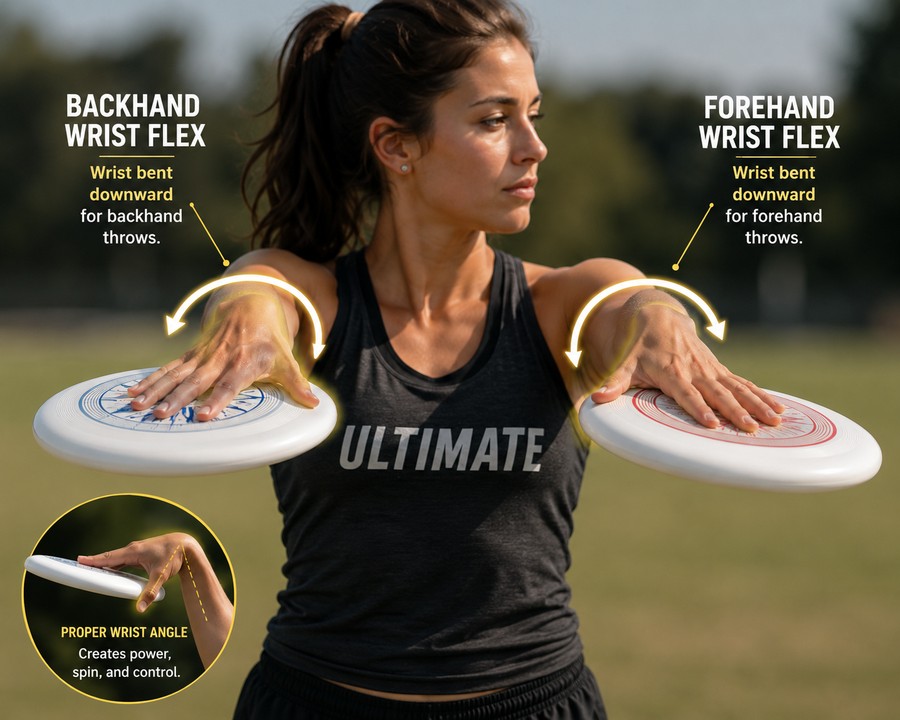
Figure eight wrist circles. Interlace your fingers in front of your body. Make figure eight motions with your joined hands, allowing your wrists to rotate fully so each hand alternates being on top. Continue for 15 seconds, rest, repeat. This is a flowing, dynamic stretch that warms up the rotational capacity of both wrists simultaneously.
Upward bound fingers pose. Interlace your fingers and extend your arms out in front of you. Turn your palms so they face you. Breathing in, raise your arms toward the ceiling, stretching your hands overhead with palms facing up. Hold for several breaths. This stretches the forearms, wrists, and fingers all at once and increases circulation through the entire lower arm.
Tabletop wrist rotations. On all fours with fingers pointing outward, make small circles with your upper body while keeping your hands planted on the floor. Your wrists get gentle rotational stretching under the load of your body weight. This mimics the rotational demands of throwing but at a slow, controlled pace that builds flexibility safely.
Forearms
Your forearms are the bridge between your arm power and your wrist snap. Tight forearms restrict wrist motion, which restricts snap, which restricts spin. If your forearms are chronically tight from throwing (and they will be if you are practicing regularly), your wrist cannot reach its full range and your throws plateau.
Extended arm wrist flexion. Extend your arm straight in front of you, palm facing out like you are signaling stop. Use your other hand to gently pull your fingers back toward your body. Hold for 30 seconds. Switch arms. You should feel a deep stretch running from your wrist up through the inside of your forearm.
Extended arm wrist extension. Same arm position but palm facing down, fingers pointing toward the floor. Use your other hand to gently press the back of your hand downward. Hold for 30 seconds. Switch arms. This stretches the extensor side, the balance to the flexion stretch above. Always do both.
Forearm self massage. Use your opposite hand, a lacrosse ball, or a tennis ball to roll pressure from your wrist to your elbow on the inside of your forearm. Press firmly and roll slowly. You may notice your fingers involuntarily curl as you roll toward the elbow and extend as you roll toward the wrist. That is the flexor and extensor muscles responding to the pressure. This releases built up tension from throwing and restores mobility to the forearm. Do this after every throwing session.
Shoulders: The Gateway Joint
Read that opening quote from David Lingua one more time. Shoulder flexibility affects everything downstream. Tight shoulders cause your elbows to compensate. Compensating elbows cause your wrists to strain. Strained wrists cause your fingers to lose precision. One tight joint at the top of the chain creates problems at every joint below it.
Your shoulders are involved in every throw you make. The backhand coil loads your shoulder. The flick extension reaches through your shoulder. The hammer launches from above your shoulder. If your shoulders are tight, the entire kinetic chain is throttled before it even gets to your arm.
Cross body shoulder stretch. Bring one arm straight across your chest. Use your other hand to press it closer to your body. Hold for 30 seconds each side. Simple, classic, effective. Do this between every set of throwing practice.
Overhead tricep and shoulder stretch. Reach one hand down your back between your shoulder blades. Use your other hand to gently push the elbow further down. This stretches the tricep and the posterior shoulder simultaneously. 30 seconds each side.
Arm circles. Big, slow circles with both arms. Forward for 20 rotations, then backward for 20 rotations. This warms up the full range of motion of the shoulder joint and is the simplest shoulder mobility exercise that exists. Do this before every throwing session.
Eagle arms (from yoga). Wrap one arm under the other at the elbows. Try to press your palms together. Lift your elbows up toward the ceiling. You will feel a deep stretch between your shoulder blades and in your rear deltoids. This is an incredible stretch for throwers who get tight between the shoulder blades from the forward pulling motion of throwing. Hold for 30 seconds, then switch which arm is on top.
Thread the needle (from yoga). Start on all fours. Slide one arm under your body and through to the other side, lowering that shoulder toward the ground. Your torso rotates and you feel the stretch through your shoulder and your thoracic spine simultaneously. Hold for 30 seconds each side. This is a two for one stretch: shoulder flexibility and spinal rotation in the same movement.
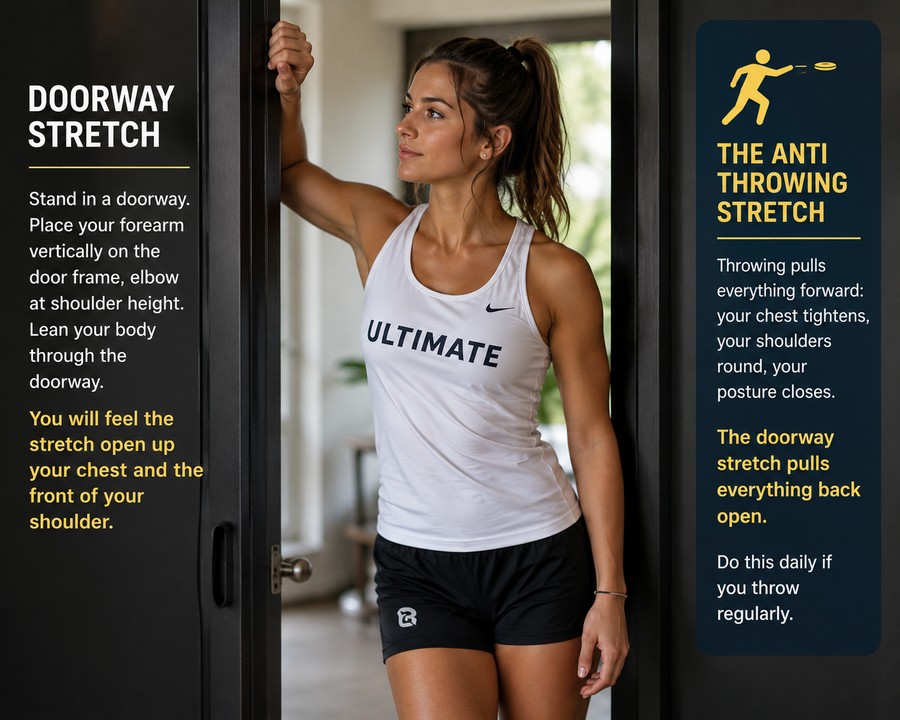
Doorway stretch. Stand in a doorway. Place your forearm vertically on the door frame, elbow at shoulder height. Lean your body through the doorway. You will feel the stretch open up your chest and the front of your shoulder. This is the anti throwing stretch. Throwing pulls everything forward: your chest tightens, your shoulders round, your posture closes. The doorway stretch pulls everything back open. Do this daily if you throw regularly.
Pull up bar dead hang. As described above: grab the bar, hang with full arm extension, let gravity stretch your shoulders, lats, and spine. 30 seconds. The simplest and most effective shoulder opener available.
Torso and Spine: The Coil Zone
This is where flexibility translates most directly to throwing power. The more your torso can rotate, the deeper your coil, the more energy you store, the harder you throw. It is that direct. Every degree of additional spinal rotation you gain from stretching is a degree more power in your backhand, your flick, your hammer, and your pull.
Research shows that spinal rotation stretches improve disc hydration between vertebrae (keeping your spine healthy long term), reduce chronic low back pain when combined with core strengthening, and increase thoracic mobility which is essential for shoulder health and upper body performance. Yoga twists, done slowly and mindfully, are one of the safest and most effective ways to gain these benefits.
The thoracic spine, the twelve vertebrae running from the base of your neck to the bottom of your rib cage, is where most of your rotational throwing power originates. This region can rotate up to 35 degrees in each direction. Your lumbar spine (lower back) only rotates about 5 to 10 degrees. So when you coil for a throw, almost all of the rotation should come from your mid and upper back, not your lower back. Stretching the thoracic spine specifically is what unlocks deeper coils.
Seated spinal twist (Ardha Matsyendrasana). This is the single most important stretch for throwers in this entire chapter. Sit with both legs extended in front of you. Bend one knee and cross that foot over the opposite leg. Place the opposite elbow on the outside of the bent knee. Inhale and lengthen your spine tall. Exhale and twist your torso toward the bent knee, using your elbow for gentle leverage. Do not force it. Lengthen on each inhale, deepen the twist on each exhale. Hold for 30 seconds to one minute each side. This stretch directly mimics the coil of a backhand: your lower body is stable while your torso rotates. Every second you spend in this stretch is increasing the rotational range available to your throws.
Supine spinal twist (reclining twist). Lie on your back. Bring one knee up and cross it over your body to the opposite side. Extend both arms out in a T position. Let gravity pull the knee down toward the floor. Your shoulder on the opposite side should stay on the ground. This is the most relaxing twist and it is perfect for before bed. Let gravity do the work. Breathe deeply. One minute each side. I do this almost every night.
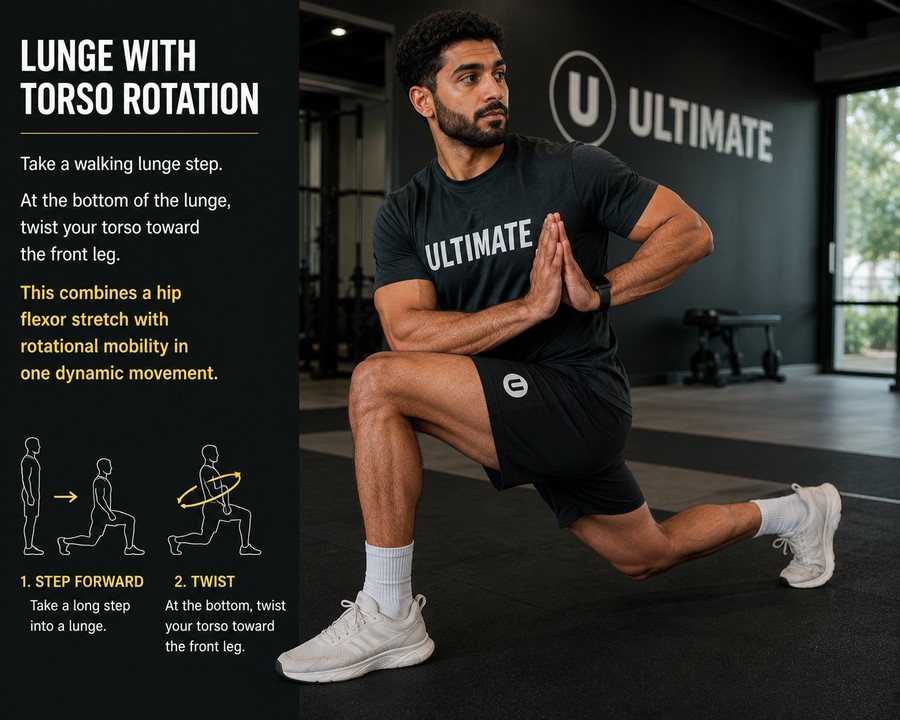
Lunge with torso rotation. Take a walking lunge step. At the bottom of the lunge, twist your torso toward the front leg. This combines a hip flexor stretch with rotational mobility in one dynamic movement. It is an excellent warmup before throwing because it opens the hips and the spine simultaneously while keeping your blood flowing. 10 reps alternating legs.
Cat/Cow with rotation. Start on all fours. Alternate between arching your back (cow, belly drops toward floor) and rounding it (cat, spine curves toward ceiling). Then add a twist: thread one arm under your body to the opposite side while the other arm reaches toward the ceiling. This warms up the entire spine in all three planes of motion: flexion, extension, and rotation. 10 rounds.
Standing torso rotation. Plant your feet shoulder width apart. Extend your arms to the sides at shoulder height. Twist your upper body side to side, keeping your hips facing forward. Start slow. Gradually increase the speed. Feel your thoracic spine loosening up with each rotation. 20 twists each direction. This is the simplest rotational warmup and you can do it anywhere.
Thoracic rotation on all fours. Start on all fours. Place one hand on the back of your head. Begin with your elbow pointing toward the floor. Then rotate your upper body, opening that elbow toward the ceiling as far as you can. Return to the floor. Repeat 10 times each side. This isolates the thoracic spine specifically, which is where your throwing rotation lives. It is one of the most targeted rotational stretches you can do.
Pull up bar hanging twist. Hang from the bar with both hands. Rotate your lower body side to side while your hands stay fixed. Your spine twists under load. This decompresses and rotates simultaneously, and it feels incredible after a long throwing session.
Hips: Where the Chain Begins
Your hips are the engine of the kinetic chain. Everything starts here. If your hips are tight, your rotation is limited at the source, and no amount of shoulder flexibility or wrist snap can compensate for what you lost at the beginning of the chain.
Hip flexor lunge stretch. Drop into a low lunge. Push your hips forward until you feel a deep stretch in the front of your back leg's hip. Hold for 30 seconds each side. Your hip flexors get tight from sitting at a desk, from driving, from any activity where your hips are bent. This stretch opens them back up.
Pigeon pose (from yoga). One of the deepest hip openers in existence. From all fours, bring one knee forward and place it behind your wrist with your shin angled across your body. Extend the other leg straight behind you. Lower your torso toward the ground. You will feel an intense stretch in the outer hip of the front leg. Hold for one minute each side. This is not comfortable at first. It gets better. And the hip mobility it builds is transformative for your throwing base.
90/90 hip stretch. Sit on the floor with your front leg bent at 90 degrees in front of you and your back leg bent at 90 degrees behind you. You are sitting between your two bent legs. Rock forward and back, rotating between internal and external hip rotation. This covers both directions of hip mobility in one stretch. 30 seconds each position, both sides.
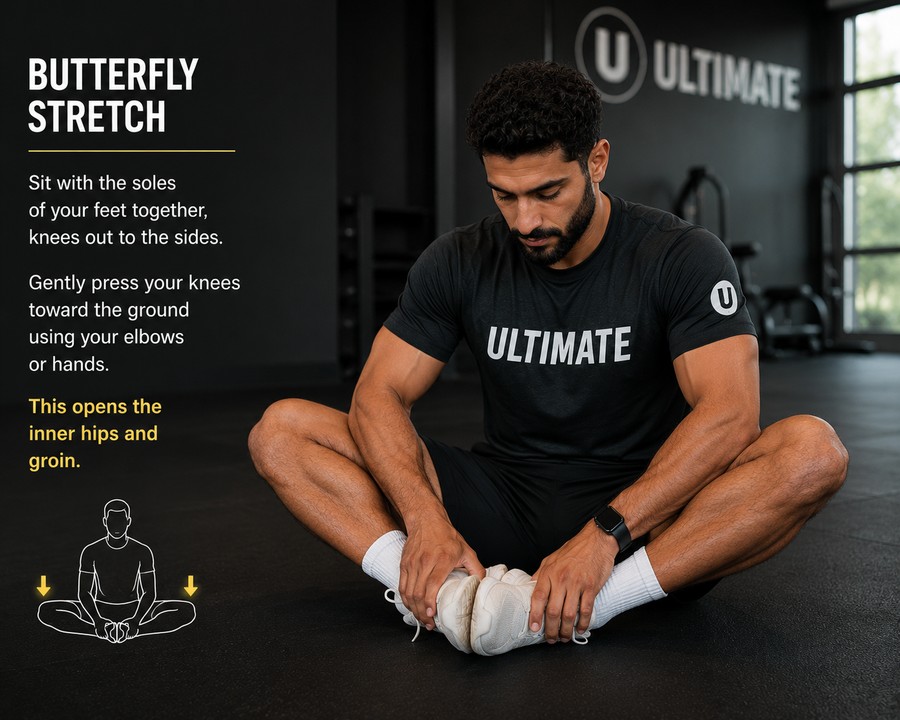
Butterfly stretch. Sit with the soles of your feet together, knees out to the sides. Gently press your knees toward the ground using your elbows or hands. This opens the inner hips and groin. I do this one regularly before running because tight inner hips restrict my stride and my lateral movement. Hold for 30 seconds to one minute.
Wide leg spread. Sit on the floor and spread your legs as wide as they will go. Lean forward and try to touch the ground in front of you with your hands, then your forearms, then your chest if your flexibility allows. This stretches the hamstrings, inner thighs, and hips all at once. It is intense but incredibly effective for opening up the entire lower body. Hold at your deepest comfortable point for 30 seconds to one minute.
Hamstrings, Calves, and Lower Body
Tight hamstrings pull your pelvis out of alignment and reduce your ability to hinge and rotate. Tight calves pull you off the balls of your feet, which David Lingua has emphasized in every chapter of this book as the foundation of athletic movement. If you are flat footed, your first step is slow. Flexible calves keep you up on the balls of your feet where you belong.
Standing hamstring stretch. Place one foot on a low bench, step, or table. Keep your standing leg straight. Lean forward with a flat back until you feel the stretch in the back of the elevated leg. 30 seconds each side. I do this regularly with my foot up on whatever surface is nearby: a park bench, a railing, a low wall.
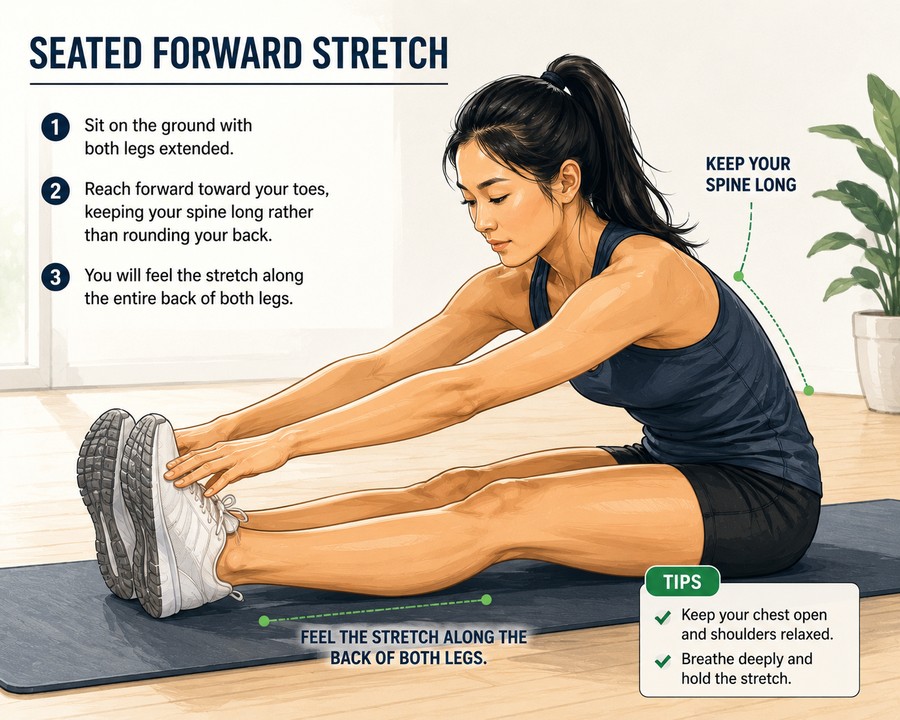
Seated forward fold. Sit on the ground with both legs extended. Reach forward toward your toes, keeping your spine long rather than rounding your back. You will feel the stretch along the entire back of both legs. Hold for 30 seconds. If you cannot reach your toes, that is fine. Reach as far as you comfortably can. The range increases over time.
Standing calf stretch. Stand facing a wall. Place one foot behind you with the heel pressed firmly to the ground. Lean into the wall until you feel the stretch in the calf of the back leg. 20 seconds each side. Tight calves are one of the most common causes of being flat footed during play. This stretch keeps them supple.
Pull up bar ankle and leg stretch. Hold onto the bar, plant your feet on the ground, and push your feet forward while leaning your body backwards. You control the depth of the stretch by how far you lean. This hits your calves, your ankles, and the front of your legs at an angle that standard standing stretches cannot reach. I do this several times a week and it has made a noticeable difference in my leg flexibility for running.
Downward dog (from yoga). Hands and feet on the floor, hips pushed high, forming an inverted V shape with your body. This stretches your calves, hamstrings, shoulders, and spine all at the same time. It is the ultimate multitasker stretch. Hold for 30 seconds to one minute. Pedal your feet by alternating bending one knee and straightening the other to deepen the calf stretch on each side.
When to Stretch
Timing matters. The wrong stretch at the wrong time can be less effective or even counterproductive. Here is the simple framework.
Before throwing: dynamic stretching. These are moving stretches that warm your joints and get blood flowing without holding long positions. Arm circles, lunges with torso rotation, leg swings, wrist circles, standing torso rotations, walking high kicks. The goal is to prepare your range of motion for action, not to push into new flexibility. Think of it as waking up your joints, not forcing them open.
After throwing: static stretching. These are the long holds, 30 seconds or more, where you settle into a stretch and let your muscles lengthen. The seated spinal twist, the pigeon pose, the prayer stretch, the doorway stretch. Your muscles are warm after throwing, which means they can safely stretch further than they could when cold. This is when real flexibility gains happen.
The pre-session ritual from Chapter 3: Two minutes of finger and wrist stretches, three minutes of body stretches. Before every solo session. Every time. Non-negotiable. This has been the rule since Chapter 3 and it still stands.
Evening routine. Supine spinal twist, pigeon pose, butterfly stretch, hamstring stretch, pull up bar dead hang. Ten minutes before bed. This is recovery AND flexibility building. Your body heals and adapts overnight, and stretching before sleep primes your muscles for that adaptation. I do sit ups combined with stretching in the evening whenever I can. It is difficult to fit everything in, but the combination of core work and flexibility work right before bed has been one of the most valuable habits I have built.
The principle: the more you stretch, the deeper your coil. The deeper your coil, the more power you uncork. Stretching is not the boring part of training. It is the part that makes everything else work better.

Wrap Up
◆ Flexibility determines the depth of your coil. More range of motion means more stored energy means more power in every throw.
◆ A pull up bar is one of the most versatile stretching tools you can own. Dead hangs, hanging twists, and leg stretches cover your shoulders, spine, and lower body in minutes.
◆ Stretch your fingers constantly, anywhere, anytime. Push them back with your thumb until you feel the stretch. Both hands, all fingers, including the thumb. Make it a habit.
◆ David Lingua's cascade principle: tight shoulders cause problems at every joint below. Stretch from the top down.
◆ The seated spinal twist is the single most important stretch for throwers. It directly mimics the backhand coil and increases the rotational range of your thoracic spine.
◆ Always balance flexor stretches with extensor stretches. Prayer stretch AND reverse prayer. Wrist flexion AND wrist extension. Balance prevents injury.
◆ Dynamic stretching before throwing (arm circles, rotations, lunges). Static stretching after throwing (long holds, yoga poses, deep stretches).
◆ Hip flexibility determines how much power your kinetic chain starts with. Pigeon pose, butterfly, and the wide leg spread open up the engine.
◆ Flexible calves keep you on the balls of your feet. Tight calves make you flat footed and slow. Stretch them daily.
Action Steps
→ Today: do David Lingua's finger routine. Finger spreads, extensions, and thumb stretches on both hands. Then push each finger back with your thumb individually. 2 minutes total.
→ This week: do the prayer stretch and reverse prayer before every throwing session. 30 seconds each. Feel your wrists open up.
→ Add the seated spinal twist to your evening routine. 30 seconds to 1 minute each side. Do it every night this week.
→ Try the 360 degree wrist stretches on all fours. Four positions, 30 seconds each. Your wrists will feel brand new afterward.
→ If you have a pull up bar, do a 30 second dead hang and then a hanging twist today. Feel the decompression in your spine.
→ Try pigeon pose for the first time. It will be intense. Hold for 30 seconds each side. It gets easier every time you do it.
→ Spread your legs wide on the floor and lean forward. See how close to the ground you can get. Write it down. Check again in a month.
→ Make a habit of stretching your fingers whenever your hands are free. In the car. At your desk. Watching TV. Those seconds add up to hours over the course of a year.
Mentor's Closing
Stretching is the quiet part of training. It is not dramatic. It is not exciting. Nobody posts their hamstring stretch on social media. Nobody brags about how deep their seated spinal twist is. It is invisible work that produces invisible results that only show up when you throw a disc farther than you could last month and you cannot quite explain why.
The reason is range. You gave your body more room to coil. More room to wind up. More room to store energy. And when you uncorked it, all that extra range converted into extra spin, extra distance, extra power. The throw felt the same. The result was better. That is flexibility at work.
I stretch my fingers while driving. I hang from the pull up bar while my coffee brews. I do the supine spinal twist before I fall asleep. I spread my legs on the floor and lean forward while watching a show with my kids. None of these moments feel like training. All of them are.
The players who throw the farthest at age 50 are not the ones who were the strongest at age 25. They are the ones who stretched. Every day. For decades. Quietly. Consistently. Without anyone watching.
Start stretching today. Do not stop. :)