You have just spent five chapters learning drills. Structured, specific, intentional drills with reps and progressions and timing benchmarks. Your fingers are stronger. Your wrist is faster. Your catches are sharper. You have earned every bit of that progress through disciplined, focused work.
Now I want you to forget all of that and just play.
This chapter is different from everything that came before it. There are no rep counts here. No timing benchmarks. No progression tiers. This chapter is about unstructured, creative, joyful play with a disc that happens to make you dramatically better at Ultimate without ever feeling like practice.
There is a secret that the best athletes in every sport eventually discover, and it is this: fun is not a distraction from getting better. Fun IS the engine of getting better. When you are having fun, you practice longer without realizing it. You experiment more freely because there is no pressure to get it right. Your body learns faster because it is relaxed and curious instead of tense and focused. A child who spends an afternoon kicking a soccer ball against a wall for fun will develop more touch than a child who does 30 minutes of drills they hate. The same is true for you and a disc.
David Lingua, a coach and longtime player in the DC area, put it perfectly when he compared freestyle disc play to juggling a soccer ball. You do not juggle a soccer ball because a coach told you to. You juggle it because it is fun, because it is satisfying, because you want to see how many you can get in a row. And along the way, without trying, you develop the kind of soft, intuitive ball control that makes everything else you do on the soccer field better.
That is exactly what this chapter is about. Pick up a disc. Do something fun with it. And let your hands get smarter while your brain is too busy smiling to notice.
The Freestyle Frisbee YouTube Channel
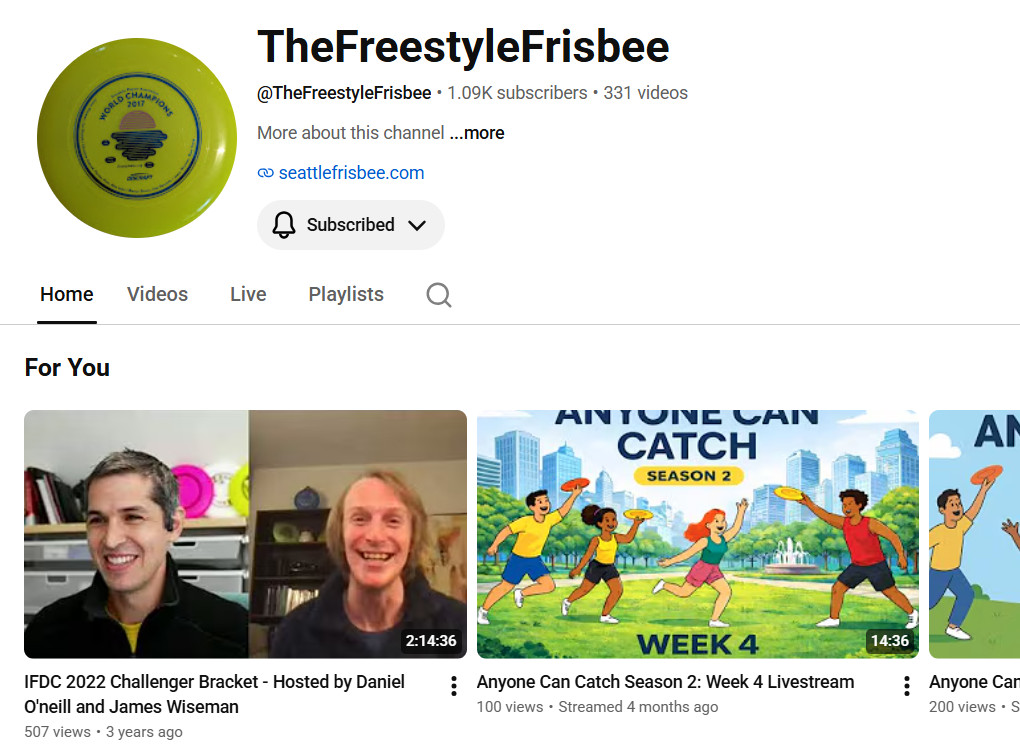
If the drills in this chapter have you hungry for more, there is a whole world of disc artistry waiting for you. The Freestyle Frisbee YouTube channel is one of the best places on the entire internet to fall down that rabbit hole, and I cannot recommend it enough.
Freestyle frisbee is the art of catch and throw turned into pure creativity. Before a player catches the disc, they perform a trick, sometimes a simple tip to an under the leg catch, sometimes a jaw dropping sequence of rolls and spins that looks like magic. It is the most beautiful, expressive corner of the entire disc world.
Much of this channel grew out of the Spread the Jam Project, a video campaign funded by the Freestyle Players Association to introduce the world to the sport. The result is a library of gorgeous, well edited videos featuring some of the best freestylers alive, players like Ryan Young, Jake Gauthier, and James Wiseman. The editing and the music make these videos a joy to watch even if you never pick up a disc yourself.
At the heart of nearly everything they do is the nail delay, which is the freestyle name for spinning the disc on your fingernail and keeping it balanced there while it rotates. Sound familiar? It is a close cousin of the Hula Hoop Drill you just learned. Once a freestyler masters the delay, they build everything else on top of it: rolls across the body, brushes that bat the disc back into the air, tips, pulls, and an endless vocabulary of creative catches.
You do not need to become a competitive freestyler to benefit from watching. Every move you study teaches your hands something new about how the disc moves through the air and across your body. And honestly, it is just inspiring. Watching what is possible with a spinning disc will make you fall in love with this sport all over again.
So please, go give them a follow and help spread the jam. youtube.com/@TheFreestyleFrisbee
Tipping the Disc to Yourself
This is the closest thing to juggling a soccer ball that exists in the disc world, and it is a perfect place to start.
The idea is simple. Throw the disc up with a push pass or a gentle backhand so it spins above you. As it comes back down, instead of catching it, tap the very center of the bottom of the disc with the tip of your finger. Push it straight back up. It pops up, spins, floats back down, and you tip it again usually with your middle finger, index finger, and ring finger close together. And again. And again. See how many tips you can get before the spin runs out and the disc wobbles away from you.
I highly suggest using a softdisc if you are new to frisbee because this can hurt your fingers.
A few tips to make this work. First, give the disc a lot of spin on the initial throw. A fast spinning disc is stable and predictable. It comes down flat and sits on your fingertip for a clean tip. A slow spinning disc wobbles and drifts and becomes nearly impossible to tip cleanly. Second, stabilize your tipping finger by pressing your thumb against it or bracing it with another finger. Tipping a spinning disc directly on the tip of your index finger can sting after a while, especially with a hard disc. That brace gives your fingertip support. Third, aim for the exact center of the disc. Off center tips send the disc tumbling sideways.
Start with one or two tips in a row. Then try for three. Eventually the spin will run out and the disc will get too wobbly to tip cleanly. When that happens, catch it, throw it back up with fresh spin, and start again. It is a simple, addictive little game with yourself that builds hand eye coordination, timing, touch, and an intuitive feel for how a spinning disc behaves.
The Nail Delay
If tipping is like juggling a soccer ball, the nail delay is like balancing a spinning plate on a stick. It is the signature move of freestyle frisbee, the trick that defines the entire sport, and it is extraordinarily difficult.
The nail delay is spinning the disc flat and horizontal on your fingernail. Not on the rim like the Hula Hoop Drill. Not tipping it up and down. Balancing it, spinning, on the very tip of your fingernail while it rotates smoothly above your hand. Khalif El-Salaam says he practices this with pillows, just to feel the balance point. That tells you something about both the difficulty and the value.
The freestyle community invented the nail delay in 1974, and within a few years over a million people worldwide had learned to do some version of it. It is the foundation of modern freestyle frisbee. Everything else in the sport, the body rolls, the leg passes, the under the arm sweeps, they all build off the ability to delay the disc on your fingernail and control it there.
I will be honest with you. I cannot do a clean nail delay. I have tried many times. I know only a handful of people who can do it well, including my friend Jimmy and Khalif. It is one of the hardest individual disc skills in existence.
But here is why I am including it: even attempting the nail delay builds disc feel and finger sensitivity that nothing else can replicate. Spending five minutes trying to balance a spinning disc on your fingertip, even if you fail every time, teaches your hands something about the disc's center of gravity, its spin axis, and its relationship with the air. That knowledge transfers to catching, to throwing, and to reading discs in flight. You do not have to master the nail delay for it to make you a better Ultimate player. You just have to try it.
Freestyle Moves Worth Trying Solo
Freestyle frisbee has been a competitive sport since the early 1970s, and in that time players have invented an incredible vocabulary of moves. You do not need to become a competitive freestyler to benefit from trying a few of these. Think of them as stretching exercises for your disc creativity. Each one teaches your body something new about how the disc moves, and that newness is what sparks growth.
The Chest Roll (Body Roll). Start with the disc on the outer edge of one hand, held slightly above your opposite shoulder. Tilt your arms so your starting hand is higher than your receiving hand. Let the disc roll off your fingertips, across your chest (or the back of your neck if you are brave), and down to the other hand. The disc rolls on its rim across your body like a wheel rolling across a table. It looks beautiful when it flows smoothly, and it teaches you an entirely different relationship with the disc's rim than any throw or catch. Start slow. It takes practice to get the tilt angle right so the disc rolls instead of falling.
The Under the Arm Sweep. With the disc spinning on a delay or just after a catch, sweep it under your arm from one side to the other. Twist your wrist and arm so the disc travels under your bicep and comes out the other side. This is a rim delay move in freestyle, where the disc stays on your fingernail the entire time, but you can practice the arm movement even without a perfect delay. Just getting your arm comfortable with that twisting motion while holding a disc builds coordination and flexibility.
The Leg Pass. Kick the disc from under your leg up to your hand. Or delay the disc on your finger, lift your leg, and pass the disc under it to your other hand. This is one of those moves that looks wildly impressive to anyone watching and is actually achievable with a few days of practice. The under the leg catch is one of the most popular freestyle catches for a reason: it is the gateway drug to thinking creatively about where the disc can travel relative to your body.
The Behind the Back Catch. Throw the disc in front of you, step forward, and reach behind your back to catch it under the rim with your hand. This requires good timing but is one of the most achievable "wow" catches for a non freestyler. Practicing it solo teaches you to track the disc without looking at it, which is a valuable game skill.
The Air Brush. Instead of catching a flying disc, strike it on the outer edge with the palm of your hand or your foot to redirect it back into the air. You are batting the disc mid flight without catching it. This works best into the wind, because the wind helps keep the disc floating after you brush it. It is a spectacular looking move and it builds a completely different kind of hand eye coordination than catching does.
The Freestyle Players Association (freestyledisc.org) has an entire moves library with video demonstrations of hundreds of tricks, from beginner to world championship level. If any of the moves above spark your curiosity, go down that rabbit hole. You will find moves with names like the Flamingo, the Scarecrow, the Gitis, and the Bad Attitude. Each one is a creative expression of what is possible with a spinning disc and a human body. And every one of them will make your hands smarter.
Disc Golf as Cross Training
If you have never played disc golf, you are missing one of the best cross training opportunities for Ultimate players. And it is usually free.
Disc golf courses are everywhere. Most public parks with a course charge nothing to play. You show up with a few discs (you can even use your UltraStar, though disc golf discs fly differently) and you play 9 or 18 holes in about an hour. It is a complete solo training session disguised as a walk in the park.
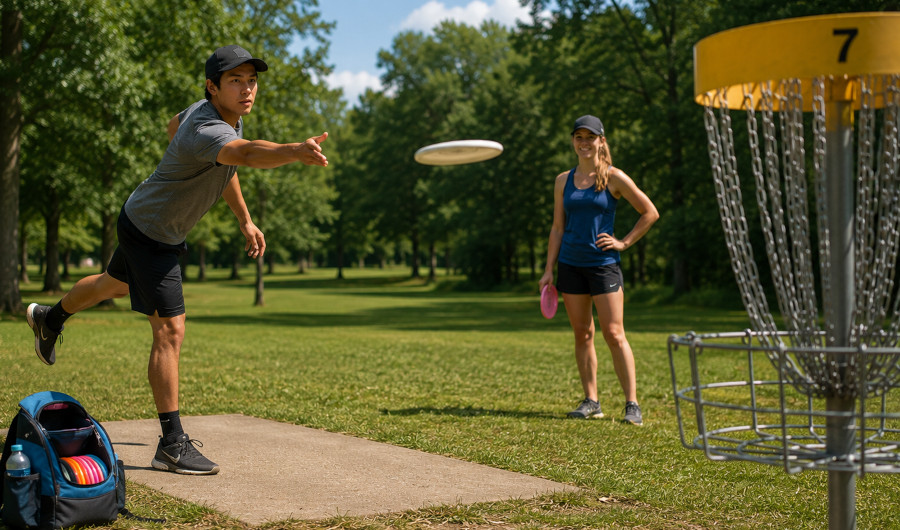
What disc golf teaches you that translates directly to Ultimate is touch. In disc golf, you are not just throwing as hard as you can. You are trying to land the disc into a metal basket. Think about what that requires. You have to control your distance precisely. You have to account for wind. You have to choose the right release angle so the disc fades toward the basket instead of away from it. You have to throw with enough spin to be stable but not so much power that you overshoot.
That is exactly what a great handler does in Ultimate. The best throwers do not just throw hard. They throw soft when there is time, so the receiver is guaranteed to catch it. They land the disc into their teammate's hands the same way a disc golfer lands the disc into the basket. Gently. Precisely. With touch.
David Lingua confirms that the mechanics of disc golf overlap significantly with Ultimate hucks and pulls. The hip rotation, the shoulder turn, the wrist snap, the release angle, they are all there. Every round of disc golf is an hour of throwing practice that develops your accuracy, your distance control, and your ability to read how the wind affects a disc in flight.
Fun Is the Foundation
I want to be very direct about something. If you dread your solo practice sessions, you will stop doing them. It does not matter how effective the drills are. It does not matter how much you want to improve. If the process feels like a chore, it has an expiration date. You will find excuses. You will skip days. You will eventually quit.
But if you love your solo sessions? If they are the part of your day you look forward to? Then you will never stop. You will practice in the rain. You will practice at midnight. You will practice on vacation. Not because you are disciplined, but because you genuinely want to.
That is why this chapter exists. Not every session needs a stopwatch and a rep count. Sometimes the best training you can do is spend 20 minutes messing around with a disc in your backyard with no plan, no structure, and no goal other than having fun.
The reps still count. The muscle memory still builds. Your fingers still get stronger. Your catches still get cleaner. The learning happens whether you are tracking it or not. The difference is that you are smiling while it happens.
Closing Part II
This chapter marks the end of Part II: Solo Drills. Over the last six chapters, you have built an entire toolbox of skills that you can practice alone, anytime, anywhere.
You can hold the disc and flow through a martial arts inspired choreography of slashes, spins, and crossovers. You can lie on your back and throw 300 Gravity Flicks against gravity. You can stand in your kitchen and toss the disc to yourself in six different ways. You can go outside, throw into the wind, skip discs off pavement, and launch pulls across an entire field. You can test your ambidexterity with the Dual Flick and train your off hand to close the gap. And now you can play. Freestyle, disc golf, Dodgebee Tag, trick shots, and games you make up yourself.
That is a complete solo practice system. From fingers to field. From beginner to legend. And you built it yourself, one chapter at a time.
The rest of this book goes deeper into throwing mechanics, the kinetic chain, pulling technique, body training, and how to measure your progress. But the drills in Part II are the engine. They are what you do every day. They are the reps that stack up. Everything that follows makes those reps more effective, but the reps themselves live here.
Come back to these chapters often. :)
Wrap Up
◆ Fun is not a distraction from improvement. It is the engine of improvement. When you are relaxed and enjoying yourself, your body learns faster.
◆ Tipping the disc to yourself is the disc version of juggling a soccer ball. It builds hand eye coordination, timing, and touch. See how many tips you can get before the spin runs out.
◆ The nail delay is the hardest individual disc skill in existence. Even attempting it builds disc feel that transfers to Ultimate.
◆ Freestyle moves like the chest roll, leg pass, air brush, and under the arm sweep teach your body new relationships with the disc that structured drills cannot.
◆ Disc golf is the best cross training for Ultimate throwers. It teaches touch, accuracy, and the soft "landing the disc into the basket" skill that great handlers use.
◆ Invent your own games and trick shots. Curiosity and creativity build the adaptability that makes you unguardable on the field.
Action Steps
→ Throw a disc up with a lot of spin and try tipping it back up with your fingertip. See how many tips you can get in a row. Write down your best number and try to beat it next week.
→ Attempt a nail delay. Just once. Throw the disc up spinning and try to let it land on your fingertip. See what happens. No expectations.
→ Try a chest roll. Start with the disc on one hand above your shoulder and let it roll across to the other hand. It will fall the first several times. That is part of the fun.
→ If there is a disc golf course near you, play a round this week. Just nine holes. Pay attention to how the throwing mechanics feel compared to your Ultimate throws.
→ Spend 20 minutes this week just messing around with a disc. No plan. No reps. No timer. Just play.
Mentor's Closing
When I watch my sons Luke and Eric play with a disc, they are not thinking about finger push percentages or wrist snap mechanics. They are throwing it on the roof and seeing if it rolls back down. They are trying to skip it across the driveway. They are inventing rules to games that only make sense to them. And they are getting better every single time.
Somewhere along the way, a lot of us forgot how to play like that. We turned practice into work. We turned reps into obligations. We turned the disc from a toy into a tool.
It is both. It has always been both. And the players who remember that, the ones who still feel a little rush of joy when a disc floats perfectly into their hands, are the ones who play the longest and improve the most.
You have all the drills now. You have the structure. You have the progressions. But do not forget to put the structure down sometimes and just throw a disc at a tree to see if you can hit it. That is where the love lives. And love is what keeps you coming back.
Part II is complete. You are ready for everything that comes next. :)