
Think about the last time you tried to teach someone something that comes naturally to you. Maybe it was tying a knot, or whistling with your fingers, or skipping a stone across a pond. You did it effortlessly, and then your friend asked, "How did you do that?" And you stood there, stumped, because you could not break it down into steps. You just... did it. Your dominant hand has been doing it for so long that the knowledge lives in your muscles, not in your words.
Now think about the last time you learned something new with your non dominant hand. Writing your name with your left hand (if you are right handed). Brushing your teeth on the other side. Suddenly every tiny motion requires your full attention. Every movement is deliberate. You feel clumsy and slow. But you also feel something else: you understand the mechanics in a way you never did when your dominant hand was doing all the work on autopilot.
That is exactly what Alex, a professor and one of the best handlers at our DC area pickup games, was describing in that opening quote. When you train your off hand, you are not just building a backup throwing arm. You are rebuilding your understanding of how throwing works from the ground up. You become a better player AND a better teacher, because you just went through the struggle of figuring it out all over again.
This chapter is about walking a path that most Ultimate players never walk. It is the Legend path. And it starts with a simple question: what if both of your hands could throw?
Why This Matters More Than You Think
Imagine you are in a game. You have just caught the disc on the left side of the field. Your best cutter is streaking deep on the left sideline. The throw is a simple flick to open space. But you are right handed. To throw a right handed flick to the left side, you have to pivot, reposition your entire body, and reset your throwing lane. That takes time. Maybe one and a half seconds. Maybe two.
In Ultimate, one and a half seconds is an eternity. Your cutter has already run past the window. The defender has closed the gap. The throw that was wide open a heartbeat ago is now covered.
But if you could throw a lefty flick? You catch the disc and it is already on your left side. No pivot. No repositioning. Just catch and throw. The disc is in the air before the defender even registers what happened. One and a half seconds saved. The point scored.
That is not a hypothetical. That is what ambidextrous play looks like in a real game. It is a time advantage that compounds on every single possession. And almost nobody in the sport has developed it.
The Soccer Parallel
Think about soccer for a moment. Every serious soccer player trains their weak foot. It is not optional. A forward who can only shoot with their right foot is predictable. Defenders know which way to push them. Goalkeepers know which side to cheat toward. But a forward who can finish with either foot? They are a nightmare to defend because you cannot take away one side without giving up the other.
Ultimate Frisbee has not caught up to this idea yet. The current culture treats ambidextrous throwing as a novelty, a party trick, something that elite players might dabble in but that regular players do not need to worry about. I believe that is going to change. I believe that in ten or twenty years, serious Ultimate players will train both hands the same way serious soccer players train both feet. It will become a fundamental expectation, not an advanced curiosity.
You have the opportunity to be ahead of that curve right now. While everyone else is perfecting their right hand, you can be building something they do not have. And when they finally realize they need it, you will already be there.
Even the Best Have Limits
Khalif El-Salaam is a six time World Champion. He is one of the most decorated Ultimate players alive. When I talked with him about his throwing arsenal, he told me he uses a lefty backhand to throw to space on his non dominant side. But he does zero lefty forehand. None. A six time World Champion does not throw a lefty flick.
That is not a criticism of Khalif. He has won six World Championships doing what he does. But it tells you something important: the ceiling for ambidextrous play in Ultimate is incredibly high, and even the best players in the world have barely started climbing it. There is room up there. A lot of room. And the drills in this chapter are the ladder.
The Embarrassment Factor
Let's be honest about something. The reason most players never develop their off hand is not physical. It is emotional. It is embarrassing.
You are at a pickup game. You are a solid player. People know you can throw. And then you try a lefty flick and it wobbles pathetically into the ground two feet in front of you. Someone chuckles. You feel your face get warm. And you think, "I am never doing that again in public."
That moment kills more ambidextrous potential than any physical limitation ever could.
This is why solo practice exists. This is why Chapter 1 talked about the private practice advantage. When you are alone in your backyard, nobody is watching your lefty flick wobble. Nobody is judging your left hand Gravity Flick. Nobody sees your left hand Hula Hoop drill fall apart after eight seconds. That privacy is not just convenient. It is essential. It is the safe space where your weak hand gets to be weak without consequence, so that it can slowly, quietly, become strong.
If you have been doing the drills in this book with both hands (and I hope you have), your off hand has already been building strength and coordination for several chapters now. The Hula Hoop Drill on your non dominant hand has been strengthening those fingers. The Gravity Flick with your off hand has been building that wrist snap. The standing self-throws have been giving your weak hand real reps.
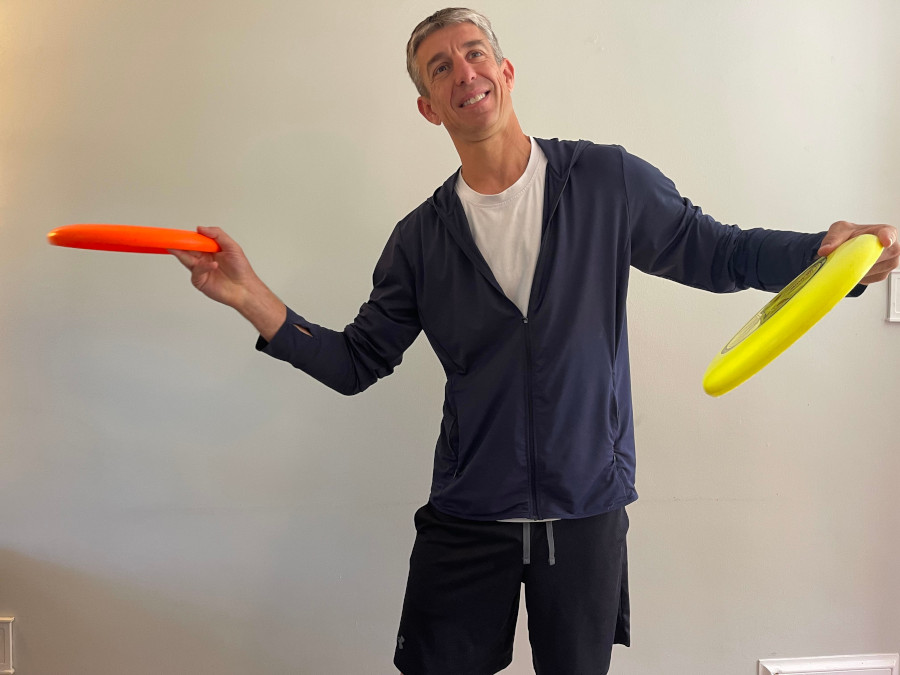
This chapter takes all of that foundation work and points it in one direction: throwing with both hands on a field, measuring your progress, and closing the gap between your dominant and non dominant side.
The Dual Flick Drill Family
I created three drills that work together as a system. The first one is a test. The second one is the training. The third one is the challenge that sits at the very top of the mountain. Nobody else teaches these drills. They are original to this book, and I believe they are the most effective ambidexterity training tools that exist in Ultimate Frisbee.
Think of them like a doctor's visit for your throwing. The first drill takes your temperature. The second drill is the treatment plan. The third drill is the goal you are working toward.
Mode 1: The Simultaneous Launch (The Test)
This is the exam. You do not practice this drill. You take it. Monthly, or whenever you want to check your progress.
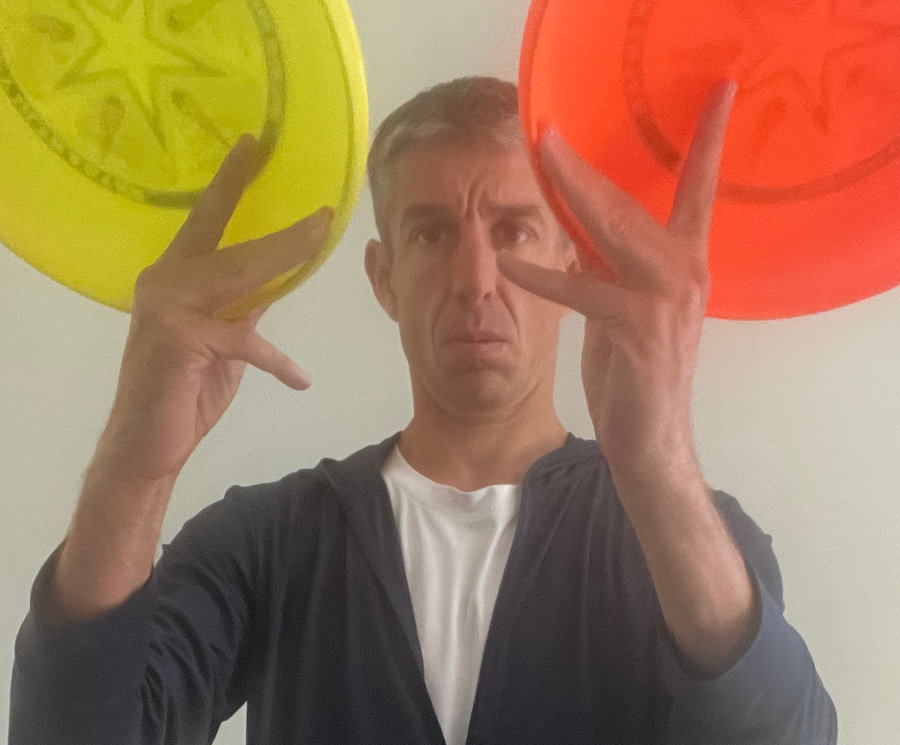
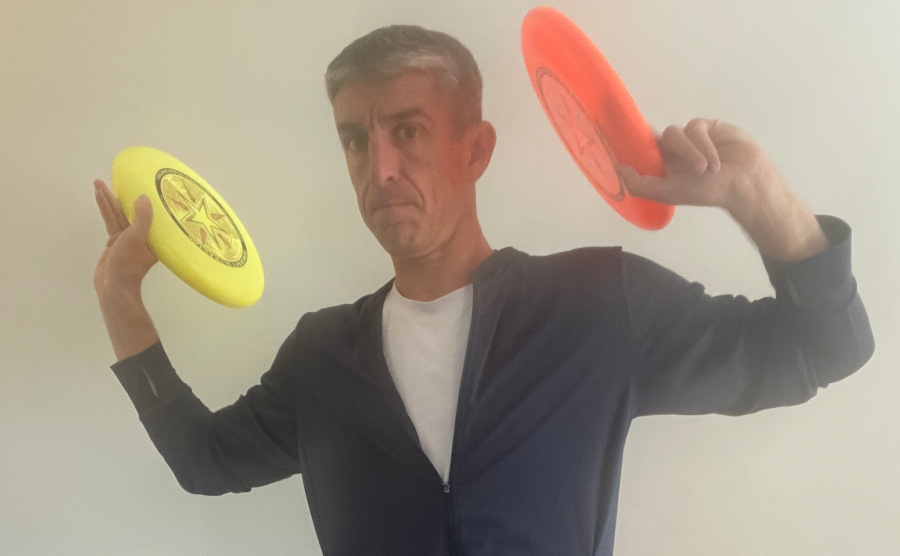
What you do: Hold a disc in flick grip in your right hand. Hold another disc in flick grip in your left hand. Stand in an open field with space in front of you. Now release both discs at the exact same time, side by side, aiming straight ahead.
Then watch.
What the flight paths tell you:
If the two discs fly in an X pattern, crossing into each other's paths, your off hand is weaker and pulling the disc toward your dominant side. The X pattern means there is a significant gap between your two hands. This is where most people start.
If the two discs fly in a V pattern, diverging away from each other, your off hand has some power but not accuracy. It is pushing the disc out instead of sending it straight. The V means you have strength on both sides but not control.
If the two discs fly in parallel lines, same speed, same distance, same trajectory, no wobble, like two railroad tracks stretching into the distance... that is true ambidexterity. That is the Legend tier. That means both of your hands are throwing with equal power, equal spin, and equal control.
The visual progression over months of training looks like this:
Beginner: Your off hand cannot throw at all. One disc sails and the other plops into the dirt.
Intermediate: Obvious X pattern. Your off hand throws, but it curves hard toward your dominant side.
Advanced: The X tightens. The lines are getting closer to parallel. Your off hand is catching up.
Legend: Parallel railroad tracks. Both discs fly the same path, the same distance, with the same spin. You have arrived.
Take this test once a month. Do not practice it. Just test it. The daily training happens in Mode 2.
Mode 2: The Staggered Launch (The Training)
This is the daily drill. This is where the real work happens. And it is one of the most satisfying drills in this entire book once you get the rhythm.
Think of it like a musician practicing scales with both hands on a piano. One hand leads, the other follows, and over time they learn to work together in harmony.
What you do: Hold a disc in your off hand (left hand if you are right handed) in flick grip. Also have a disc ready in your dominant hand. Now fire your off hand first. Throw it high and floaty, about 30 yards out. A gentle lob.
Watch it. For one and a half to two seconds, just watch the trajectory. Read where it is going to land. Feel the arc.
Now fire your dominant hand. Full power. Aim to land your dominant hand disc in the exact same spot as your off hand disc, at the exact same time. Both discs touching down together.
Grab two more discs. Boom boom. Two more. Boom boom. Six to eight discs total, thrown in rapid pairs.
Why this works so beautifully: Every pair of throws trains multiple skills at once. Your off hand gets a real throw at real distance. Your dominant hand practices pinpoint accuracy to a live, moving target (the off hand disc in the air). Your eyes learn to read trajectory in real time. And the rhythm of boom boom, boom boom creates a flow state where your body starts to figure things out that your conscious mind could never teach it.
The progression is about the landing gap:
→ Landing within 10 feet of each other: you are getting the timing.
→ Landing within a body length: your accuracy is dialing in.
→ Landing on top of each other: you are operating at an elite level.
Do this drill two or three times a week. Bring six to eight discs to a field. Throw them all in pairs. Collect. Repeat. Each session takes maybe 15 minutes. The improvement over weeks and months is remarkable.
Mode 3: The Target Strike (The Legend Challenge)
I almost hesitate to include this one because it sounds impossible. But it is the peak of the mountain, and you deserve to know it is there.
The Target Strike is this: throw the off hand disc up in the air. Then throw the dominant hand disc and try to actually hit the off hand disc while it is airborne.
Hit a flying disc with another flying disc. In mid air. On purpose.
Yes, this is absurdly hard. I have done it exactly a handful of times and each time it felt like a small miracle. But that is the point. It is the ultimate accuracy test. It is the thing that sits at the top of the ambidexterity mountain and says, "Come and get me."
You may never hit it. That is fine. But the act of trying, of aiming your dominant hand throw at a moving target in the sky and getting close, will sharpen your accuracy in ways that no stationary target ever could. A trash can does not move. A disc in the air does. Training against a moving target raises the bar for everything.
Your Daily Off Hand Routine
The Dual Flick drills are your main ambidexterity training, but they require a field and multiple discs. Here is what you should be doing every single day, in addition to those field sessions, to build your off hand.
You already know these drills. You have been doing them with your dominant hand throughout this book. Now commit to doing every one of them with your non dominant hand, for at least five minutes per session.
The Hula Hoop Drill. Your off hand fingers need the same centripetal force training as your dominant hand. When I started doing the Hula Hoop on my left hand, the disc would fly off after a few seconds. My fingers were weak and uncoordinated. After months of daily practice, I could sustain it for minutes. And my left hand flick improved dramatically because of it. The strength transfer is direct and undeniable.
The Gravity Flick. Lie on your back and throw with your off hand. 100 reps. It will feel awkward at first. Your release point will be different. The disc will go sideways more than up. That is okay. Every rep is a conversation between your off hand and the disc, and each conversation gets a little smoother.
Wall throws. Throw with your off hand at the wall. Start close. Focus on a flat release and good spin. The wall does not care which hand you use. It throws back the same either way.
Push passes. Your off hand push pass will develop faster than your off hand flick because the push pass requires less wrist snap strength. This gives your off hand an early win, and early wins matter for motivation.
Track your progress. How far can your left hand throw this week compared to last week? Keep a simple log. Distance, accuracy, wobble. Seeing the numbers improve, even slightly, keeps you going on the days when your off hand feels hopeless.
Ben Wiggins, in his Zen Throwing program, includes an exercise called Off Leg Pivots. You pivot deep, low, and powerfully on your non throwing leg. This evens out the strength distribution in your lower body and prevents the kind of asymmetric injuries that come from always pivoting on the same side. Add this to your routine. Your body should be as balanced as your throwing.
The Long View
Ambidexterity is not a project you finish in a week. It is not even a project you finish in a season. It is a slow, patient process that unfolds over months and years. Your off hand will feel useless for a long time. It will throw wobbly discs that make you wince. It will drop the Hula Hoop after five seconds when your dominant hand can sustain it for five minutes.
That gap is discouraging. I know. I have lived it.
But here is what I also know: the gap closes. Not fast. Not dramatically. But steadily. One week your left hand throws 10 yards. A month later, 15. Two months later, 20. And one day, you are at a pickup game, and the disc is on your left side, and without thinking about it, you throw a lefty flick to an open cutter and it gets there. Clean. No wobble. No hesitation.
And your defender's face tells you everything you need to know. They did not see that coming. Nobody did. Because nobody else put in the work.
That moment is worth every awkward, frustrating, wobble throwing minute you spent alone in your backyard. I promise you that.
Wrap Up
◆ Ambidextrous play is the Legend tier skill. It saves 1 to 1.5 seconds on every throw from your non dominant side, which is an eternity in a fast game.
◆ The current Ultimate culture undervalues weak hand development. This will change. Be ahead of the curve.
◆ Solo practice removes the embarrassment of training your weak hand in public. Privacy is where ambidextrous players are built.
◆ The Simultaneous Launch is your monthly test. Two discs, two flight paths: X pattern means keep working, parallel lines means you have arrived.
◆ The Staggered Launch is your main training drill. Off hand fires first, dominant hand fires to match. Boom boom. Six to eight discs in rapid pairs.
◆ The Target Strike is the Legend challenge. Hit an airborne disc with another disc. It sounds impossible. It is almost impossible. Try it anyway.
◆ Every solo session, five dedicated minutes with your off hand. Hula Hoop, Gravity Flick, wall throws, push passes. Track your progress weekly.
Action Steps
→ This week, take the Simultaneous Launch test. Two discs, both hands, same time. Observe the flight paths. Are they X, V, or parallel? Write it down. That is your baseline.
→ Bring six discs to a field and try the Staggered Launch. Off hand fires first, dominant hand fires to match. Do three rounds. Feel the rhythm.
→ Commit to five minutes of off hand practice in every solo session from today forward. Set a timer if you need to.
→ Try the Hula Hoop Drill on your non dominant hand right now. Time how long you can sustain it. Write that number down. Check it again in a month.
→ If you are feeling brave, try the Target Strike. Once. Just once. See how close you get.
Mentor's Closing
When I started training my left hand, it felt like learning to write with my feet. Everything was backwards. Everything was clumsy. I dropped discs. I threw them into the ground. I laughed at myself a lot.
But I kept going. Five minutes a day. Hula Hoop on my left index finger. Gravity Flicks with my left wrist. Wall throws with my left hand leading. And slowly, very slowly, my left hand started to understand what my right hand had known for years.
I am not there yet. I may never throw a lefty flick as well as my right handed one. But I throw it well enough to surprise people. Well enough to score. Well enough to make my defender think twice about which side to take away.
And that started with a simple decision: five minutes a day, with my weak hand, when nobody was watching.
You can make that same decision right now. :)