
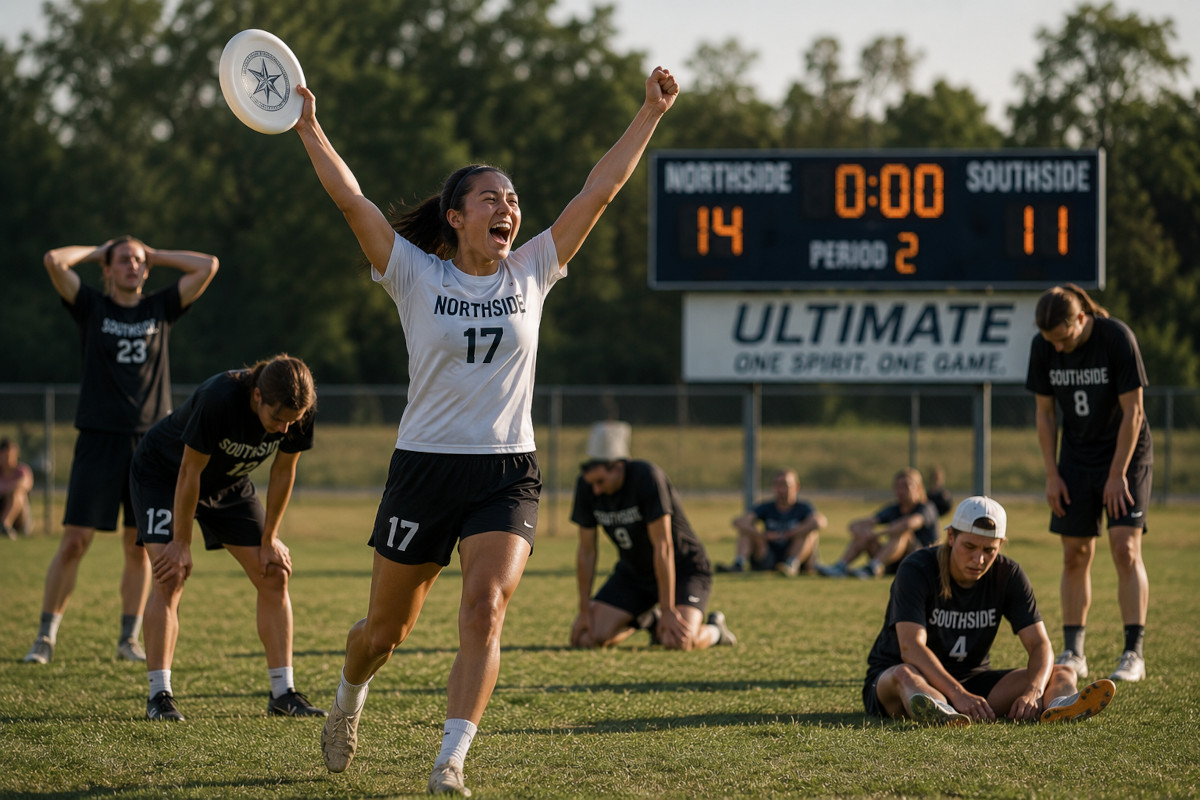
You have spent the entire book so far training your hands. Your fingers, your wrist, your grip, your release, your spin, your kinetic chain. All of that work is real and it matters enormously. But here is a truth that nobody wants to hear: the most beautiful throw in the world means nothing if you are bent over with your hands on your knees gasping for air on point 12 of a tournament.
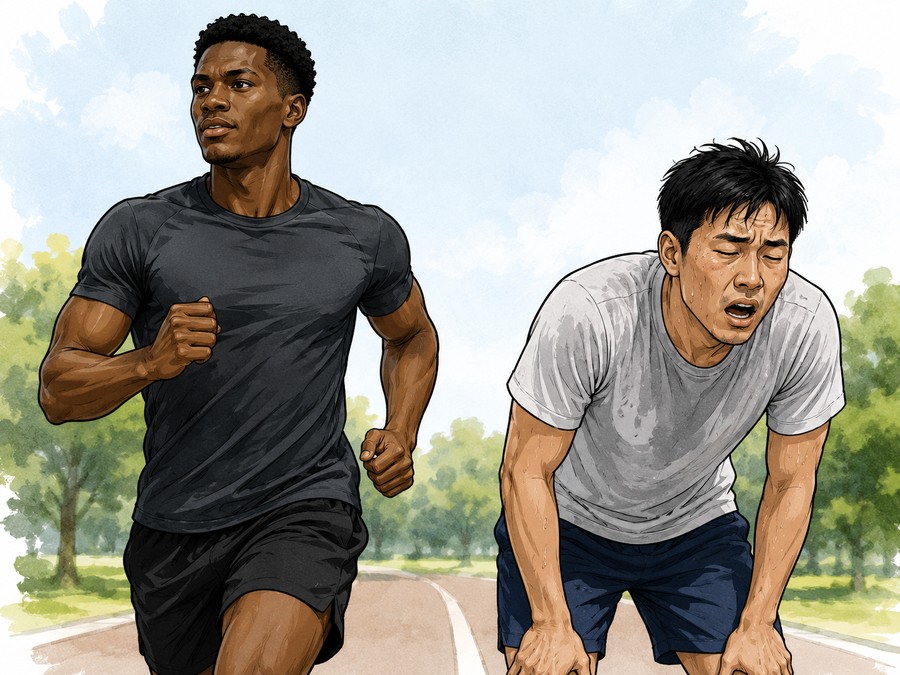
Your throws do not get tired. Your body does. And when your body gets tired, your throws fall apart anyway. Your grip loosens. Your wrist slows down. Your release point drifts. Your decision making gets foggy. You see the open cutter but your brain takes an extra half second to process it. You know the throw is there but your wrist does not snap the way it did an hour ago.
Fatigue does not just make your legs heavy. It makes your hands stupid.
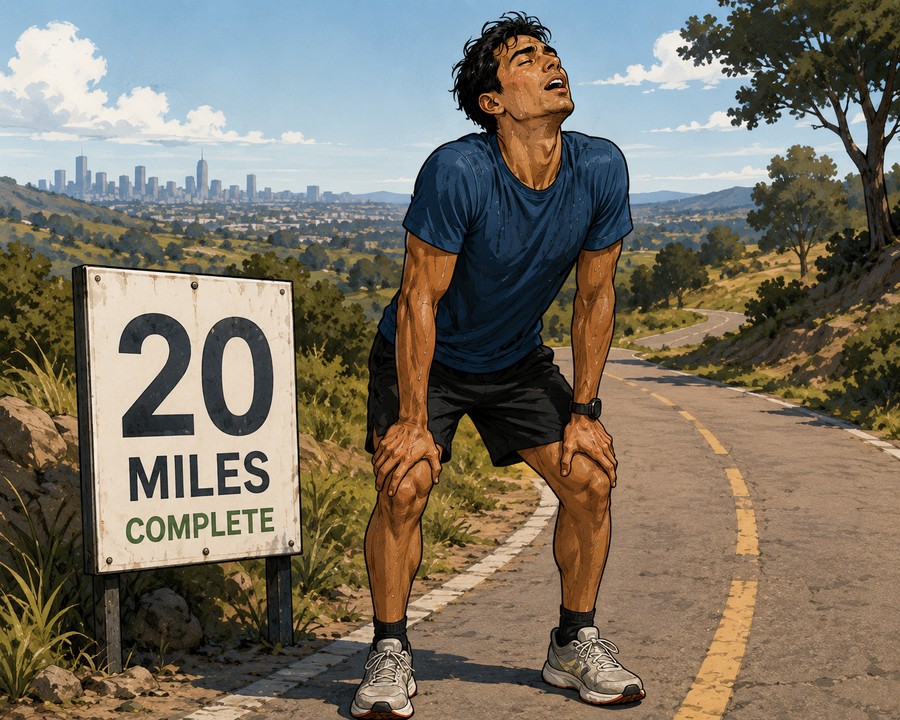
This chapter is about building the engine that carries your throws. The legs that get you open. The lungs that keep you running. The stamina that keeps your mind sharp when everyone else on the field is fading. Because the game is not won in the first ten minutes when everyone is fresh and excited. It is won in the last ten minutes when everyone is tired and the players who trained their bodies are the only ones still cutting hard and throwing clean.
What you do by yourself, alone, running stairs and sprinting in parks and doing shuttle drills in your backyard, directly correlates to how long you last in a game. There is no shortcut. The stamina you build in solo training IS the stamina you have on the field. Every solo run you skip is a point in the fourth quarter where your legs give out.
The Silent Killer
Fatigue does not announce itself. It creeps in. That is what makes it so dangerous.
You feel fine on point 1. Strong on point 5. Good on point 8. And then somewhere around point 10 or 11, something shifts. Your cuts are not as sharp. You are a half step slow to the disc. Your defender blows by you on a deep cut and you think, "I would have had that 30 minutes ago." You are right. You would have. But that was 30 minutes ago and your legs do not have those 30 minutes anymore.
Think of your stamina like the battery on your phone. At 100% everything works perfectly. At 50% things start to slow down. At 20% your phone starts shutting down apps to conserve power. Your body does the same thing. When your energy reserves drop, your body starts shutting down the "apps" it considers non essential. Quick decision making. Explosive first steps. Precise wrist snap. Those are the first things to go because your body is redirecting all remaining energy to just keeping your legs moving.
The players who dominate the last quarter of a game are not necessarily the most talented players on the field. They are the best conditioned. They are the ones whose phone is still at 60% when everyone else is at 15%. And that conditioning was built alone, on runs and stair sessions and sprint drills, long before game day.
How Ultimate Actually Works: Sprint, Rest, Sprint
Before you design your running program, you need to understand what Ultimate actually demands from your body. And it might not be what you think.
A study of 85 elite men's Ultimate points found that the average active play segment, the time the disc is in play before a stoppage, was just 21.2 seconds. 75% of all active play segments were 25 seconds or less. Then there is a brief pause. Then another burst.
Ultimate is not a marathon. It is hundreds of short sprints with brief recoveries. Like doing 200 meter dashes with 30 second breaks for two hours straight. Your body uses different energy systems for this kind of effort than it does for steady state jogging. It needs explosive power for those 20 second bursts and efficient recovery during the brief rest periods.
Tim Morrill, a Certified Strength and Conditioning Specialist who trains Boston's elite club teams Ironside and Brute Squad, puts it bluntly. His main conditioning workout is the 10 Cut Agility: ten 180 degree direction changes in around 30 seconds of sprinting, then 90 seconds of rest. Repeat twelve times. "Is that going to transfer to the field? Hell yea!" Morrill says. "Is riding a bike for 10 minutes or running five miles? Maybe, but not as dramatically."
The principle is clear: train the way you play. Sprint, rest, sprint, rest. Not jog, jog, jog.
A Personal Note About Long Runs and Swimming
Now, I want to be honest with you, because on this one I part ways with the research a little. I think long runs are super important, and I do them regularly. A 30 to 45 minute run clears my head, builds my aerobic base, and strengthens the joints and tendons that all that sprinting and cutting depends on.
But here is the real reason I believe in them, and I notice it every single time I play: endurance to last the whole game. In the fourth quarter, when everyone else's legs are turning to concrete, I am still moving close to full speed. I am stronger at the end of games than most people on the field, and I credit my long runs for that directly. Ultimate is a sprinting sport, yes. But the player who can still sprint in the final points wins the final points. The deep aerobic tank is what makes that possible, and long runs are how you dig that tank.
The conditioning experts are still right that sprint intervals transfer to the field most directly, and that work stays priority one. Do the sprint training. But do not let anyone tell you the long run is wasted time. It is the quiet engine behind late game legs.
And let me add one more endurance builder to the list: swimming. I swim for the same reason I run long, and it might be the most underrated training an Ultimate player can do. It builds that same deep endurance with zero pounding on your knees, ankles, and hips, which matters more every year you play. It works your shoulders, lungs, and core all at once. And on a recovery day after a long tournament weekend, nothing loosens up a beat up body like time in the water. Run long for your legs and your lungs, swim for your whole body, and sprint for the game. All three together are how you outlast everyone. Build your breath and breathing techniques during long runs and many laps.
The 20/40 Workout: The Simplest Solo Conditioning
If you want one workout that you can do anywhere, anytime, with zero equipment, this is it.
Run 20 seconds at 70 to 85% of your sprint speed. Walk 40 seconds. Repeat.
That is the entire workout. Start with 8 reps. Work your way up to 20 reps by adding 1 to 2 per week. The whole session takes about 15 to 20 minutes including your warmup.
This workout is simple to the point of being boring. But boring works. The speed is close enough to a sprint that your running mechanics are the same ones you use on the field. The effort is light enough and the duration long enough that you can actually pay attention to what your body is doing and improve your running form while you train. And the work to rest ratio mimics the game pattern: hard effort followed by recovery, over and over.
You can do this 3 to 4 times per week. I prefer keeping it moderately difficult and frequent rather than once a week and brutal. Consistency beats intensity. Always.
Sprint Drills You Can Do Solo
These drills simulate the actual demands of a game: explosive acceleration, sharp deceleration, and rapid changes of direction. Each one takes 10 to 15 minutes including rest. You need a field or park and a few cones (or shoes, water bottles, anything you can see on the ground).
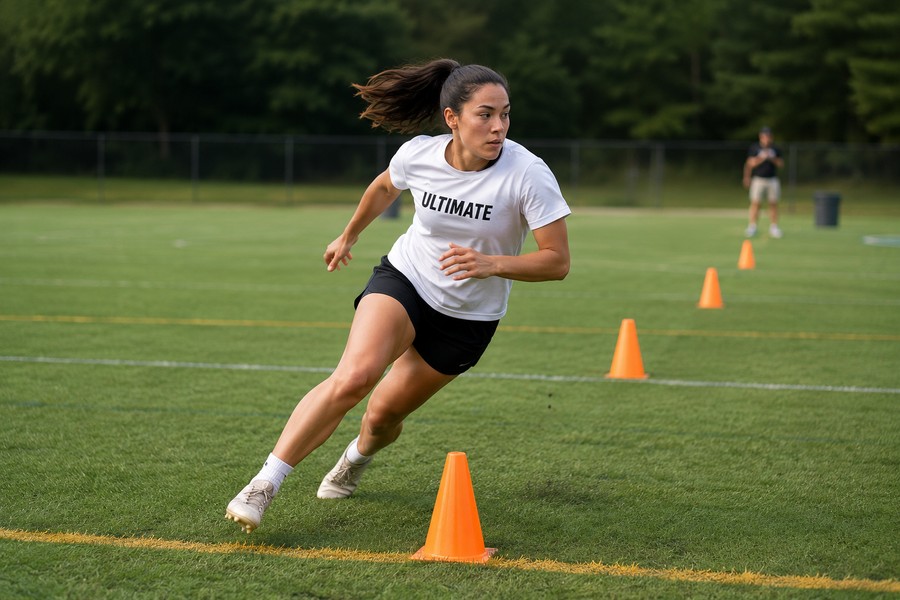
40 Yard Acceleration Sprints. Start in a three point stance (or just standing with one foot slightly ahead of the other). Sprint 40 yards at absolute maximum effort. Rest 90 seconds. Switch which foot starts forward. Repeat 6 times. This drill is about pure acceleration, getting to full speed as quickly as possible. That explosive first step is what gets you open on a cut or closes the gap on defense.
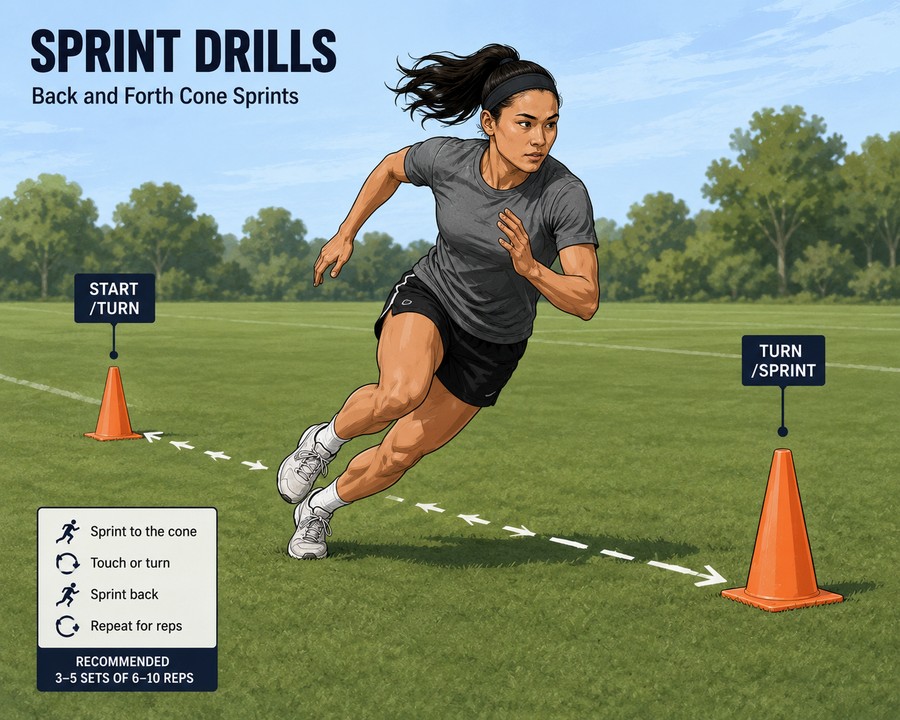
Shuttle Runs. Set up 3 cones in a straight line, 5 to 10 yards apart. Start at the middle cone. Sprint to the right cone, touch the ground. Sprint back to the middle cone. Sprint to the left cone, touch the ground. Sprint back to the middle. That is one rep. The constant direction changes simulate what you actually do during a point: sprinting one direction, planting, reversing, and sprinting another direction. 6 to 8 reps with 60 seconds rest between each.
Goose Cones (Tim Morrill). Space 5 cones in a straight line at 5 yard intervals. Start at the middle cone. Cut hard to the first cone in one direction. Plant, change direction, sprint past your middle cone to the next short cone. Plant again and go to the very end of the line. Plant one more time and sprint the full 20 yards to the opposite end. This is devastating. Your legs will burn. Your lungs will burn. And that is exactly what point 14 of a tournament feels like. 4 to 6 reps with 90 seconds rest.
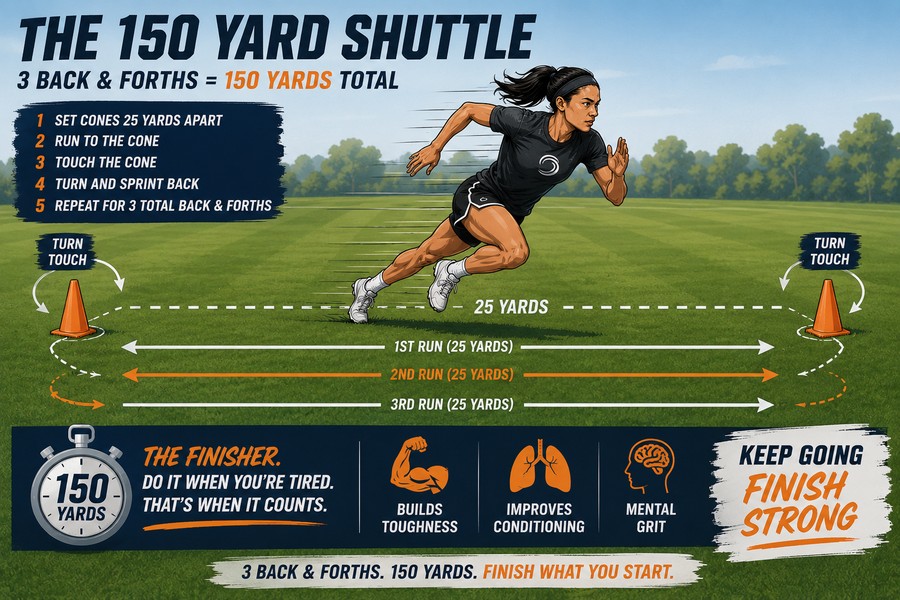
The 150 Yard Shuttle. Set a cone at each end of 25 yards. Run back and forth 3 times for 150 yards total. This is a finisher. Do it at the end of your sprint session when you are already tired. It builds the toughness to keep going when your body wants to stop, which is exactly what the last quarter of a game demands.
Cutting Drills Solo
Sprinting in a straight line is important, but Ultimate is not a track sport. You are cutting. Changing direction. Planting one foot and exploding the other way. These drills train the specific movement patterns that Ultimate demands.
Cone Cutting Drill. Set up 5 to 6 cones in a line, 5 to 10 yards apart. Sprint to the first cone. Make a sharp cut at 45 degrees or less. Do not round the turn. Plant your outside foot hard and explode in the new direction. Accelerate to the next cone and repeat. The tighter you slice around each cone, the sharper your cuts will be against a real defender. Rounded cuts are easy to follow. Sharp cuts create separation.
The Cutting Tree. Set up cones simulating real offensive cutting patterns: an in cut, a change of direction, a deep cut, another change. Sprint the pattern, making each turn at 120 degrees. One full cycle covers 60 to 75 yards. Do no more than 4 continuous cycles per rep. Between reps, do active rest: shuffle your feet in a ready stance, eyes up, just like you would when waiting your turn to cut in a real game. That active rest trains your body to stay engaged during the pauses between cuts, not to shut down and restart.
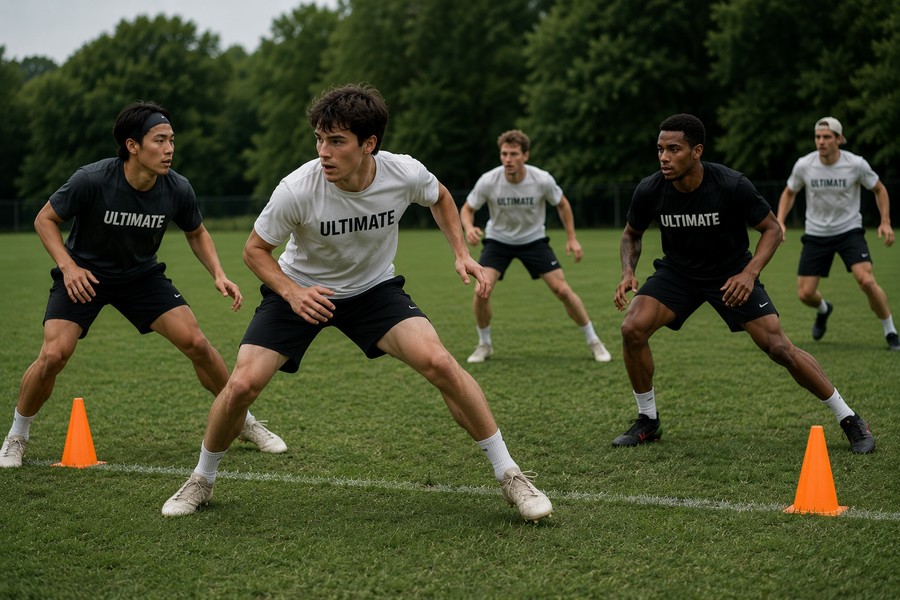
Serpentine Cuts. Set cones in a zigzag pattern. Sprint through them simulating under cuts, in cuts, and deep cuts. Work on keeping sharp angles, not sweeping turns. Think of each cone as a defender you are cutting around. The sharper the angle, the more separation you create.
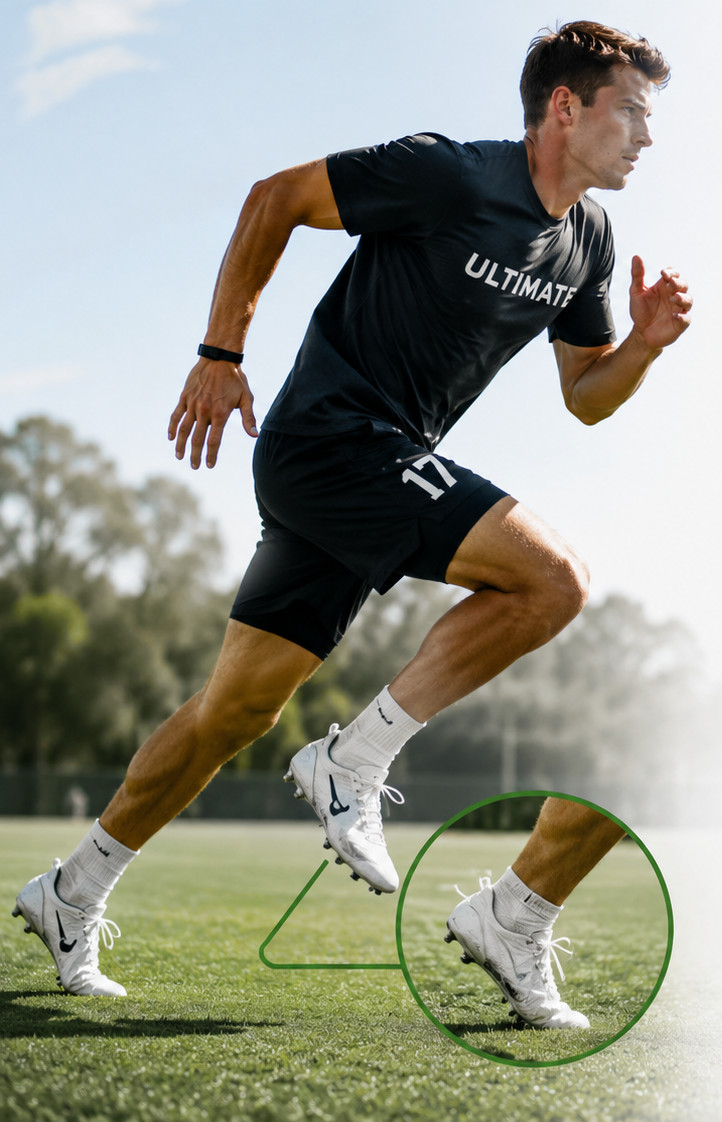
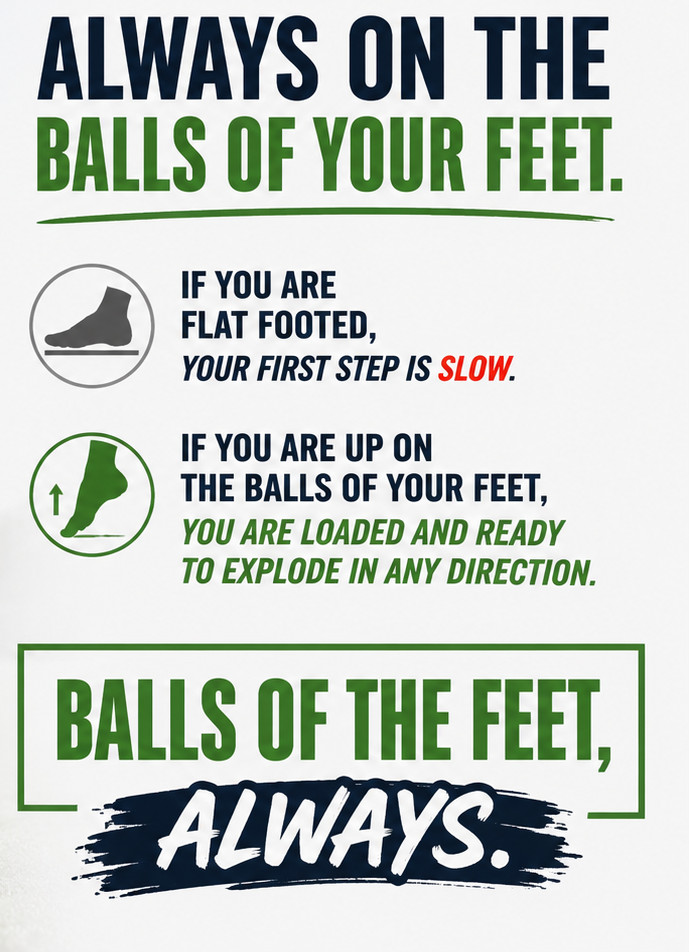
David Lingua's emphasis applies to every single one of these drills: always on the balls of your feet. If you are flat footed, your first step is slow. If you are up on the balls of your feet, you are loaded and ready to explode in any direction. Balls of the feet, always.
Defensive Footwork: Side Steps, Crossovers, and Backpedaling
This section might be the most important footwork training in this entire chapter, and it is the one that most solo practice routines completely ignore.
When you are on defense in Ultimate, you are not sprinting forward in a straight line. You are moving sideways. You are crossing over. You are backpedaling. You are doing all of these things while keeping your eyes on two things at once: the person you are guarding and the handler who has the disc. Your body is moving in one direction while your head is looking in another. That is an incredibly complex physical skill, and the only way to get good at it is to practice it.
Side Steps (Shuffle Steps). Set two cones 10 yards apart. Get in a low defensive stance, knees bent, weight on the balls of your feet. Shuffle sideways from one cone to the other without crossing your feet. Stay low. Stay light. Your feet should barely leave the ground, almost sliding across the surface. The key is keeping your ankles up. Dorsiflexion, which means pulling your toes up toward your shin so your foot is cocked and ready to push off instantly. When your ankle is droopy and your foot is flat, you are slow. When your ankle is up and your foot is loaded, you are lightning.
Shuffle to the right cone, shuffle back to the left cone. 10 reps. Then do it faster. Then do it with your hands up like you are guarding a mark. The goal is to be so comfortable moving laterally that you never have to think about it during a game. Your feet just go.
Crossover Steps. Same two cones, same 10 yards. But instead of shuffling, you cross one foot over the other as you move laterally. Your right foot crosses in front of your left foot, then your left foot steps out, then your right crosses in front again. This covers more ground per step than the shuffle and is what you use when your cutter makes a longer lateral move and you need to stay with them.
Crossover steps use different leg muscles than shuffling. They engage your hip flexors and your inner thighs in ways that forward sprinting never does. This is why defensive footwork is so tiring even when you are in great sprinting shape. Different muscles. Different demands. You have to train them specifically.
Practice crossing over to the right, then crossing over to the left. 10 reps each direction. Then mix it up: shuffle for 5 yards, crossover for 5 yards. Shuffle, crossover. That transition is what happens in a real game when your cutter changes speed and you have to switch footwork patterns instantly.
Backpedaling. Set a cone 15 yards behind you. Run backwards to it as fast as you can while staying balanced and controlled. Your weight should be slightly forward, not leaning back. Stay on the balls of your feet. Keep your head up, imagining you are watching the handler and your cutter at the same time.
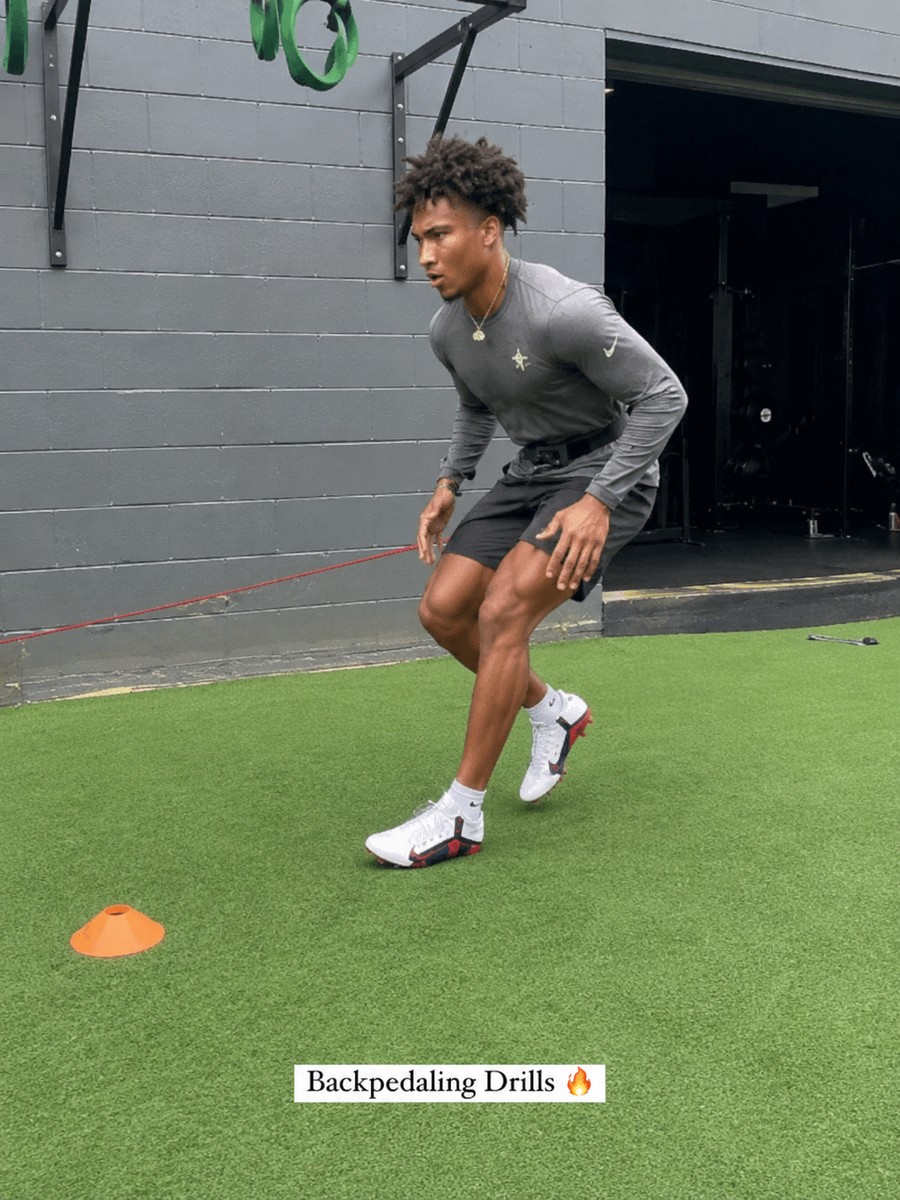
Backpedaling is essential for defense when your cutter is threatening deep. You need to give ground while staying in a position to react if they change direction. If you turn and sprint (which is faster), you lose sight of the disc. If you backpedal (which is slower but keeps you facing the play), you can see everything but your cutter might beat you deep. The best defenders can backpedal at high speed while reading the play, and then transition instantly to a forward sprint when they commit to chasing the deep cut.
The Backpedal to Sprint Transition. This is one of the most important solo drills you can do for defense. Set a cone 10 yards behind you and another cone 20 yards in front of you. Backpedal to the rear cone. The moment you touch it, explode forward into a full sprint to the front cone. That transition, from backward to forward at maximum speed, is the exact moment in a game when you read the deep cut and decide to turn and chase. Practice it until the transition feels seamless.
The Defensive Mixer. Set up 4 cones in a square, 10 yards apart. Start at one corner. Shuffle sideways to the next cone. Backpedal to the next cone. Crossover step to the next cone. Sprint forward to the start. That is one rep. You have used all four defensive footwork patterns in one continuous sequence. Do 4 to 6 reps, alternating which direction you go around the square. This builds the ability to transition fluidly between different footwork patterns, which is exactly what defense requires.
Stairs: Your Secret Weapon
This is not a workout. This is a lifestyle change.
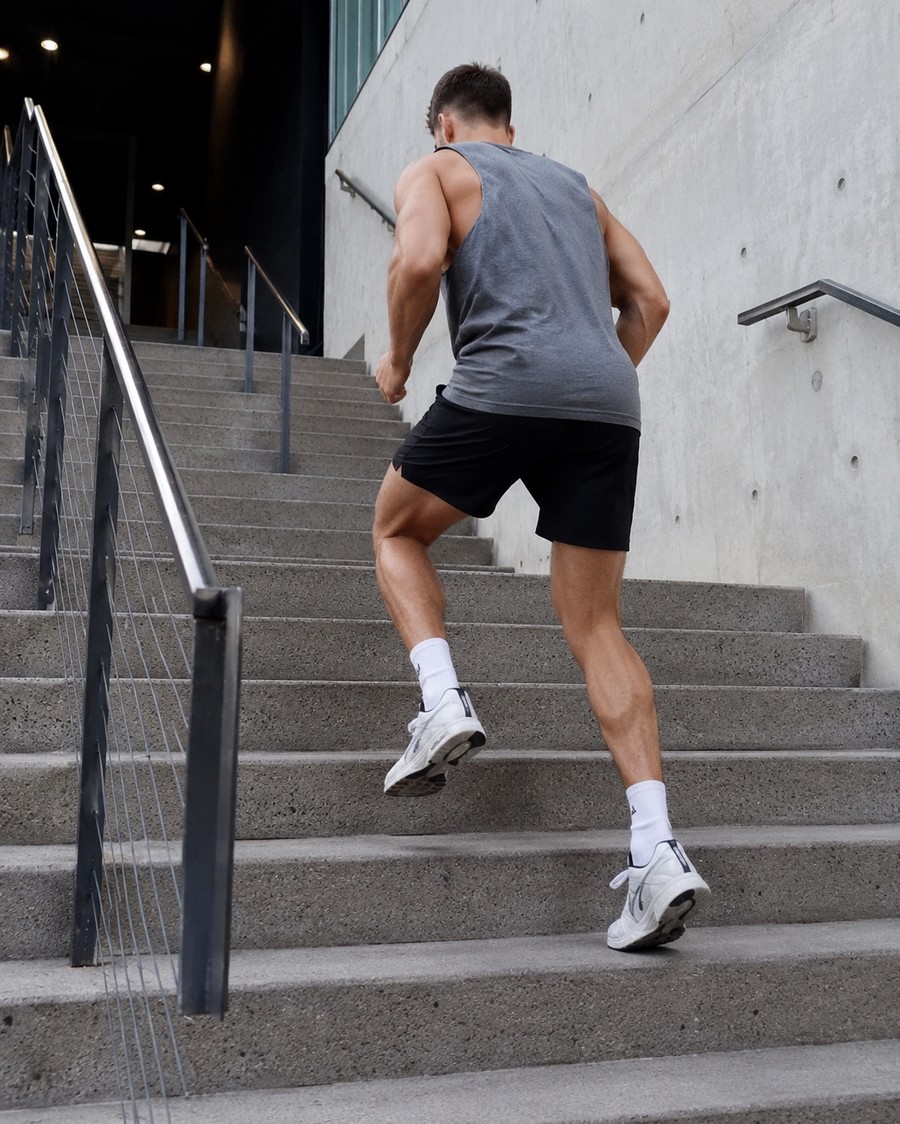
Take the stairs. Always. Every time. Instead of the escalator. Instead of the elevator. At the mall, at the office, at the parking garage, at the airport. Every flight of stairs is free leg training. Zero equipment. Zero time commitment beyond the 30 extra seconds it takes versus standing on an escalator.
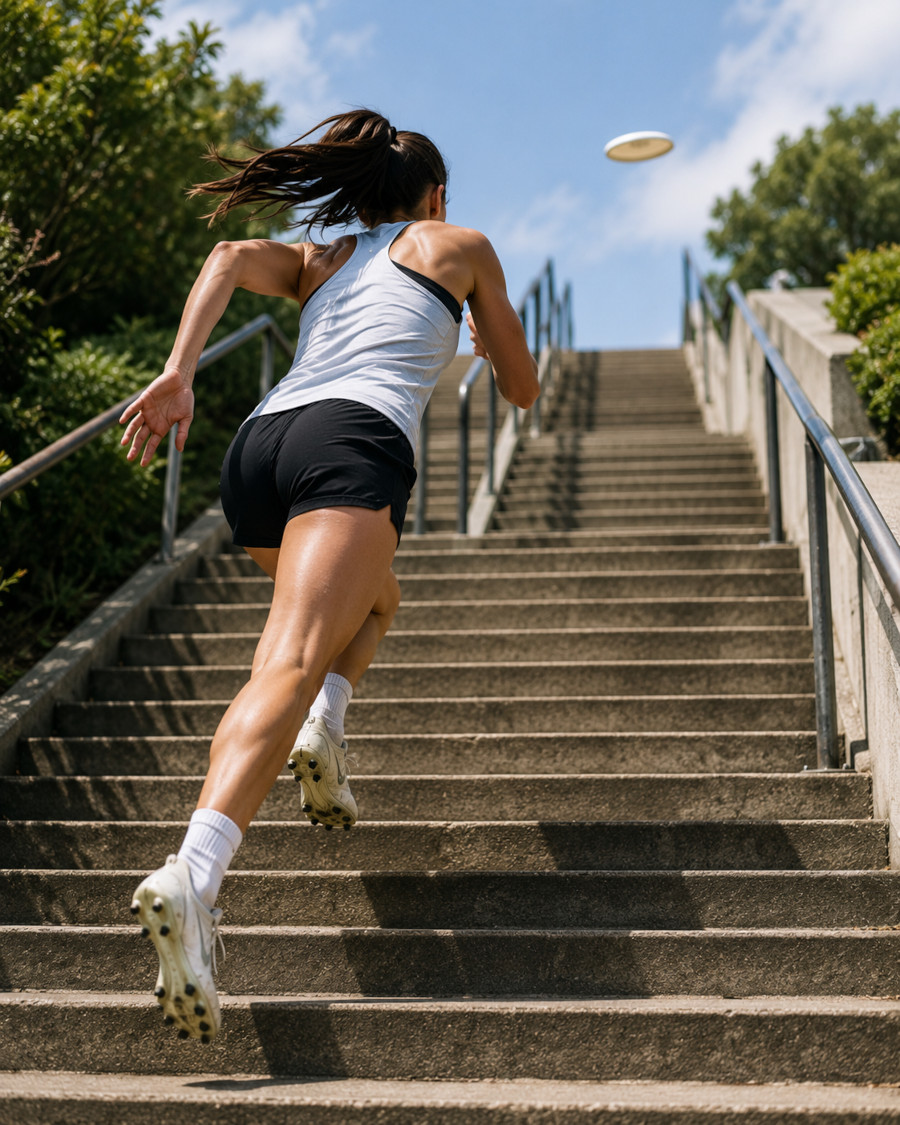
The person who takes stairs every day for a year has done thousands more leg reps than the person who rode the elevator. Thousands. And those reps accumulate in your quads, your calves, your glutes, and your cardiovascular fitness without you ever scheduling a "workout."
But you can also turn stairs into an intentional training tool. When you have access to a good staircase, a set of stadium bleachers, or even a parking garage ramp with stairs, try these variations.
Normal speed: one step at a time, as fast as you can. This is pure cardiovascular conditioning and calf strength. See how fast you can get to the top. Time yourself. Try to beat it next time.
Double step: take two stairs at once. This lengthens your stride and builds power in your quads and glutes. Each step is like a lunge. Two flights of double steps and your legs will be burning in a way that regular stair climbing does not touch.
2 up, 1 back. This is my personal favorite. Go up two stairs, step back down one. Go up two more, step back one. It is maddening because you are literally going backwards to go forwards. But it builds endurance and mental toughness in a way that normal stair climbing cannot. Your legs never get a break because the downward step loads your muscles eccentrically (lengthening under load), which builds a different kind of strength than the upward step. And mentally, it trains you to keep working even when progress feels slow, which is exactly what the last quarter of a tournament feels like.
Triple step: take three stairs at once. Serious quad and glute power. Only do this when you are comfortable with double steps and your balance is solid. Each step is basically a deep single leg squat. Three flights of triple steps is a legitimate strength workout.
Single leg hops. Hop up each stair on one leg. This builds explosive single leg power, which is exactly what you use when you jump for a disc off one foot. Alternate legs every flight. Your weaker leg will be obvious immediately.
Side steps. Go up the stairs sideways, alternating which side leads. This builds lateral strength in your hips and inner thighs, the same muscles that power your defensive shuffle and crossover steps. It feels awkward at first, but that awkwardness means you are training muscles that are not used to working this way.
The philosophy is simple: every staircase is an opportunity. The grocery store has stairs? Take them. The parking garage has three flights? Take them. Your office is on the fourth floor? Take the stairs every single day. These reps add up invisibly over months and years, building a base of leg strength and cardiovascular fitness that you never had to schedule time for.
Plyometrics and Jumping
Ultimate requires explosive jumping ability. You jump for high discs. You jump to lay out. You jump for the Greatest. And the person who jumps higher and faster has an enormous advantage in every contested disc situation.
Lateral Bounds. These are the king of agility exercises for Ultimate players. Stand on one foot. Jump sideways as far as you can, landing on the opposite foot. Absorb the landing, balance, then jump back. You are bounding side to side like a speed skater. This builds explosive lateral power and teaches your body to change direction with force. You will be sore in muscles you did not know you had. That means it is working.
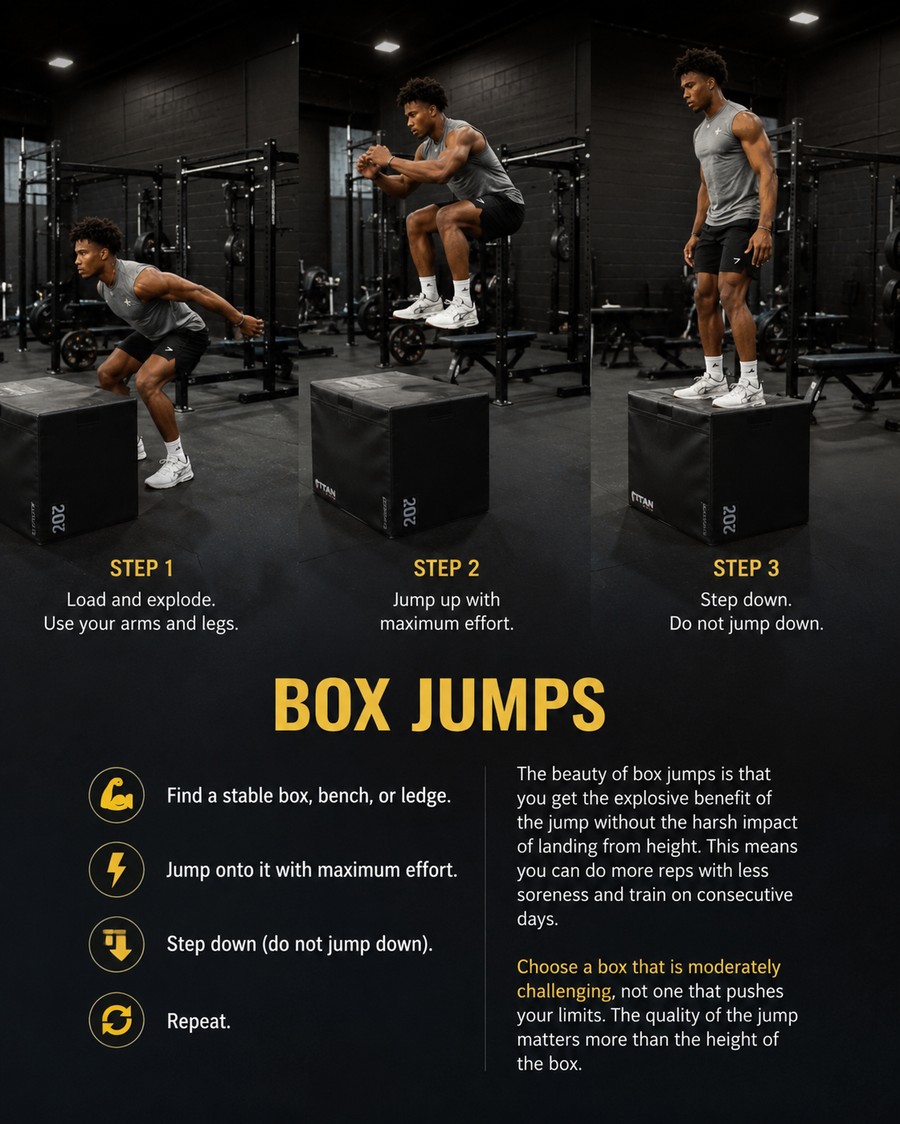
Box Jumps. Find a stable box, bench, or ledge. Jump onto it with maximum effort. Step down (do not jump down). Repeat. The beauty of box jumps is that you get the explosive benefit of the jump without the harsh impact of landing from height. This means you can do more reps with less soreness and train on consecutive days. Choose a box that is moderately challenging, not one that pushes your limits. The quality of the jump matters more than the height of the box.
Single Leg Jumps. Jump off your right foot for height. Rest 30 seconds. Jump off your left foot. Rest 30 seconds. Repeat twice. This builds the single leg takeoff power you need when jumping for a disc on the run. Most game jumps are off one foot, not two. Train accordingly.
Broad Jumps. Standing long jump for maximum distance. This builds the horizontal explosive power for your first step on a cut, the initial burst that creates separation from your defender. Do 5 reps with full rest between each. Focus on jumping as far forward as possible and sticking the landing.
Jump Timing with Disc. This connects your jumping to your disc work. Throw a disc up into the air. Time your jump to catch it at the very top of your leap. One hand. Full extension. This is the drill from Chapter 10 (Field Drills), but now you understand the athletic foundation behind it. Every jump catch is a combination of leg power, timing, and hand eye coordination. Build all three together.
Exercise Trampolines. A small exercise trampoline adds a jumping element you can use indoors on a rainy day or outside in the yard. Bounce and catch a disc at the top of your hop. Bounce and toss a soft flick to a partner, then bounce and reach for their return. The rebound trains your air timing and teaches your hands to work while your feet are off the ground, all with far less stress on your knees than jumping off hard ground. It is easy on the joints and genuinely fun for every age, which means kids will keep at it and adults will too. Do a few minutes at a time and treat it as one more way to get comfortable leaving the ground.
The Treadmill: Four Directions and a Disc
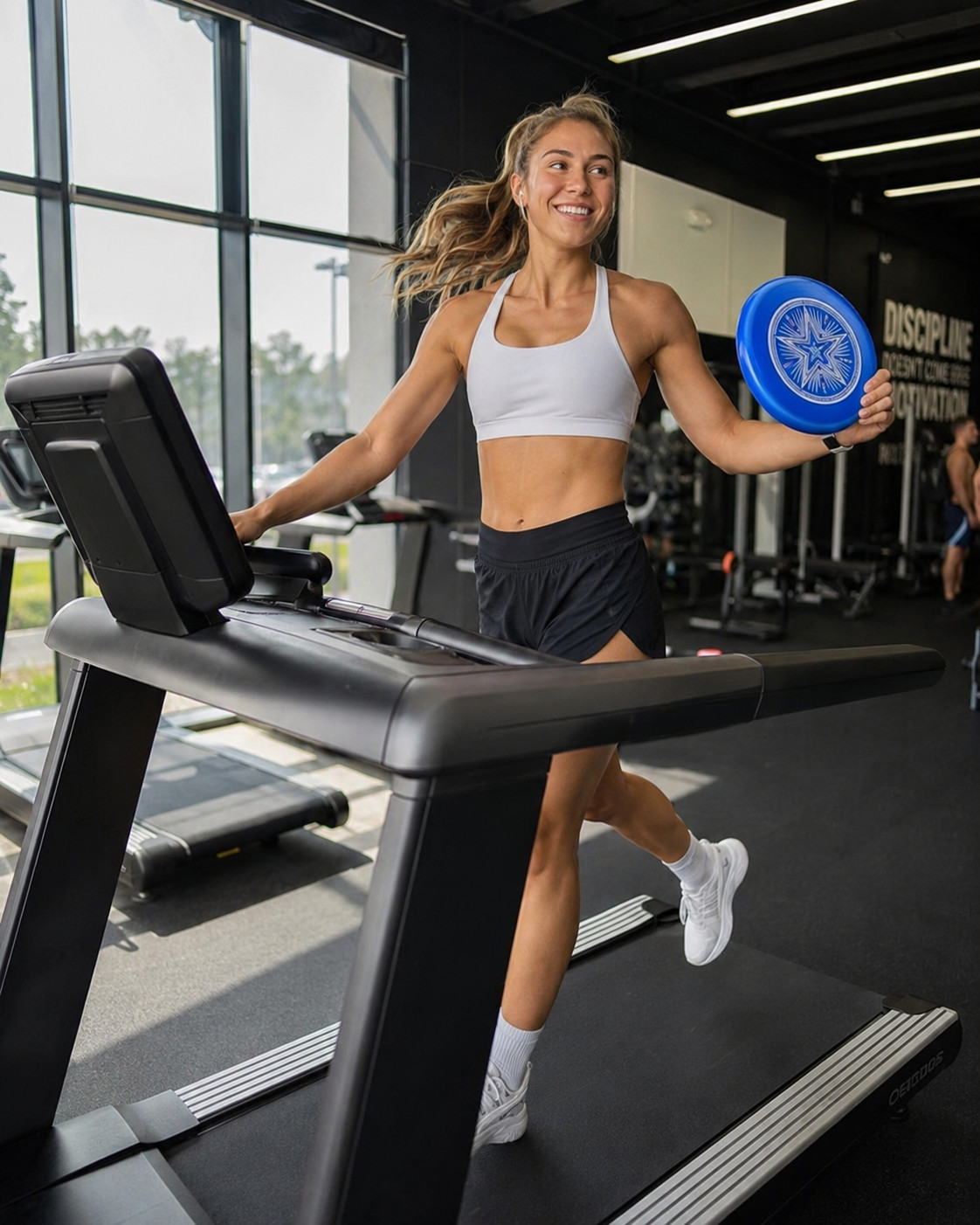
Do not overlook the treadmill. Most people climb on, press start, and stare straight ahead for thirty minutes of forward motion. That is fine cardio, but Ultimate is not a forward-only sport, and your treadmill time should not be either. When I use a treadmill, I turn it into a four direction movement session. I start with regular forward walking or running to warm up. Then I slow the belt down and rotate through the directions: side to side shuffle steps facing one way, then a slow careful backwards jog, then side to side shuffles facing the other way, then back to forward again. All four movements, cycled through on one machine. Your hips, ankles, and stabilizer muscles get worked in every direction the game will demand of them, because a defender does not care that you only trained forward.
And here is my favorite part: bring your discs. When the belt is moving slowly in that forward walk, I keep discs within reach and work them the whole time. Spinning them on my fingers. Hula Hoop Drill while walking. Little passes to myself, hand to hand. It stacks two workouts into one: my legs are logging steady miles while my fingers and hands are logging disc reps, and my brain is learning to do disc work while my body is in motion, which is exactly what the game asks of you every single point. A word of care though: keep the belt slow whenever discs are in your hands, and step off before picking up anything you drop. Train smart, then train smooth, and the treadmill becomes one of the sneakiest Ultimate tools in the whole gym.
Building It Into Your Life
You do not need to schedule a "running workout" to become a better conditioned Ultimate player. You need to build movement into your daily routine, the same way you built the Hula Hoop Drill into your daily routine back in Chapter 4.
Take stairs. Always. That one change, by itself, over months, will make a noticeable difference in your leg strength and cardiovascular fitness.
Walk or jog to your target practice sessions instead of driving when possible. That is a warmup and a conditioning session rolled into your existing practice routine.
Do the 20/40 workout on your lunch break. It takes 20 minutes total. You can do it in a park, on a sidewalk, around a parking lot. Anywhere you can run for 20 seconds and walk for 40.
Sprint drills at the park take 15 minutes. Cutting drills with cones in your backyard take 10 minutes. Defensive footwork drills in your driveway take 10 minutes. The stair variations in your house take 5 minutes.
The person who fits 15 minutes of running and footwork into every day will dramatically outperform the person who does one hard hour once a week. Frequency beats intensity for building the kind of sustained conditioning that Ultimate requires. Show up every day. Do a little. Let it accumulate.
The Ultimate Test: Throw When Tired
Here is a challenge that will show you exactly why this chapter matters.
Go do a full sprint workout. Shuttle runs, Goose Cones, 150 yard shuttles. Get yourself genuinely tired. Legs burning. Heart pounding. Breathing hard.
Now pick up a disc and throw 20 flicks at your target.
Notice what happens. Your grip is weaker. Your wrist snap is slower. Your release point is off. Throws that were easy an hour ago are suddenly inconsistent. The disc wobbles. Your accuracy drops. Everything you built in the throwing chapters is degraded because your body is fatigued.
That is what point 14 of a tournament feels like. That is what the fourth quarter of a pickup game feels like. And the players who can still throw clean when they are tired are the players who trained their conditioning to the point where they are LESS tired than everyone else at that stage of the game.
Make this a regular test. Sprint workout, then throw. See how your accuracy holds up. Over weeks and months, as your conditioning improves, you will notice that your throws stay sharper later into the fatigue. That is the direct transfer from running to throwing. That is the engine carrying the skill.
Wrap Up
◆ Fatigue is the silent killer of Ultimate games. It degrades your throws, your decisions, and your cutting. Everything you built in the throwing chapters falls apart when you are tired.
◆ Ultimate is a multi-sprint sport, not a marathon. Train the way you play: short bursts of max effort with brief recovery. The 20/40 workout is the simplest starting point.
◆ Long runs are not the most efficient conditioning for Ultimate, but they are not useless either. They build aerobic base and help with recovery between sprints. Do the sprint work first, add long runs if you enjoy them.
◆ Defensive footwork is as important as sprinting. Side steps, crossover steps, and backpedaling use different muscles than forward running. Train them specifically. Stay on the balls of your feet with your ankles dorsiflexed.
◆ The backpedal to sprint transition is one of the most important solo defensive drills. Practice it until the switch from backward to forward is seamless.
◆ Take stairs. Always. Every escalator and elevator you skip is free leg training that accumulates over months. Try the 2 up 1 back variation for endurance and mental toughness.
◆ Plyometrics (lateral bounds, box jumps, single leg jumps) build the explosive power for jumping, cutting, and that critical first step.
◆ Test yourself: sprint workout, then throw. See how your accuracy holds up when fatigued. That gap is what you are training to close.
Action Steps
→ This week: do the 20/40 workout twice. Run 20 seconds, walk 40 seconds, repeat 8 times. It takes less than 15 minutes.
→ Set up 3 cones and do shuttle runs. 6 reps with 60 seconds rest. Feel the direction changes in your legs.
→ Practice the Defensive Mixer: shuffle, backpedal, crossover, sprint around 4 cones in a square. 4 reps each direction.
→ Take the stairs every single day this week. No escalators. No elevators. Try the double step on at least one flight.
→ Try the 2 up, 1 back stair variation. Go up two stairs, step back one. One full flight. Feel the burn.
→ Do 10 lateral bounds (5 each direction). Land on one foot. Balance. Bound back. These will make you sore. That is good.
→ After your next sprint session, pick up a disc and throw 20 flicks at a target. Observe what fatigue does to your accuracy. That is your baseline. Work to improve it.
→ Commit to one staircase in your daily life that you will never take the elevator or escalator for again. Make it a rule. Make it permanent.
Mentor's Closing
I want to tell you something that might sound counterintuitive in a book about disc skills: the most important thing you can do to become a better Ultimate player might not involve a disc at all.
It might be a Tuesday evening jog around your neighborhood. It might be taking the stairs at work every day for six months. It might be 15 minutes of shuttle runs in your backyard before dinner. It might be practicing your defensive shuffle in your driveway while your coffee brews.
None of those things involve a disc. All of them will make you dramatically better at Ultimate.
Because the game does not care how pretty your flick is if you cannot get open to catch the disc. The game does not care how powerful your backhand is if you are too gassed to pivot and find the window. The game does not care how many throws you know if your legs quit on you in the fourth quarter.
Build the engine. Take the stairs. Sprint the shuttles. Practice your crossovers and your backpedals. Get comfortable being uncomfortable, because the last ten minutes of a close game is nothing but uncomfortable. And the player who trained for that discomfort is the player who wins.
Your hands are ready. Now make sure your body can carry them all the way to the final point. :)