The strength exercise that has helped my game more than anything in the last six years is the push up. Not a fancy gym machine. Not a barbell. Not a kettlebell. The push up.
Since February 2020, I have done 300 push ups every single day. Ten sets of 30. Some days I do them all in the morning. Some days I spread them across the day. Some days I knock out three sets before breakfast and finish the rest while watching TV at night. But every day, without exception, 300 push ups.
That one exercise strengthens your triceps, your chest, and your core all at the same time. Those three muscle groups are directly involved in every throw you make. Your chest stabilizes your shoulder during the coil. Your triceps extend your arm during the release. Your core transfers the rotational power from your hips to your upper body. Push ups train all three, every rep, with zero equipment.
I also do sit ups in the morning and again at night, usually combined with stretching. It is difficult to fit it all in. Life gets busy. But I usually manage, because I have learned that the days I skip are the days I feel weaker on the field.
This chapter is about building the body behind the throws. Every technique you learned in the earlier chapters, every grip and release and kinetic chain connection, gets amplified when the muscles powering those movements get stronger. Strength training is not separate from disc training. It IS disc training, with resistance.
The Weighted Eagle Slash
Before we go any further, I want to show you the drill that connects everything in this chapter to everything you learned in the throwing chapters.
Remember the Eagle Slash from Chapter 4? You held the disc in your flick grip and slashed it forward horizontally, simulating a full power flick, then snapped it back into the webbing. Over and over. Forward slash, snap back.
Now do that same motion with a light dumbbell or a small kettlebell in your hand instead of a disc. Two to three pounds to start. Not heavy. Just enough to add resistance to the motion your muscles already know.
Slash forward. Snap back. Slash forward. Snap back. 20 reps per hand.
It burns in places you did not know existed. Muscles in your forearm, your wrist, and the base of your fingers that the disc alone never stressed enough to fatigue. After a set of weighted Eagle Slashes, pick up a real disc and do the same motion. It feels effortless. The disc feels like nothing in your hand. Your slash is faster. Your snap is sharper.
That is the whole philosophy of this chapter. Add resistance to the movements you already know, and the movements get stronger. You can do the same thing with the Hammer Slash: hold a light weight and do the vertical overhead motion. You can do it with the IO Bicep Curl from Chapter 4: add a two to three pound weight to the curl motion. Every no-release drill from Chapter 4 becomes a strength exercise when you add a little weight.
Start light. Seriously light. Two to three pounds. These are not powerlifting exercises. They are throwing motions with added resistance, and if you go too heavy, your form breaks down and you train the wrong movement pattern. Light weight, perfect form, high reps. That is the formula.
The Balance Principle
This is the single most important concept in strength training for Ultimate, and it is the one that most players get wrong.
Every muscle in your body has an opposite. Your bicep curls your arm closed. Your tricep extends it open. Your quadricep straightens your knee. Your hamstring bends it. Your grip muscles close your hand around the disc. Your extensor muscles open your fingers back up. Your chest pushes. Your back pulls.
If you only train the muscles you use for throwing, the pushing muscles, the grip muscles, the biceps, the chest, the opposing muscles get weak. And that imbalance is where injuries live. A strong bicep pulling against a weak tricep creates strain on the elbow joint. Strong quads pulling against weak hamstrings is one of the most common causes of ACL tears. A powerful grip with no extensor balance leads to forearm pain and finger cramping.
Brent Steepe, founder of the Detroit Mechanix and a 35 year fitness expert, is emphatic about this: "Focus on triceps because you're used to doing biceps and your biceps are probably stronger. If you do triceps it helps balance out that muscle group. It's about balancing out the muscles in your arm to make it a stronger arm for throwing and catching."
The rule is simple: for every pushing exercise, do a pulling exercise. For every curl, do an extension. For every chest press, do a row. Balance is not optional. Balance is injury prevention. Balance is how you play for 20 years instead of 5.
Fingers and Grip
Your fingers are where every throw begins and ends. The spin on the disc, the control of the release, the accuracy of the flight path, it all comes down to what your fingers do in the final milliseconds of the throw. Strong fingers throw farther, spin harder, and control better.
But here is the mistake almost everyone makes: they only train the closing muscles. The grip. The squeeze. And they completely ignore the opening muscles, the extensors.
Finger extension bands. These are small elastic bands that cost under $15 on Amazon. You put each finger in a ring and spread your fingers apart against the resistance. 3 sets of 15 reps daily. This trains the extensor muscles that almost nobody ever trains. Brent Steepe is passionate about this: "We do everything with a grip and a grab. We do nothing weighted with an extension. Without that evening of tension, we have a problem." He has seen people who could not palm a basketball suddenly able to after training their extensors. The balanced hand, strong in both closing and opening, has more control and more endurance than a hand that only knows how to squeeze.
Grip strengtheners and squeeze balls. These build the closing side of your grip. Squeeze a tennis ball, a grip trainer, or a stress ball throughout the day. But ALWAYS balance grip work with extensor work. If you do 3 sets of squeezes, do 3 sets of extensions.
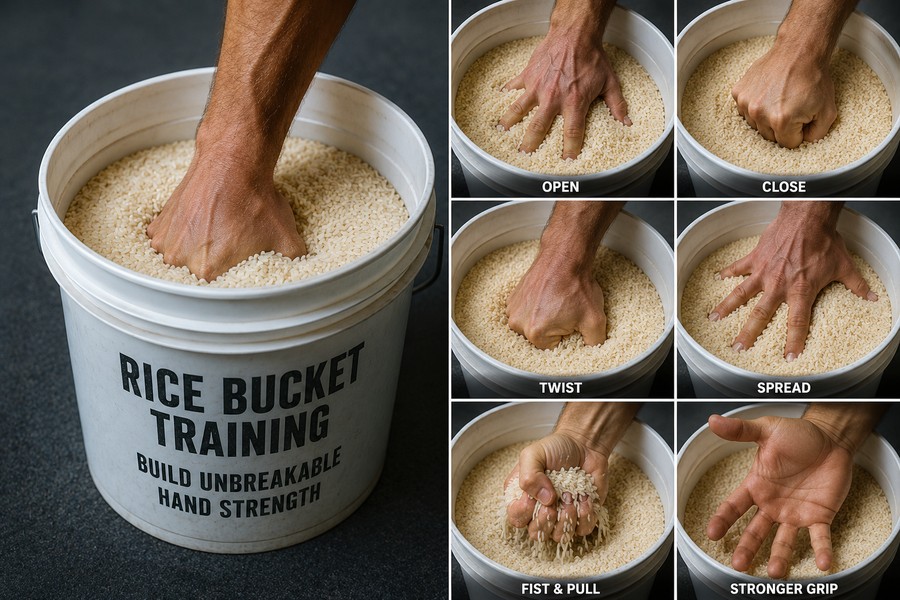
Rice bucket training. This is old school and devastatingly effective. Fill a bucket with dry rice. Plunge your hand in and open and close your fingers against the resistance of the rice. Twist your wrist. Spread your fingers. Make a fist and pull it out. The rice provides resistance in every direction simultaneously, training muscles that no single exercise can isolate. Rock climbers and martial artists have used this technique for decades. It builds a comprehensive hand strength that translates directly to disc control.
Finger push ups (advanced). Regular push ups but on your fingertips instead of your palms. This requires significant finger strength and builds it rapidly. Start with just a few reps. If you cannot do a full finger push up, start on your knees. This builds the kind of finger strength that makes the Hula Hoop Drill easier and your grip on the disc unshakeable.
The Hula Hoop as strength training. A callback to Chapter 4: the Hula Hoop Drill itself IS resistance training for your fingers. The centripetal force of the spinning disc pulling against your finger is a continuous strength exercise. The inverted spin (upside down) from Chapter 4 is the heaviest version, creating maximum force against your finger. If you are doing the Hula Hoop daily, you are already doing finger strength training. The exercises above supplement and accelerate that.
Wrists and Forearms
Your wrist is where spin is born. The snap of the wrist is the final accelerator in the kinetic chain, the crack at the tip of the whip. Stronger wrists mean harder snaps, more spin, and longer throws.
Wrist curls (palm up). Sit with your forearm resting on your thigh or a bench, palm facing up. Curl a light dumbbell upward using only your wrist. This builds the flexor side of your forearm, the muscles that power the wrist snap on both the backhand and flick. 3 sets of 15 reps.
Reverse wrist curls (palm down). Same position but palm facing down. Curl the dumbbell upward using the back of your wrist. This builds the extensor side. The balance pair. Without reverse curls, the flexor side gets overdeveloped and you risk wrist strain and tendonitis. 3 sets of 15 reps.
Forearm rotation with dumbbells. Hold a light dumbbell with your arm extended. Rotate your forearm from palm up to palm down and back. This builds the rotational strength that powers the flick release, the twisting motion that sends the disc spinning off your fingers. 3 sets of 10 reps each direction.
Wrist roller. If you have access to one, this is one of the most effective forearm exercises that exists. A bar with a rope and weight hanging from it. You roll the weight up by rotating the bar forward with your wrists, then roll it back down. By the time the weight reaches the top, your forearms will be on fire. If you do not have a wrist roller, you can make one with a dowel, a rope, and a small weight.
The Weighted Eagle Slash and Hammer Slash. As described in the opening section. Light dumbbells, 2 to 3 pounds, doing the Eagle Slash motion for horizontal flick strength and the Hammer Slash motion for overhead throw strength. These are the most sport-specific wrist and forearm exercises you can do because they replicate the exact movement patterns of the throws. 20 reps per hand.
Arms: The Balance Pair
Your biceps and your triceps are the most obvious balance pair in your body, and they are the pair that most people get wrong. Here is why.
Biceps are fun to train. Curls feel good. You can see the muscle growing. Everyone does them. Triceps? Less fun. Less visible. Less glamorous. And so most people's biceps are significantly stronger than their triceps.
For Ultimate, this imbalance is a problem. Your triceps are the pushing muscles that extend your arm during every throw. They power the final extension of the backhand follow through and the outward reach of the flick. If your triceps are weak relative to your biceps, your throws lose power in the exact phase where power matters most: the release.
Bicep exercises: Standard curls, hammer curls (thumbs up position, great for forearm involvement), concentration curls. These build the pulling and catching muscles. The arm that reaches out and snatches a disc from the air is using its bicep. 3 sets of 10 to 12 reps.
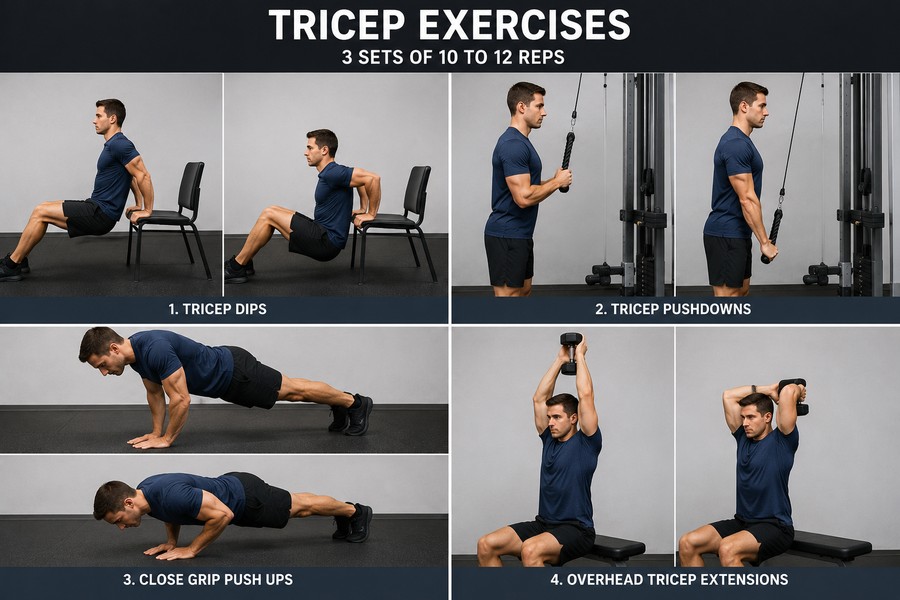
Tricep exercises: Tricep dips (on a chair, a bench, or the ground), tricep pushdowns (if you have a cable or band), close grip push ups (hands close together, elbows tight to body), overhead tricep extensions with a dumbbell. These build the pushing and throwing muscles. 3 sets of 10 to 12 reps.
The rule: every time you do bicep curls, do an equal number of tricep reps. Every time. No exceptions. Your arms will be stronger, more balanced, and more resistant to the elbow and shoulder injuries that plague Ultimate players who only train one side.
The IO Bicep Curl with weight. Take the IO Bicep Curl motion from Chapter 4, the one where you coil the disc up over your forearm and onto the outside of your shoulder. Now do it with a light dumbbell. The resistance builds the exact muscles used in the inside out flick release. 20 reps per hand. This is one of the most sport-specific arm exercises in this chapter.
Shoulders and Rotator Cuff
Your shoulders are involved in every single throw you make. The backhand coil loads your shoulder. The flick extension reaches through your shoulder. The hammer launches from above your shoulder. If your shoulders are weak or unbalanced, your entire throwing chain is compromised.
And here is the scary part: the rotator cuff, the group of small muscles and tendons that stabilize your shoulder joint, is the most injury prone area for Ultimate players. Rotator cuff injuries are painful, slow to heal, and can end seasons. Strengthening this area is not optional. It is insurance.
Shoulder press (overhead press). Stand or sit. Press dumbbells or a barbell overhead. This builds the power for hammer throws, scoobers, and any high release throw. 3 sets of 8 to 10 reps.
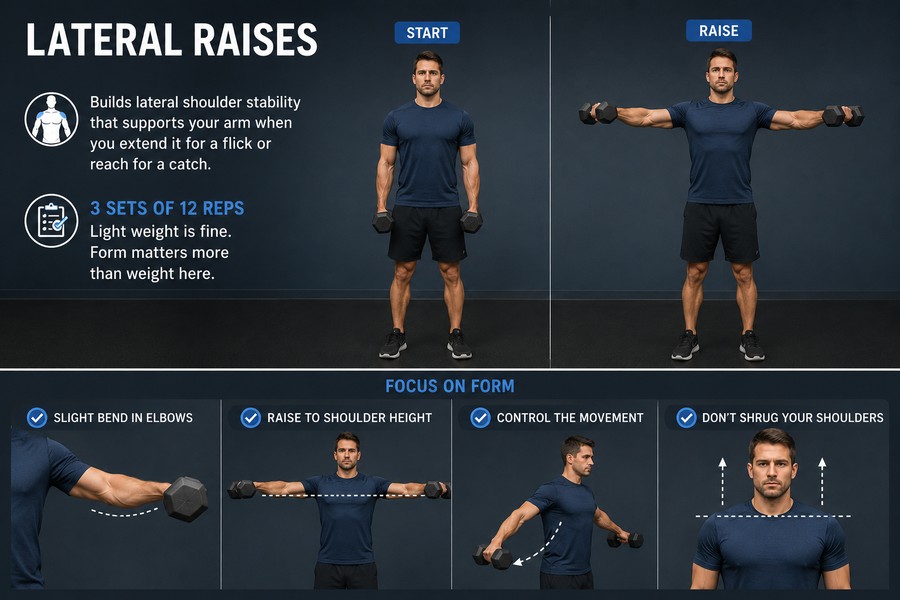
Lateral raises. Hold dumbbells at your sides. Raise them out to shoulder height. This builds the lateral shoulder stability that supports your arm when you extend it for a flick or reach for a catch. 3 sets of 12 reps. Light weight is fine. Form matters more than weight here.
Front raises. Same as lateral raises but lifting forward. Builds the front deltoid used in backhand follow through and reaching catches. 3 sets of 12 reps.
Rotator cuff exercises with bands. Internal rotation: hold a band at your side, elbow bent 90 degrees, rotate your forearm toward your body. External rotation: same position, rotate away from your body. These small movements strengthen the small muscles that keep your shoulder joint stable under the tremendous forces of throwing. 3 sets of 15 reps each direction. Do these before every throwing session as a warmup.
Band pull aparts. Hold a resistance band in front of you at chest height. Pull it apart, squeezing your shoulder blades together. This builds the rear deltoids and upper back muscles that balance all the forward throwing motion. For every push (press, front raise), your body needs a pull (band pull apart, row). 3 sets of 15 reps.
Core: The Engine of Rotation
Your core is where rotational power lives. The kinetic chain from the throwing mechanics chapter starts in your hips and transfers through your core to your upper body. If your core is weak, that transfer breaks down. Energy leaks out. Your throws lose power that your hips generated but your core could not deliver.
I do sit ups every morning and again at night, usually combined with stretching. It is a simple routine but the consistency over years has built a rotational foundation that I can feel in every throw.
Planks. The king of core stability. Hard style planks are the most effective: get in plank position and flex everything, your abs, your glutes, your quads, your arms, as hard as you can for 10 seconds. Rest. Repeat 5 times. Ten seconds of maximum tension is more effective than 60 seconds of lazy holding.
Medicine ball rotational throws. This is the most sport-specific core exercise for Ultimate. Hold a medicine ball. Stand sideways to a wall. Twist your torso away from the wall (the coil), then explosively rotate and throw the ball against the wall (the uncork). Catch the bounce. Repeat. This IS the backhand motion with resistance. Every rep builds the exact rotational power that drives the kinetic chain. 3 sets of 10 each side.
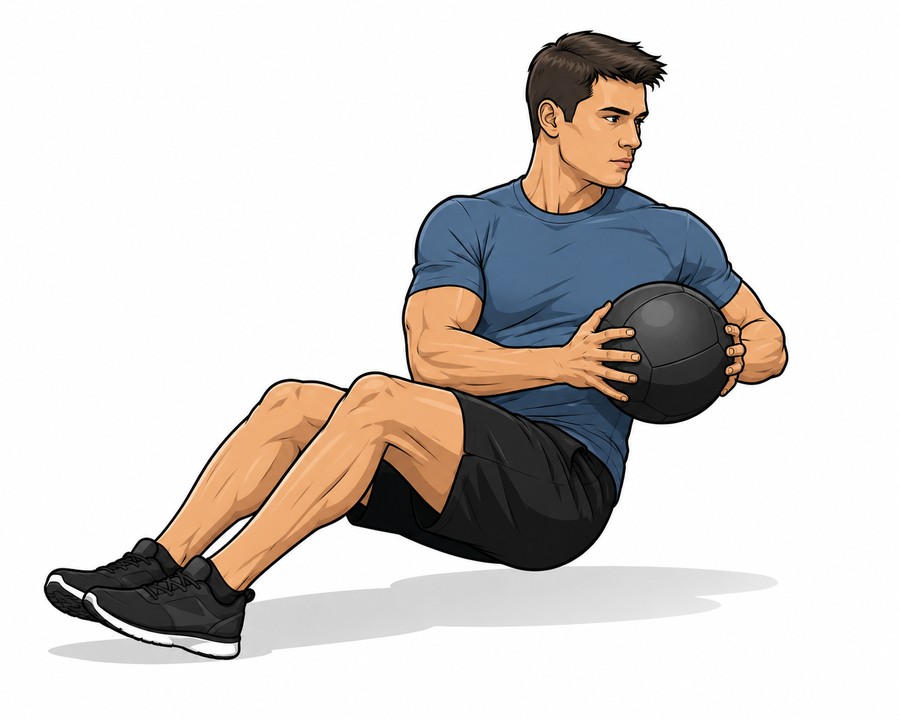
Russian twists. Sit on the ground, lean back slightly, feet off the floor. Hold a weight or medicine ball. Twist side to side, touching the weight to the ground on each side. This builds rotational endurance, the ability to keep twisting powerfully in the fourth quarter when everyone else's core is exhausted. 3 sets to failure.
Bicycle crunches. Lie on your back, hands behind your head. Bring your right elbow to your left knee, then your left elbow to your right knee. This rotational crunch mimics the twisting motion of throwing and builds both the upper and lower abs simultaneously. 3 sets of 20.
Dead bugs. Lie on your back, arms extended toward the ceiling, knees bent at 90 degrees. Extend your right arm overhead while extending your left leg straight, keeping your lower back pressed into the ground. Return and switch sides. This builds core stability and coordination, teaching your body to control opposite limbs simultaneously, which is exactly what happens during a throw. 3 sets of 10 each side.
Sit ups and crunches. Basic but effective. Do them daily. Morning and night if you can. The consistency matters more than the volume. 50 sit ups every morning is better than 200 once a week.
Legs: The Foundation of Everything
Your legs are where the kinetic chain begins. Every throw starts from the ground. Your feet plant, your legs drive, your hips rotate, and everything above follows. Weak legs mean a weak foundation, and a weak foundation means your kinetic chain starts with a broken link.
Tim Morrill recommends three exercises above all others for Ultimate players: split squats, single leg deadlifts, and an explosive hip movement like a kettlebell swing, a clean, or a snatch. Those three exercises, done consistently, build the leg strength and explosive power that Ultimate demands.
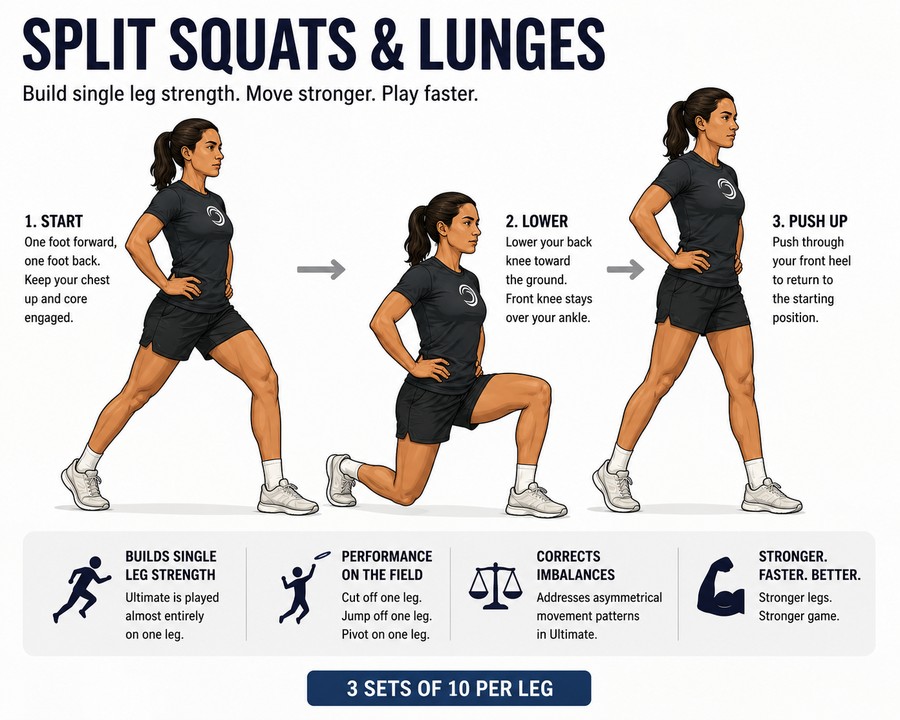
Split squats and lunges. One foot forward, one foot back. Lower your back knee toward the ground. Push back up. This builds single leg strength, which is critical because Ultimate is played almost entirely on one leg at a time. You cut off one leg. You jump off one leg. You pivot on one leg. Split squats also correct the imbalances that develop from the asymmetrical movement patterns in Ultimate, where one side of your body does more work than the other. 3 sets of 10 per leg.
Single leg deadlifts. Stand on one leg. Hinge forward at the hips, reaching your free leg behind you and your hands toward the ground. Return to standing. This works the entire posterior chain: hamstrings, glutes, and lower back. It is arguably the most valuable counter movement exercise for Ultimate players because it builds the muscles that decelerate your body when you plant and change direction. Without strong hamstrings, your quads overpower the joint and your knees pay the price. 3 sets of 8 per leg.
Squats. Start with bodyweight squats. Progress to goblet squats (holding a dumbbell or kettlebell at your chest). Eventually progress to barbell back squats if you have access. Squats build comprehensive leg strength for jumping, sprinting, and cutting. They are the king of leg exercises for a reason. 3 sets of 10.
Kettlebell swings. Stand with feet shoulder width apart, kettlebell on the ground between your feet. Hinge at your hips, grab the kettlebell, and swing it forward by explosively extending your hips. The kettlebell swings up to chest height, then falls back. Repeat. This is an explosive hip extension exercise that builds power in your glutes, hamstrings, and core simultaneously. It is low impact, high reward, and directly trains the hip snap that initiates the kinetic chain. 3 sets of 15.
Calf raises. Stand on the edge of a stair with your heels hanging off. Rise up on your toes. Lower back down. This builds the calf strength that powers your first step, your ability to stay on the balls of your feet (David Lingua's constant emphasis), and your jumping ability. 3 sets of 20. You can also do these on flat ground, anywhere, anytime.
Pistol squats (advanced). A single leg squat all the way down to the ground and back up. This is extremely challenging and builds powerful legs and flexible ankles. Only attempt these once your basic squat strength is solid. They are a long term goal, not a starting point.
The balance pair for legs: Quad exercises (squats, lunges, leg press) balanced with hamstring exercises (deadlifts, leg curls, kettlebell swings). Quad/hamstring imbalance is one of the most common causes of knee injuries in Ultimate. Train both sides. Always.
Push Ups: The One Exercise
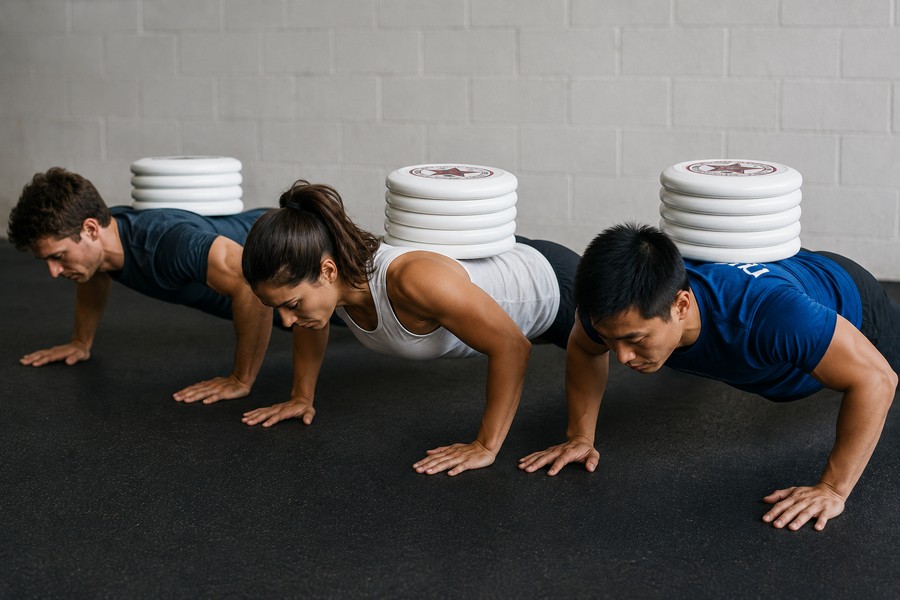
If I had to pick one exercise for the rest of my life, it would be the push up. And I am not just saying that. I have been doing 300 push ups a day for six years. Let me tell you why.
The push up trains your triceps, your chest, and your core simultaneously. Those are three of the most important muscle groups for throwing. One exercise, three muscle groups, zero equipment, can be done anywhere, takes about 15 minutes total when spread across the day.
My routine: 10 sets of 30, spread throughout the day. Three sets in the morning before anything else. Two or three sets during the day when I have a break. The rest in the evening. Some days I do them all in one session. Most days I spread them out. The total is always 300.
Since I started this routine, my throwing power has increased noticeably. My chest and shoulders feel more stable during the coil. My triceps are stronger during the extension. My core is more solid during the rotation. And I have not had a single upper body injury related to throwing.
You do not need to start at 300. Start at whatever number you can do. 10 push ups a day. Then 20. Then 50. Add 10 per week. The number does not matter as much as the consistency. Every single day. No days off. Push ups are the simplest, most effective, most accessible strength exercise for an Ultimate player. Period.
You Do Not Need a Gym
Everything in this chapter can be done at home with minimal equipment. Here is what you actually need.
Nothing. Push ups, squats, lunges, planks, dips on a chair, calf raises on a stair, wall sits, sit ups, bicycle crunches, dead bugs. All bodyweight. All effective. All free.
A pair of light dumbbells (3 to 10 pounds). This unlocks the weighted Eagle Slashes, wrist curls, shoulder work, bicep/tricep balance work, and the weighted IO Bicep Curl. A pair of 5 pound dumbbells costs about $15 and covers most of what you need.
Resistance bands. Cheap, portable, and essential for rotator cuff work and band pull aparts. A set of bands costs under $15 and fits in a drawer.
Finger extension bands. Under $15 on Amazon. Train the muscles nobody trains.
A kettlebell (optional). One kettlebell gives you swings, goblet squats, Turkish get ups, presses, and dozens of other exercises. A 20 to 25 pound kettlebell is a good starting point for most players.
Total cost of a complete home Ultimate strength training setup: about $50 to $75. Less than a pair of cleats. And it will last you years.
Start with bodyweight. Get comfortable with the movements. Build the habit of daily strength work. Then add the dumbbells. Then the bands. Then the kettlebell if you want it. You do not need a gym membership. You do not need a personal trainer. You need consistency and the willingness to do push ups when nobody is watching.
The Workout Order
If you are combining strength training with disc practice on the same day, the order matters.
Melissa Witmer of the Ultimate Athlete Project recommends this sequence: warmup first, then speed and agility work, then strength training, then conditioning last. This order puts the exercises that require the most neurological freshness (speed, agility, power) first and the exercises that require endurance (conditioning) last.
For your solo practice days, I would add one more rule: do your disc work FIRST. Before the strength training. Your wrists and fingers need to be fresh for throwing. If you exhaust your forearms with wrist curls and then try to throw 50 flicks, your release will be sloppy because your muscles are pre-fatigued. Throw first. Lift after. Your technique stays sharp and your strength work serves the technique instead of undermining it.
Wrap Up
◆ The push up is the single most effective and accessible strength exercise for Ultimate players. It trains triceps, chest, and core simultaneously. Start with whatever you can do daily and build from there.
◆ The Balance Principle: for every pushing exercise, do a pulling exercise. For every curl, do an extension. Imbalance leads to injury. Balance leads to longevity.
◆ Train your finger extensors, not just your grip. Finger extension bands balance your hand muscles and improve disc control.
◆ The Weighted Eagle Slash and Hammer Slash are the most sport-specific strength exercises in this chapter. Light weight (2 to 3 pounds), perfect form, high reps.
◆ Your rotator cuff needs band work before every throwing session. Three minutes of internal and external rotation can prevent months of injury recovery.
◆ Medicine ball rotational throws are the backhand motion with resistance. They build the exact rotational power that drives the kinetic chain.
◆ Single leg exercises (split squats, single leg deadlifts) correct imbalances and build the one-legged strength that Ultimate actually requires.
◆ You do not need a gym. Push ups, bodyweight squats, a pair of light dumbbells, and resistance bands cover everything. Total cost: under $75.
◆ Do disc work FIRST, strength training AFTER. Fresh wrists throw better than fatigued wrists.
Action Steps
→ Today: do push ups. However many you can. Write down the number. That is your starting point. Tomorrow, do the same number. Next week, add 5.
→ This week: order a set of finger extension bands. Start doing 3 sets of 15 reps daily. Balance your grip.
→ Try the Weighted Eagle Slash with anything you have: a can of soup, a small water bottle, a light dumbbell. 20 reps per hand. Feel the burn in your forearm. Then pick up a real disc and feel the difference.
→ Do wrist curls and reverse wrist curls with a light weight. 3 sets of 15 each direction. Balance your forearms.
→ Add rotator cuff band work before your next throwing session. Internal rotation, external rotation, 15 reps each. Three minutes total. Make it a habit.
→ Do 3 sets of 10 split squats per leg. Feel the single leg burn. This is the foundation of your cutting power.
→ If you have a medicine ball and a wall, do 10 rotational throws each side. Feel how this IS the backhand motion. The connection is immediate.
→ Commit to a daily push up number and a daily sit up number. Write it on your calendar. Track it. Do not miss a day.
Mentor's Closing
Here is something I have learned after six years of daily push ups: the hardest part is not the exercise. The hardest part is showing up. Day after day. When you are tired. When you are busy. When you do not feel like it. When nobody is watching and nobody cares whether you do them or not.
But those are the days that matter most. Because anyone can do push ups when they are motivated. The difference is doing them when you are not. And over weeks and months and years, that consistency builds something that motivation alone never could: a body that is genuinely, reliably, permanently stronger.
You do not need to do 300 a day. You do not need to bench press your body weight. You do not need a gym or a trainer or a program. You need to do something, anything, every single day that makes your body a little bit stronger than it was yesterday.
Push ups. Sit ups. Wrist curls. Band work. Weighted Eagle Slashes. Squats in your living room. Finger extensions while watching TV. Small things. Boring things. The things that nobody posts about on social media but that compound over years into a body that can throw harder, cut sharper, jump higher, and outlast everyone else on the field.
Your throws are only as strong as the body behind them. Build that body. One rep at a time. Every day. :)