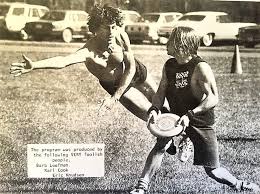
Jerry Mindes was there at the beginning.
In 1972, he was part of the original Columbia High School team in New Jersey, the birthplace of organized Ultimate Frisbee. More than fifty years later, Jerry still shows up every Sunday morning at the Nolte pickup game in Maryland. He is in his seventies now, and he is still throwing that distinctive "chicken wing" forehand he learned back when Ultimate was just a bunch of kids tossing a disc in a parking lot.
I play with Jerry regularly. I watch him read the field with patience that younger players have not developed yet. I watch him deliver throws that hit receivers in stride, thrown with muscle memory built over five decades.
And I think to myself: this sport is different. What other sport lets you play competitively from age 12 to 72 and beyond? Football? Your knees are done by 35. Basketball? Good luck keeping up with 20 year olds when you are 50. Ultimate is different. And understanding why, and how to make it happen for yourself, might be the most important chapter in this book.
The Masters Divisions: Age Is Just a Number
USA Ultimate has built an entire competitive structure for players who refuse to hang up their cleats.
Masters division (Men 33+, Women 30+): This is where recently retired club players go to keep competing. Do not let the name fool you. Masters Ultimate is highly competitive. Many of these players were elite just a few years ago.
Grand Masters division (Men 40+, Women 37+): This is "getting the band back together" territory. Old teammates reunite. Rivalries resume. The pace is slightly slower, but the strategy is sharper.
Great Grand Masters division (Men 48 to 50+, Women 45 to 47+): This is where the original pioneers prove that age is just a number. Some of these players have been throwing discs since the 1970s. They have forgotten more about Ultimate than most people will ever learn.
I turn 48 next year, which means I will be eligible for Great Grand Masters. I am already looking at teams like Magma here in DC. At 48, I will be one of the youngest players in a division that goes up to 60+. That is not a disadvantage. That is an opportunity.
The 2024 World Masters Ultimate Championships in Irvine, California was the first ever WFDF event for Masters national teams. Countries sent squads in all three age divisions. This is not recreational tossing. This is world championship competition.
The Injury Reality
Let me be honest about the risks. Ultimate has a surprisingly high injury rate. The data is sobering.
88% of polled players have been sidelined by injury at some point. 76% have experienced muscle strains. 71% have sought medical care for Ultimate related injuries. Women are 7 times more likely to tear knee ligaments than men. And 26% lifetime prevalence of concussion is higher than volleyball or softball.
The most commonly injured body parts: knees (35% of injuries, including ACL tears and meniscus damage), ankles (65% have experienced ankle injuries from cutting and sudden stops), shoulders (37%, from overuse and repetitive throwing), hamstring strains, and concussions.
Here is the critical insight: 40% of injuries involve running or overuse. That means nearly half of all injuries are preventable with proper training, warm up, and load management.
My Injury Story
I have collected my share of battle wounds over the years.
The worst was an ankle injury. I made a sudden stop with a defender right on me. They hit me, and my ankle bent backwards in a way ankles are not supposed to bend. That one took a full year to heal properly.
I have had plenty of scrapes and bruises from diving, the kind that make your spouse wince when you come home. I have learned not to dive unless it is absolutely necessary. And when I do dive, I have learned the correct technique to minimize damage.
The scariest moments come from collisions. When you are playing at full capacity in a tournament, everyone is running hard. The timing margins between catching a disc and colliding with another body are measured in milliseconds. You have to be hyper aware of where other players are moving.
The Longevity Playbook: How to Play Into Your 60s
Here is what I have learned from watching Jerry and the other 50+ and 60+ players at Nolte.
Adapt your role. Older players do not try to outrun 25 year olds. They cannot, and they know it. Instead, they become elite handlers. They position themselves for resets and dumps. They let the young legs do the deep cutting while they control the disc in the middle of the field.
Master both hands. The smartest older players I know are ambidextrous. They have thrown so many discs over their lifetime that their muscle memory is automatic. A lefty flick, a righty backhand, a quick release around the mark. They have seen every situation a thousand times.
See the field. Older players are more patient. They do not force throws into tight windows. They wait for the defense to make a mistake, then exploit it. They read the field with wisdom that only comes from decades of experience.
At Nolte, I watch the 60 year olds make throws that look effortless because they have calculated exactly where the receiver will be. No wasted motion. No panic. Just precision.
Accept the trade offs. Older players do not throw as many long hucks. For me personally, that is less exciting because I love the deep game. But those controlled, patient possessions that move the disc systematically down the field? They are just as effective at scoring, and much safer for aging bodies.
The ACL Prevention Protocol
Here is the good news: ACL injuries are partially preventable. Studies show that dedicated ACL prevention programs reduce tear rates by 50 to 60%.
How these programs work: strengthening stabilizing muscles (especially hamstrings), training your neuromuscular system to fire those muscles at the right moments, and teaching body mechanics that prevent your knee from falling into dangerous positions.
The key cue that every player should memorize: knee over toes. When you land from a jump or plant for a cut, your knee should track directly over your toes, not caving inward. That inward collapse is exactly how ACL tears happen.
Other critical form points:
- Land softly on the ball of your foot, then let the rest of your foot come down
- Land with a bent knee and slightly bent hip, never locked out
- Keep your feet between your shoulders when landing
These programs take 15 to 20 minutes, 2 to 3 times per week, for at least 2 to 3 months. That is a tiny investment for a 50 to 60% reduction in one of the most devastating injuries in sports.
→ Action Step: Look up "FIFA 11+ warm up" or "ACL prevention exercises" on YouTube. Start incorporating these movements into your pre game routine this week.
Wheelchair Ultimate: The Sport Evolves
In September 2023, the World Flying Disc Federation hosted the first ever World Wheelchair Ultimate Championships in Lignano Sabbiadoro, Italy. Four teams competed: Germany, two Italian teams, and an international squad primarily from Japan.
How wheelchair Ultimate works: smaller court, 4 to 6 players per side, teams throwing across opposing goal lines. The core of Ultimate remains intact. Non contact. Players officiate themselves. Built on Spirit of the Game.
The German team's coach, Tanja Gebert, said something that stuck with me: "Inclusion is more than just wheelchairs and ramps. It is about recognizing the many disabilities that are not visible at first glance."
Wheelchair Ultimate serves people who have lost mobility due to injury, illness, or conditions they were born with. It serves older players whose bodies can no longer handle the running demands but who still want to compete. And it serves anyone who wants to experience the sport in a new way. This is what Spirit of the Game looks like when it truly includes everyone.
Disc Golf: Your Future Self
Here is a truth that every Ultimate player should understand: your disc skills do not expire when your legs do.
Many players transition to disc golf when their bodies cannot handle Ultimate anymore. Brodie Smith, one of the most famous Ultimate players from Florida, is now a full time disc golfer with a massive following.
The Professional Disc Golf Association has age divisions that go all the way to 80+. There are players in their 70s winning world championships. A 70 year old player recently posted about throwing 280 feet from a standstill, with no run up due to knee issues. That is still competitive.
Skills that transfer directly: your backhand mechanics work the same way, your forehand translates to disc golf approaches, your understanding of disc flight applies immediately, and your ability to read wind conditions gives you an advantage. Many disc golf leagues are filled with former Ultimate players. You find your friends again on a different kind of course.
Why Ultimate Belongs on the Lifetime Sports List
Research from the Mayo Clinic identified sports associated with the longest life expectancy gains. Tennis adds nearly 10 years. Badminton adds 6+ years. Soccer, cycling, swimming, and jogging all show significant benefits.
What the top longevity sports have in common: they are social, they involve community, and they keep people connected to others while staying physically active.
Ultimate checks every box. Low equipment cost. Age divisions for competitive play. Self paced intensity. Deeply social, with pickup games, tournaments, and leagues creating lasting friendships. And skills that transfer to disc golf when running becomes too demanding.
Seth Martin, one of the coaches and players featured in this book, is not quite 60 yet but has been at this for decades. He does not play for the championships anymore. He plays because he loves the game and the people in it. That is what longevity looks like. Not clinging to your prime, but evolving with the sport.
Your Longevity Checklist
Physical preparation: Warm up properly before every game. Do ACL prevention exercises 2 to 3 times per week. Stop when you feel a cramp coming on. Stretch after playing, not just before. Train for tournaments like you are training for a marathon.
Role evolution: Develop your handler skills even while you are still fast. Practice ambidextrous throwing. Learn to read the field with patience instead of relying on speed. Accept that your role will change, and embrace it.
Community investment: Show up consistently to pickup games. Build relationships that will last longer than your legs. Welcome new players and help them improve. Be the veteran that younger players want to become.
Mindset shifts: Compete hard but play safe. Celebrate what your body can do instead of mourning what it cannot. Remember that the friendships matter more than the score.
Wrap Up
◆ Ultimate lets you play competitively from age 12 to 72 and beyond. No other major sport offers that range.
◆ USA Ultimate's Masters, Grand Masters, and Great Grand Masters divisions provide competitive pathways for every age group.
◆ 40% of injuries come from overuse and poor preparation. ACL prevention programs reduce tear rates by 50 to 60%. Knee over toes.
◆ The longevity playbook: adapt your role to handler, master both hands, see the field with patience, and accept the trade offs.
◆ Wheelchair Ultimate and disc golf extend the sport's reach to players of all abilities and ages.
◆ The players who last longest are the ones who adapt, stay connected, and prioritize longevity over ego.
Mentor's Closing
I watch Jerry Mindes play every Sunday and I see my future.
Not a future of decline. A future of evolution. A future where the throws get smarter even as the legs get slower. Where the field vision gets sharper even as the sprints get shorter. Where the joy of the game stays exactly the same, decade after decade, because the disc does not care how old you are.
Jerry has been playing for over fifty years. He was there when Ultimate was invented. And he is still here, on a Sunday morning in Maryland, throwing that chicken wing forehand to players who were not born when he started playing.
That is the promise of this sport. If you take care of your body, adapt your game, and stay connected to the community, Ultimate will grow old with you. It will be there at 30, at 50, at 70, and beyond.
The field does not have an age limit. The disc does not check your birth certificate. The game is there for you as long as you keep showing up.
So keep showing up. :)