
That is what Bill Nye writes when he signs Ultimate discs. And he should know. Before he became the Science Guy, Bill was throwing discs at Cornell University in 1973, helping found one of the earliest college Ultimate teams. He went on to co-found Seattle's first men's team, the Olympic Windjammers. Today, he is an investor in the UFA and still plays pickup games whenever he can.
"It's just an elegant game," Nye says. "The frisbee is just more interesting to watch fly than a ball, and I love baseball."
What makes a disc so elegant? What invisible force keeps it stable in the air instead of tumbling like a brick? And how does your body create that force?
The answer to the first question is spin. The answer to the second is the kinetic chain. Together, they are the science behind every throw you have learned in this book. Understanding them will not just make you smarter about the game. It will make you physically better at throwing, because once you feel how spin and the chain work together, you stop muscling the disc and start whipping it. And that changes everything.
Why Spin Is King
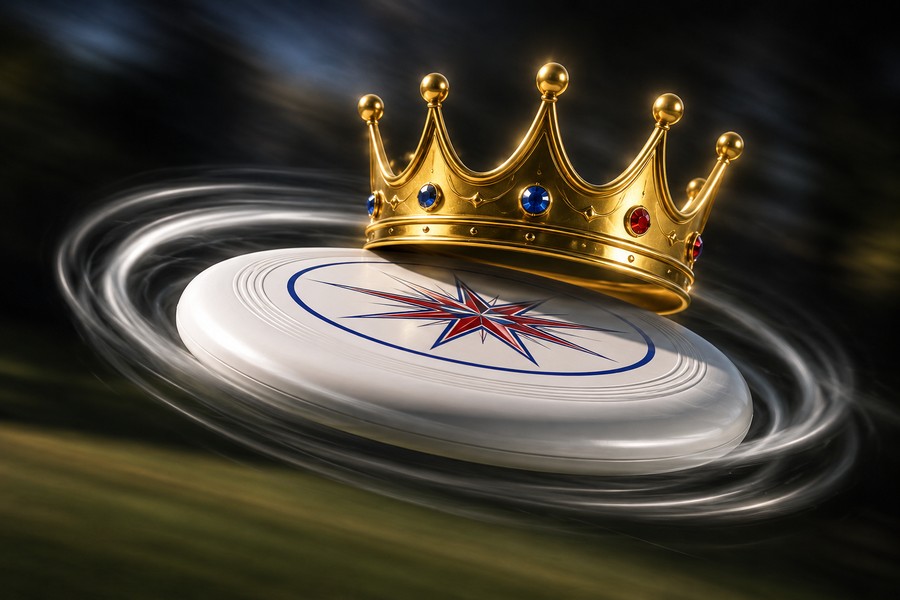
Picture the International Space Station orbiting Earth at 17,500 miles per hour. It weighs almost a million pounds. And somehow, it stays perfectly oriented. Solar panels facing the sun. Cameras pointed at Earth. Antennas locked onto ground stations.
How? Four spinning wheels called Control Moment Gyroscopes, each about the size of a refrigerator, rotating at 6,600 revolutions per minute. When NASA needs to turn the station, computers tilt these spinning wheels. The physics reaction turns the entire spacecraft without firing a single thruster.
This is called gyroscopic stability. And it is the exact same physics that keeps your disc in the air.
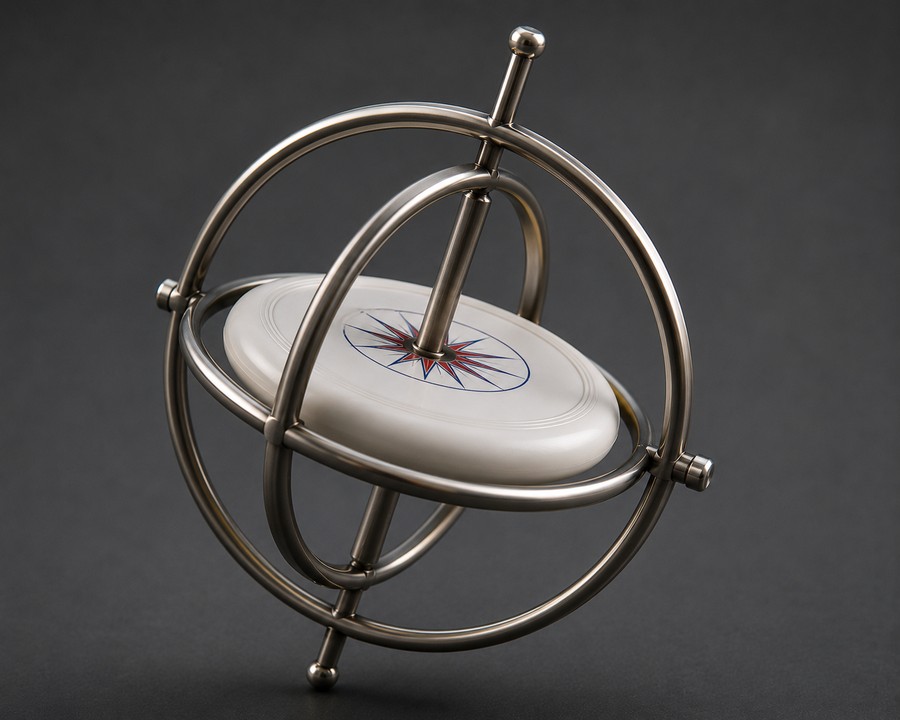
When something spins, it wants to keep spinning in the same direction. Physicists call this the conservation of angular momentum. Tilt it? Push it? Bump it? The spinning object resists. It fights back. It stays stable.
Think about a bicycle wheel. Hold it still, and you can easily twist it any direction with your hands. But spin it fast, then try to turn it. Suddenly it pushes back against you. That resistance is gyroscopic force. And it is exactly what keeps your disc flying flat instead of tumbling out of the air like a playing card thrown across a room.
Here is the key insight that should change how you think about every throw: more spin equals more stability equals straighter flight equals more distance. The disc stays stable longer, which means it flies farther before finally fading and falling.
Why Your Disc Actually Flies
"It's all about aerodynamics," Bill Nye explains. And he is right. Your disc uses the same principles that lift airplane wings off the runway.
Here is what happens in the half second after you release the disc.
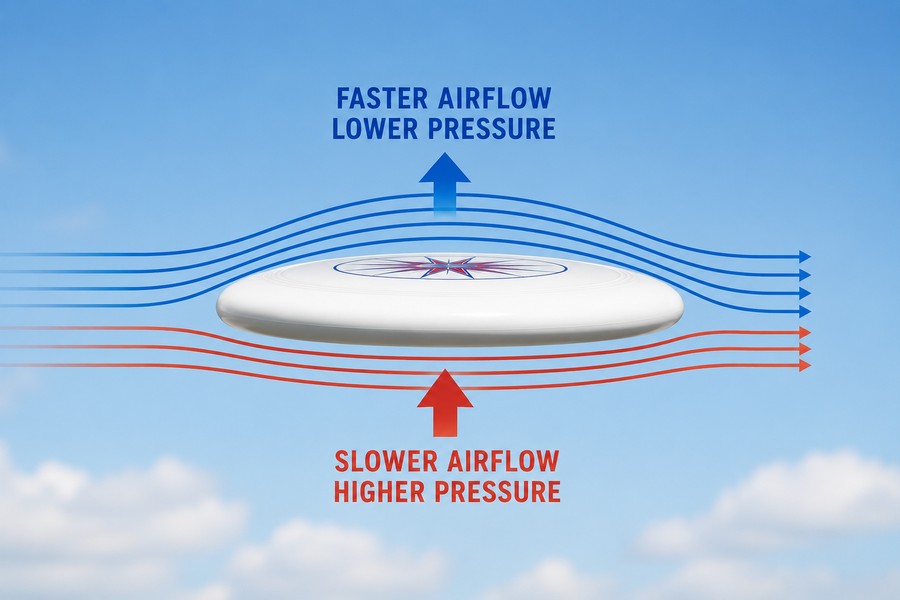
The Lift. Air flows faster over the curved top of the disc than under the flatter bottom. This creates lower pressure on top and higher pressure below. The disc gets pushed upward. That is lift. The same lift that holds a 747 in the air holds your UltraStar up too.
The Spin. Your disc is rotating maybe 500 to 1,000 times per minute on a good throw. That rotation creates gyroscopic stability. The disc resists tilting. It wants to stay flat. It fights against every gust and bump and wobble that tries to knock it off course.
The Battle. Here is the part that most people never think about. From the moment the disc leaves your hand, it is in a fight. Wind and gravity are constantly trying to flip it, tilt it, and drag it down. Without spin, they win immediately. The disc tumbles and crashes. With spin, the disc fights back and maintains its angle.
The more spin you generate, the longer your disc wins this battle. And the longer it wins, the farther it flies before gravity finally pulls it to the ground. That is the direct, physical link between the spin your fingers create and the distance your throw achieves.
The Art of Uncorking: Your Body Is a Spring
Now we get to the secret that separates good throwers from great ones. And I promise you, once you understand this, you will never throw the same way again.
I call it uncorking.
Think about how a corkscrew works. You twist it down into the cork, coiling it tighter and tighter with every turn. Energy builds with each rotation. And then you pull up, and all that stored twist energy releases at once. The cork pops out effortlessly.
Your body works the same way when you throw a disc.
The Coil. Before you throw, you are corking. You are winding up energy into your body like loading a spring. Your wrist curls back. Your arm draws across your chest (for a backhand) or cocks behind your hip (for a flick). Your shoulder rotates. Your torso twists. Your hips turn. Every piece of your body is compressing, storing energy, getting ready to release.
The Release. When you throw, you are uncorking. All of that stored energy uncoils in one explosive, connected sequence. Each body part adds its power to the next, like dominoes falling in a chain reaction. The energy builds and builds and builds until it reaches the very last link in the chain.
The Snap. At the very end, your middle finger whips across the disc's rim, adding that final burst of spin. This is where the magic happens. This millisecond of finger contact is what separates a floaty, wobbly throw from a flat laser beam that sails 60 yards and drops right on target.
You can feel it when you do it right. The more you coil up, really wind yourself tight, the more power you have to release. It is physics you can sense in your muscles. A tight coil feels loaded, springlike, ready to explode. A lazy coil feels flat and weak. Your body knows the difference.
The Kinetic Chain: Building Power from the Ground Up
Here is where things get beautiful. The power for a massive throw does not start in your arm. It starts in your hips.
Picture a baseball player hitting a home run. Does the power come from their arms? No. It starts in their legs, transfers through their hips, rotates through their core, flows into their shoulders, down their arms, and explodes through the bat. Each link in the chain multiplies the power from the link before it. That is why a 170 pound shortstop can hit a ball 400 feet. It is not arm strength. It is chain efficiency.
Your disc throw works exactly the same way.
Step 1: Hips rotate. This starts the chain, generating the foundation of power. Your lower body is the engine. Everything above it is just transferring and amplifying what the hips create.
Step 2: Core and torso follow. Your abdominal muscles and your back rotate with your hips, adding their mass and momentum to the wave of energy traveling upward.
Step 3: Shoulder follows. Your upper body rotates, pulled forward by the core, adding even more speed.
Step 4: Arm extends. Your bicep and forearm whip forward, accelerating the disc. The elbow straightens explosively.
Step 5: Wrist snaps. Quick wrist rotation adds the crucial burst of spin.
Step 6: Finger whips. That final touch from your middle finger completes the spin cycle. The disc rips off your fingertip with maximum rotation.
Each link builds on the previous one. If you throw with just your wrist, you get a little spin. Add your forearm, and you triple it. Add your bicep, triple it again. Add your shoulder, triple it again. Add your hips? You have created a throw with nine times the power of a wrist only flick.
Nine times. From the same fingers. Just by connecting the chain.
The flick forehand uses the same kinetic chain, but it is reversed, more like a sidearm baseball pitch. Your body still coils, your hips still rotate, but the release angle is different. The energy flows through the same links in the same order. Hips, core, shoulder, arm, wrist, fingers. The physics does not change. Only the direction does.
Your Body Is a Whip
Have you ever snapped a towel at someone? You know there is a technique to it. You do not just swing the towel forward. You whip it. You launch it forward and then pull back slightly right at the end. That pullback creates a wave of energy that travels down the towel and explodes at the tip with a loud crack.
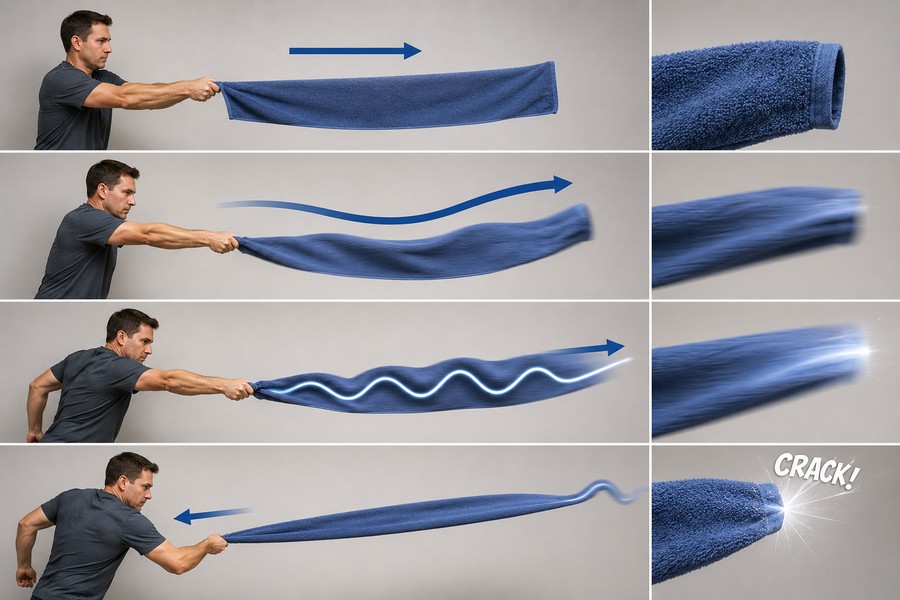
Your disc throw should feel the same way.
When you release, do not just push the disc forward. Launch it. And at the very last millisecond, let your hand pull back slightly. This creates that whip effect. The energy travels down your arm, into your fingers, and cracks off the disc's rim as pure spin.
That is why the best throws feel almost effortless. The thrower is not muscling the disc. They are whipping it. The spin comes from technique, not from strength. A 120 pound teenager with a great whip will out throw a 200 pound adult who is pushing the disc with raw muscle. Every time.
And here is the connection to grip that we talked about in the last chapter: if you grip too tight, you kill the whip. Tension in your forearm prevents the natural acceleration at the end. A relaxed grip actually produces MORE spin because it allows that final finger snap to happen on its own, like the tip of the towel cracking naturally instead of being forced.
The Millisecond That Matters
Here is something most coaches do not talk about, and it is one of the most important concepts in this entire book.
The release point is not a position. It is a moment in time. Literally a few milliseconds.
Release too early, and the disc goes too high. Too late, and it goes into the dirt. The perfect release happens in a window of maybe 20 to 30 milliseconds. Blink, and you have missed it.
How do you hit that window consistently? The answer is counterintuitive: grip the disc more loosely than you think you should.
When beginners grip tight, they have to consciously open their fingers to release. This adds delay. It is like trying to throw a ball while squeezing it. The release becomes a decision instead of a reflex. And decisions take time. Milliseconds of time. Enough to miss the window.
But with a relaxed grip, the disc naturally slips out when the timing is right. Your body finds the release point automatically. The same way a golf swing finds its timing, the same way a basketball shot finds its arc. Tension kills timing. Relaxation finds it.
Hold the disc firmly enough that it will not fall out of your hand, but loose enough that you could drop it if you wanted to. That is the sweet spot. That is where the 20 millisecond window opens up and becomes hittable.
Why Wobbles Happen and How to Fix Them
A wobbly throw is a disc that has lost its battle against the air. It is not spinning fast enough to maintain gyroscopic stability, so it starts to tilt and tumble. The gyroscopes have failed. The space station is drifting.
The main causes, in order of how often I see them:
Not enough wrist snap. The finger whip at the end is what generates most of your spin. If you are not snapping hard enough, the disc does not have the RPM to stay stable.
Broken kinetic chain. If your body parts do not connect smoothly, energy gets lost at the broken link. Your hips might generate great power, but if your shoulder does not follow, that power dies before it reaches your wrist.
Grip too tight. We just covered this. Tension prevents the natural whip motion and delays the release.
Release angle off. The disc exits your hand tilted instead of flat. Even with great spin, a tilted release means the disc starts its flight fighting against itself.
The fix for all of these is the same, and it is simple: focus on spin first, distance second. Throw shorter passes at your target with maximum spin. Watch how flat and stable they are. Then gradually add power while maintaining that same spin quality. Distance will come naturally once your technique is dialed in. It always does.
Solo Practice: Building the Chain Link by Link
Here is a drill that will teach you exactly how the kinetic chain works, not as a concept, but as a physical feeling in your body. You need your target and a few discs.
The Isolation Drill.
Stand 15 feet from your target. Throw a backhand using ONLY your wrist. Lock your arm against your body. Lock your hips. Just snap the wrist. Feel how far the disc goes and how much spin it has. That is the baseline. That is one link.
Now add your forearm. Keep your shoulder and hips locked. Just wrist and forearm. Throw at the same target. Feel the difference. More spin. More speed. More distance. That is two links.
Now add your shoulder. Let your arm extend and your shoulder rotate, but keep your hips still. Throw. Feel the jump in power. Three links.
Now add your hips. Let everything connect. Hips initiate, core follows, shoulder follows, arm follows, wrist snaps, fingers whip. Throw. Feel the difference between one link and four links. It is not a small difference. It is massive. The disc flies like a completely different object.
Now add footwork. Take a step toward your target as you throw. Then two steps. Then a full run up. Feel how the forward momentum feeds into the hip rotation, which feeds into the core, which feeds into everything above it. The chain gets longer and more powerful with every link you add.
Do this drill for both throws. Backhand first: wrist only, then add forearm, shoulder, hips, feet. Then flick: wrist only, then add forearm, then core rotation, then hips, then feet. The same progression, different release angle. The physics is identical.
And do it with your off hand. The isolation drill is even more valuable on your non dominant side because it shows you exactly which link in the chain is weakest. Usually it is the wrist snap. Build that link and everything above it starts working.
The Coil Check
Before every throw at your target, pause for one second and do a coil check. Ask yourself:
Are my hips loaded? Is my core twisted? Is my shoulder rotated? Is my wrist cocked?
If any one of those is missing, the chain is broken before you even throw. The coil check takes one second. It ensures that every throw has access to the full chain of power, not just the links you happened to remember.
Over time, the coil check becomes unconscious. You will not need to ask yourself the questions anymore because your body will automatically load every link before every throw. That is what muscle memory looks like. Not remembering to do something, but being unable to do it any other way.
Wrap Up
◆ Spin is king. More spin equals more gyroscopic stability equals straighter flight equals more distance. A disc with great spin and moderate speed outflies a disc with great speed and no spin.
◆ Your disc flies because of lift (air pressure difference) stabilized by spin (gyroscopic force). The disc is in a constant battle against wind and gravity. Spin is how it wins.
◆ The coil and uncork: wind your body up like a spring, then release all that stored energy in one explosive sequence. The tighter the coil, the more powerful the uncork.
◆ The kinetic chain: hips → core → shoulder → arm → wrist → fingers. Each link multiplies the power of the previous one. A fully connected chain produces nine times the power of the wrist alone.
◆ Your body is a whip, not a catapult. The power comes from the crack at the tip, not from the swing of the handle. Relax your grip and let the whip happen.
◆ The release point is a 20 to 30 millisecond window. A loose grip finds it automatically. A tight grip misses it.
◆ Wobbles come from broken chains and insufficient spin. Fix wobbles by focusing on spin first, distance second.
Action Steps
→ Today: do the isolation drill. Throw 5 backhands at your target with wrist only. Then add forearm. Then shoulder. Then hips. Then footwork. Feel each link add power.
→ Do the same isolation drill for the flick. Wrist only first, then build the chain one link at a time.
→ Try Ben Wiggins' throw hard drill. 10 backhands and 10 flicks at maximum effort at any distance. Let your body figure out the chain on its own.
→ Before every throw this week, do a one second coil check. Hips loaded? Core twisted? Shoulder rotated? Wrist cocked? If anything is missing, reset before you throw.
→ Focus on spin for the next 20 throws. Short distance, maximum spin. Watch how flat and stable the disc is. Then gradually add power without losing that spin quality.
Mentor's Closing
Bill Nye has been throwing discs for over fifty years. He showed up at his 50 year Cornell Ultimate reunion and played more points than any of his contemporaries. After the game, he said: "This is still the best game. It's just the best game."
Fifty years of throwing. Fifty years of spinning. Fifty years of loving the physics of flight.
Your fingers are your gyroscopes. Your kinetic chain is your propulsion system. And like any machine, they only work if you train them. The isolation drill builds the chain consciously. The throw hard drill lets it flow instinctively. The coil check makes sure every link is loaded before every throw.
The science is beautiful. The physics are elegant. And the feeling of a perfectly spinning disc sailing flat and true to your target, carried by forces you now understand, is one of the most satisfying things you will ever experience with a piece of plastic in your hand.
Because flying discs ARE science. And science gets better with practice. :)